Research

Research
Papers.

Deep dives into groundbreaking AI research — analysis, implementation notes, and practical takeaways.

SEAL-RAG: Replace, Don't Expand — The Right Fix for Multi-Hop Context Dilution
LLM ResearchMarch 12, 2026

SEAL-RAG: Replace, Don't Expand — The Right Fix for Multi-Hop Context Dilution

SEAL-RAG, from December 2025, formalizes a problem that every multi-hop RAG practitioner has hit: context dilution, where iterative retrieval accumulates irrelevant passages that drown out the evidence that matters. The fix is counterintuitive — replace unhelpful retrieved content instead of expanding context — and it works, delivering 3-13% accuracy gains on HotpotQA with predictable computational cost.

Beyond STDP: Spike Agreement-Dependent Plasticity Is the Scalable Learning Rule Neuromorphic Hardware Has Been Waiting For
Neuromorphic ComputingMarch 12, 2026

Beyond STDP: Spike Agreement-Dependent Plasticity Is the Scalable Learning Rule Neuromorphic Hardware Has Been Waiting For

Classical STDP requires millisecond-precise spike timing — a constraint that kills scalability on real neuromorphic hardware. A August 2025 paper introduces SADP, which replaces pairwise spike timing with population-level agreement metrics, achieves linear-time complexity, and runs efficiently via bitwise logic. This is the learning rule that could finally make large-scale neuromorphic learning practical.

RT-RAG: Why Your Multi-Hop RAG System Needs a Reasoning Tree, Not a Chain
LLM ResearchMarch 12, 2026

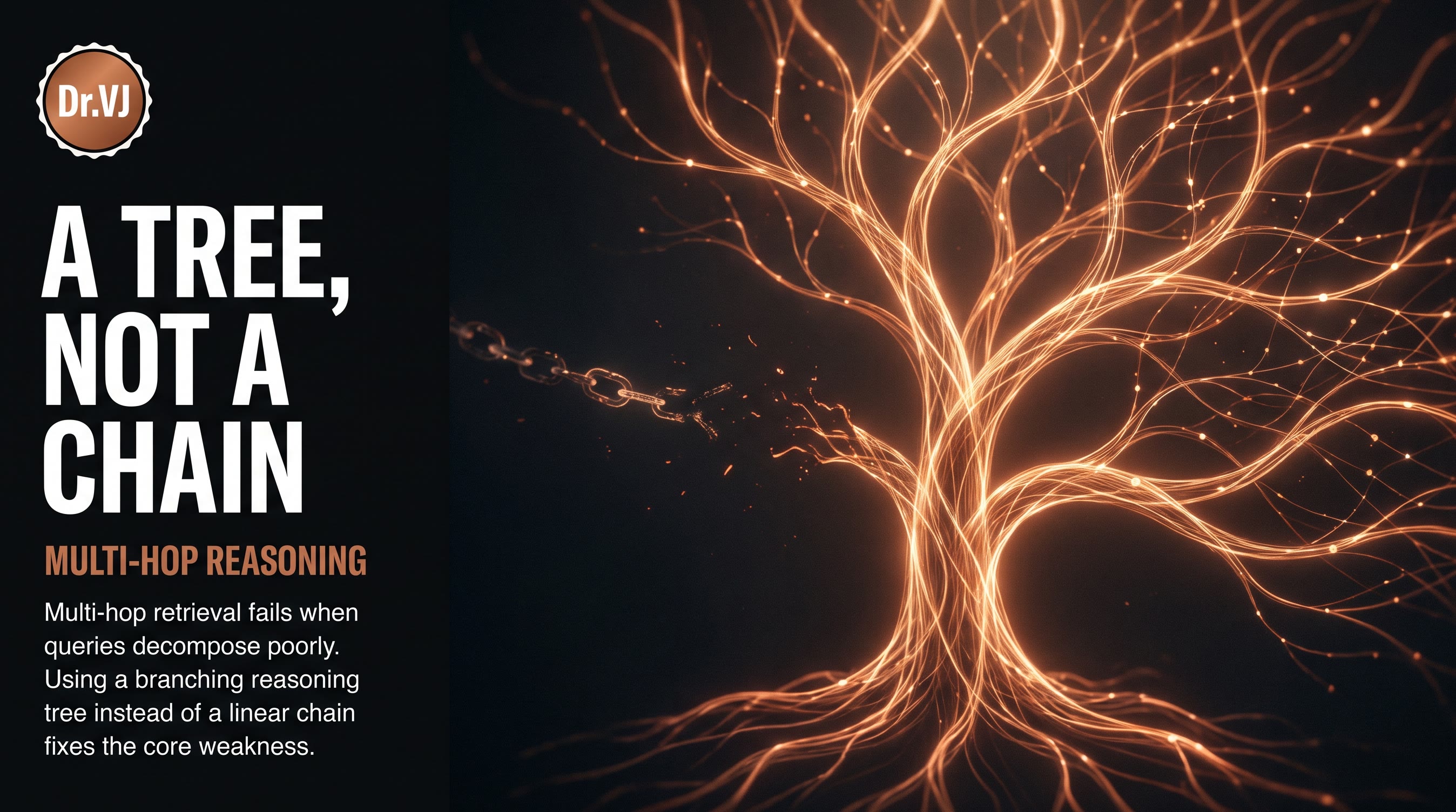
RT-RAG: Why Your Multi-Hop RAG System Needs a Reasoning Tree, Not a Chain

RT-RAG, presented at WWW 2026, diagnoses the core failure of multi-hop RAG: inaccurate query decomposition and error propagation along retrieval chains. By restructuring decomposition as explicit reasoning trees and separating known from unknown entities, RT-RAG achieves 7% F1 and 6% EM gains over the prior state-of-the-art. The architecture is principled, the results are solid, and the diagnosis of why chains fail is spot-on.

REFRAG: 30x Faster RAG Decoding Without Sacrificing Accuracy
LLM ResearchMarch 12, 2026

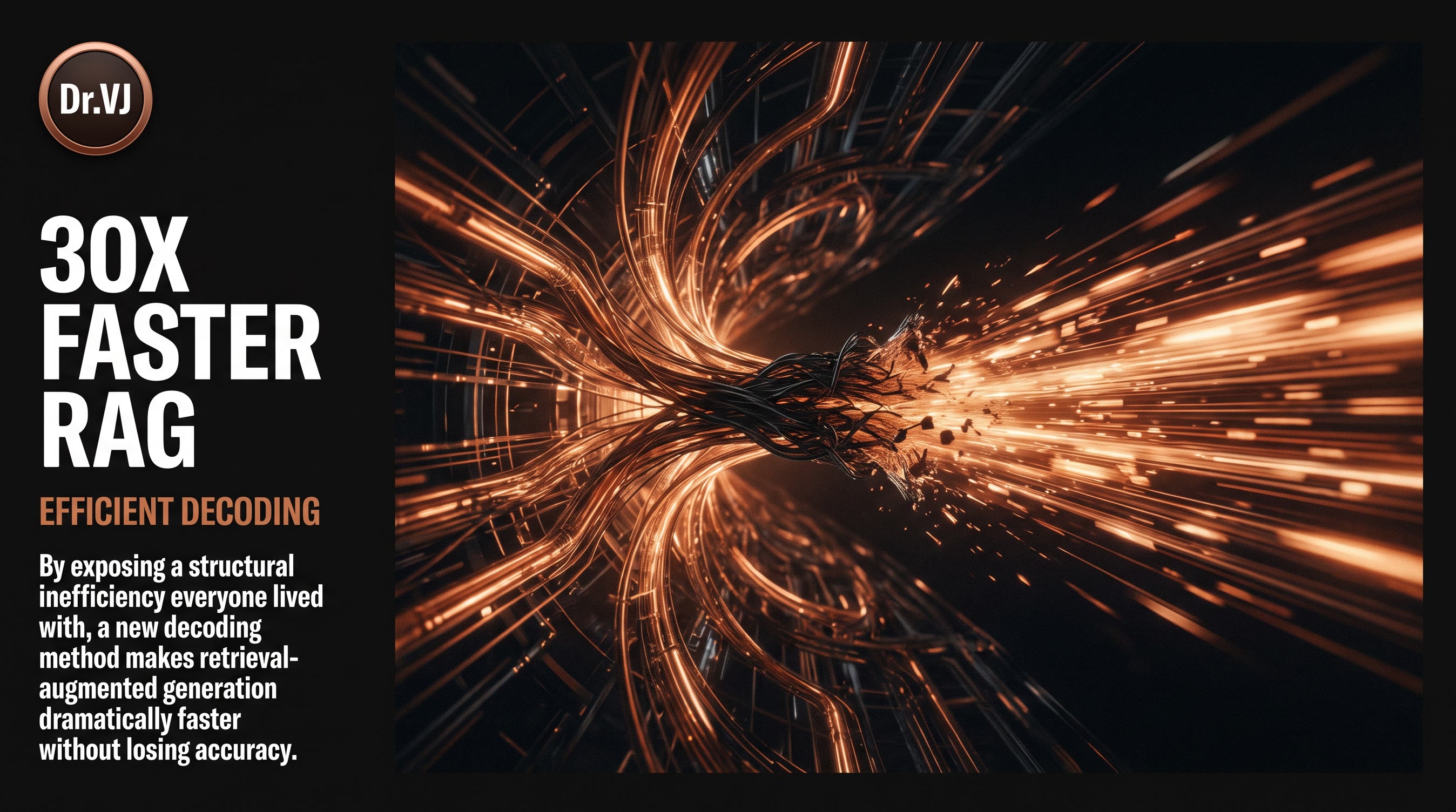
REFRAG: 30x Faster RAG Decoding Without Sacrificing Accuracy

REFRAG, from September 2025, exposes a structural inefficiency that everyone in the RAG field has accepted as inevitable: LLMs process concatenated retrieval passages with massive attention over largely irrelevant tokens. By applying compression, sensing, and expansion at the decoding level, REFRAG achieves 30x TTFT acceleration and 16x context extension. This is systems engineering applied to a real bottleneck.

Neuromorphic Embodied Intelligence: The Survey That Maps the Next Decade of Autonomous Systems
Neuromorphic ComputingMarch 12, 2026

Neuromorphic Embodied Intelligence: The Survey That Maps the Next Decade of Autonomous Systems

A comprehensive July 2025 survey from arXiv maps the intersection of neuromorphic computing and embodied intelligence for autonomous systems — robotics, UAVs, and self-driving vehicles. It is the most thorough technical assessment of where neuromorphic hardware stands today and where it needs to go, and it is more honest about the gaps than most papers in the field.

LinearRAG: How to Build Scalable Graph RAG Without Breaking Relation Extraction
LLM ResearchMarch 12, 2026

LinearRAG: How to Build Scalable Graph RAG Without Breaking Relation Extraction

LinearRAG, from October 2025, solves a fundamental brittleness in graph RAG systems: their dependence on unreliable relation extraction. By building a 'Tri-Graph' from lightweight entity identification and semantic connections — no explicit relation extraction needed — LinearRAG achieves better performance than dense KG systems at lower computational cost. The insight is that explicit relations are often noise, not signal.

EcphoryRAG: What Happens When You Design Knowledge Graph RAG Like Human Memory
LLM ResearchMarch 12, 2026

EcphoryRAG: What Happens When You Design Knowledge Graph RAG Like Human Memory

EcphoryRAG, from October 2025, takes inspiration from cognitive neuroscience — specifically the brain's associative memory system — to redesign how knowledge graphs are built and queried for RAG. The result: a system that uses 94% fewer tokens than comparable structured RAG approaches while improving exact match scores from 0.392 to 0.474. The design principle is elegant: store less, infer more.

Chunking, Retrieval, Re-ranking: An Empirical Wake-Up Call for RAG Builders
LLM ResearchMarch 12, 2026

Chunking, Retrieval, Re-ranking: An Empirical Wake-Up Call for RAG Builders

A January 2026 empirical study on RAG for public health policy documents cuts through the hype with hard numbers: baseline LLMs hallucinate (faithfulness 0.347), basic RAG helps but not enough (0.621), and only advanced RAG with re-ranking gets you to production-quality faithfulness (0.797). The gap between these tiers is larger than most teams assume, and the paper tells you exactly where and why.

GraphBFF: Building Billion-Scale Graph Foundation Models That Actually Generalize
GenAI IndustryMarch 12, 2026

GraphBFF: Building Billion-Scale Graph Foundation Models That Actually Generalize

February 2026 brings the first end-to-end recipe for billion-parameter Graph Foundation Models across arbitrary heterogeneous graphs. GraphBFF demonstrates that the foundation model paradigm — pre-train once, fine-tune everywhere — can work for graphs at the scale where the real-world data lives. The implications for knowledge graphs, social networks, and biological networks are substantial.

ARE: Meta's Framework for Evaluating Agents at Scale — And the Tradeoff It Exposes
Agentic EngineeringMarch 12, 2026

ARE: Meta's Framework for Evaluating Agents at Scale — And the Tradeoff It Exposes

Meta's ARE (Agent Research Environments) platform and its Gaia2 benchmark reveal something counterintuitive: stronger reasoning often comes at the cost of efficiency. This September 2025 paper by Froger et al. is building the infrastructure for the next generation of agent evaluation, and the early results should shape how we think about performance-efficiency tradeoffs in agentic systems.