The AI industry has a sustainability problem that it's slowly being forced to confront. Data centers consume enormous amounts of power. Training large models produces measurable carbon emissions. But there's a category of AI hardware emissions that almost nobody talks about: the carbon cost of making the chip in the first place.
Life-Cycle Emissions of AI Hardware: A Cradle-To-Grave Approach and Generational Trends (arXiv:2502.01671) changes that. Published in February 2025, this paper provides what the authors describe as the first comprehensive AI accelerator lifecycle assessment — including the first publication of manufacturing emissions data for an actual AI accelerator — analyzing five generations of Google's Tensor Processing Units.
This is the paper I've been waiting for. And the results are more complicated than the "AI is burning the planet" narrative and more consequential than the "AI will solve climate change" counter-narrative.
Cradle to Grave: What Gets Measured
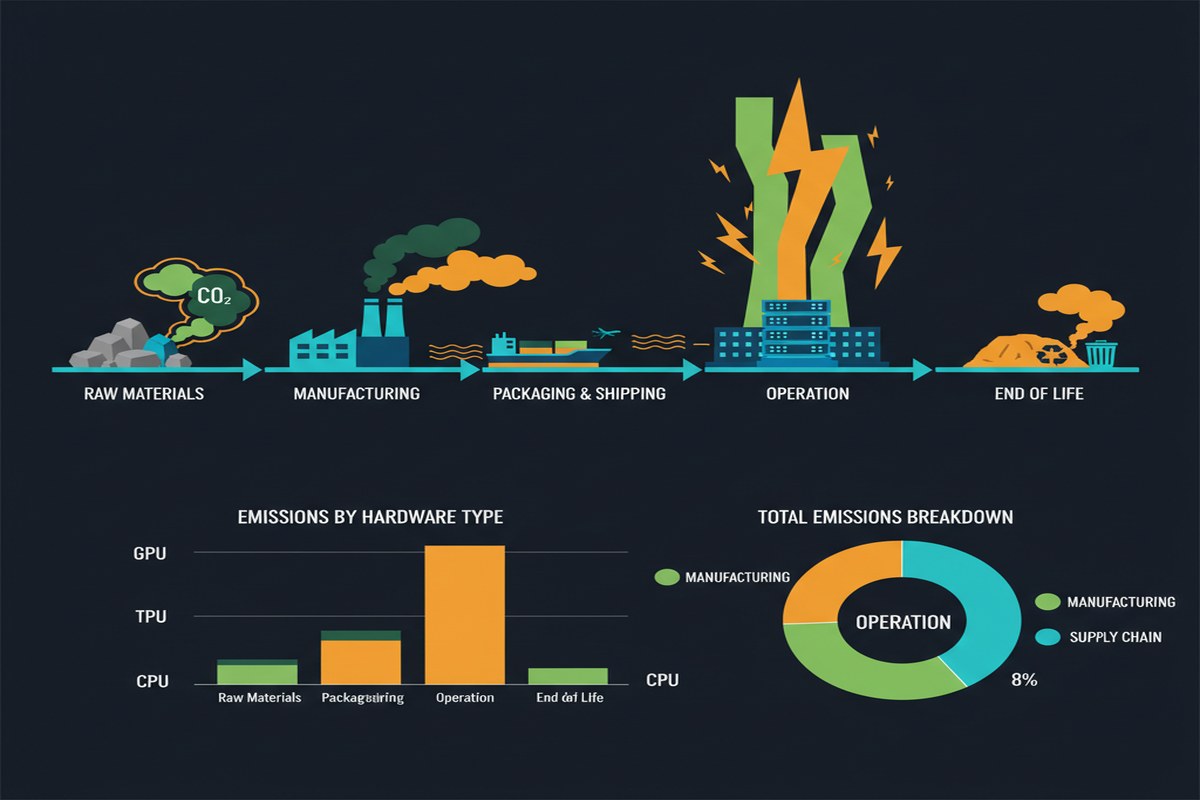
A proper lifecycle assessment (LCA) covers emissions across all phases:
- Raw material extraction: Mining and processing silicon, copper, rare earth elements for the chip
- Manufacturing: The semiconductor fabrication process — one of the most energy-intensive manufacturing processes in existence
- Operational emissions: The power consumed during actual use
- End of life: Disposal, recycling, or landfill
The paper covers all four phases for five TPU generations: TPU v4i (2018), TPU v4 (2021), TPU v5e (2023), TPU v5p (2023), and TPU v6e (2024). This longitudinal view is extraordinarily valuable — it lets you see how emissions have evolved as Google improved both chip design and manufacturing.
The Key Metric: Compute Carbon Intensity (CCI)
The paper introduces a new metric called Compute Carbon Intensity (CCI), which measures CO₂ equivalent emissions per unit of compute (expressed as grams CO₂e per TFLOP). This is the AI hardware equivalent of grams CO₂ per kilometer for cars — it normalizes environmental impact to the useful work the hardware produces.
CCI has two components:
- Manufacturing CCI: Emissions from production divided by total lifetime compute
- Operational CCI: Emissions from electricity use during operation
The headline finding: CCI improves 3× from TPU v4i to TPU v6e. This is substantial progress — AI hardware is getting meaningfully more sustainable per unit of useful work. But the absolute numbers and the breakdown between manufacturing vs operational emissions are where it gets interesting.
xychart-beta
    title "Relative Compute Carbon Intensity (CCI) by TPU Generation"
    x-axis ["TPU v4i", "TPU v4", "TPU v5e", "TPU v5p", "TPU v6e"]
    y-axis "Relative CCI (v4i=100)" 0 --> 110
    bar [100, 85, 60, 50, 33]
Manufacturing Emissions: The Ignored Half of the Story
Here's the fact that surprised me most: manufacturing emissions represent a larger fraction of total AI hardware emissions than most industry discussions assume.
For GPU-class chips made at leading-edge nodes (5nm, 3nm), the manufacturing process is extraordinarily energy-intensive. Photolithography, chemical vapor deposition, ion implantation — each of these steps requires enormous amounts of ultra-pure electricity and exotic chemicals. The paper provides direct measurements from Google's TPU fleet (a first in the published literature) that show manufacturing accounts for a substantial portion of the total lifecycle carbon — in some cases approaching or exceeding operational emissions when operational carbon intensity is low (e.g., when running on renewable energy).
This has a profound implication: buying a new chip has a significant upfront carbon cost. Upgrading your GPU fleet from H100 to B200 doesn't just cost money — it has a real carbon cost from manufacturing, even if B200 is more efficient to operate. The paper quantifies this trade-off.
pie title TPU v5e: Manufacturing vs Operational Carbon (estimated breakdown)
    "Manufacturing Emissions" : 40
    "Operational Emissions (Grid Mix)" : 45
    "End of Life" : 15
Operational Emissions: Grid Mix Matters Enormously
The paper also makes an important methodological point about operational emissions: using thermal design power (TDP) as a proxy for actual energy use is misleading. Real operating energy varies substantially based on:
- Utilization: A chip running at 80% utilization consumes very differently than one at 30%
- Workload type: Memory-bandwidth-bound inference workloads vs compute-bound training have different power profiles
- Voltage/frequency settings: Dynamic power management substantially affects consumption
By using direct measurement across Google's TPU fleet rather than TDP-based estimates, the paper gets actual operational emissions data. The gap between TDP-based estimates and real measurements is significant — sometimes 30-50%.
The other critical variable: where the electricity comes from. Google operates substantial renewable energy infrastructure, so their TPU operational emissions are substantially lower than an equivalent chip running on coal-powered grid electricity. A chip with twice the operational efficiency running on 100% coal power may have higher lifetime carbon than a less efficient chip running on 100% renewables.
Why This Matters
I think this paper is important for three reasons:
First, it gives the industry the tools to make honest sustainability comparisons. CCI is a better metric than FLOPS/watt or TDP because it captures both manufacturing and operational emissions per unit of useful work. Hardware vendors should be required to publish CCI figures, just as automotive manufacturers publish fuel economy ratings.
Second, it challenges the "just buy the latest hardware" narrative. If your H100 cluster is running on renewable energy at high utilization, the manufacturing carbon cost of upgrading to B200 may not be justified by efficiency gains — depending on your utilization patterns and energy mix. This is a calculation the paper gives you tools to actually do.
Third, it validates the importance of chip lifetime and utilization. Manufacturing emissions are amortized over the chip's operational lifetime. A chip used for 5 years at high utilization has lower lifecycle CCI than the same chip used for 2 years at low utilization. This argues for maximizing utilization of existing hardware before upgrading.
My Take
I want to praise this paper and criticize the industry in the same breath.
The paper is outstanding. The CCI metric is exactly the kind of rigorous, lifecycle-aware measurement that AI hardware discussions need. The longitudinal TPU data gives us something rare in this field: actual improvement trends, not just vendor claims.
But the paper also makes visible how badly the AI industry has failed at sustainability transparency. We are in 2026. We have been training large models since at least 2018. And we are just now getting the first published manufacturing emissions data for an AI accelerator. That's not a research gap — that's an industry-wide transparency failure.
Every major AI chip vendor — NVIDIA, Google, AMD, Intel — should be publishing full lifecycle assessments for their products. The automotive industry publishes lifecycle emissions data. The consumer electronics industry (under pressure from regulators) is moving toward it. AI hardware, which is increasingly responsible for a non-trivial fraction of global semiconductor manufacturing and data center energy use, should not be exempt.
My stronger opinion: the AI community's casual approach to sustainability is going to catch up with it. As AI hardware spend scales toward hundreds of billions annually, the carbon footprint will become large enough to be politically unavoidable. Better to build the measurement and reporting infrastructure now, voluntarily, than to have it imposed by regulation with inadequate frameworks.
The 3× CCI improvement from TPU v4i to v6e is real progress. It shows the industry can make hardware more sustainable. The question is whether it will be fast enough, and whether it will be measured honestly enough to actually guide decisions.

References
- (2025). Life-Cycle Emissions of AI Hardware: A Cradle-To-Grave Approach and Generational Trends. arXiv:2502.01671.