There is a class of computing research that the AI mainstream largely ignores because it does not fit neatly into the "bigger transformer, more GPUs" narrative. Reservoir computing is one of those things. It has been around since the early 2000s, it has solid theoretical foundations, and it has repeatedly demonstrated that you do not need a fully trained recurrent network to solve temporal pattern recognition problems. You need a fixed, complex dynamical system — the reservoir — and a single trained readout layer. The reservoir does the hard work of expanding input signals into a high-dimensional representational space. The readout layer just learns to pick out the relevant dimensions.
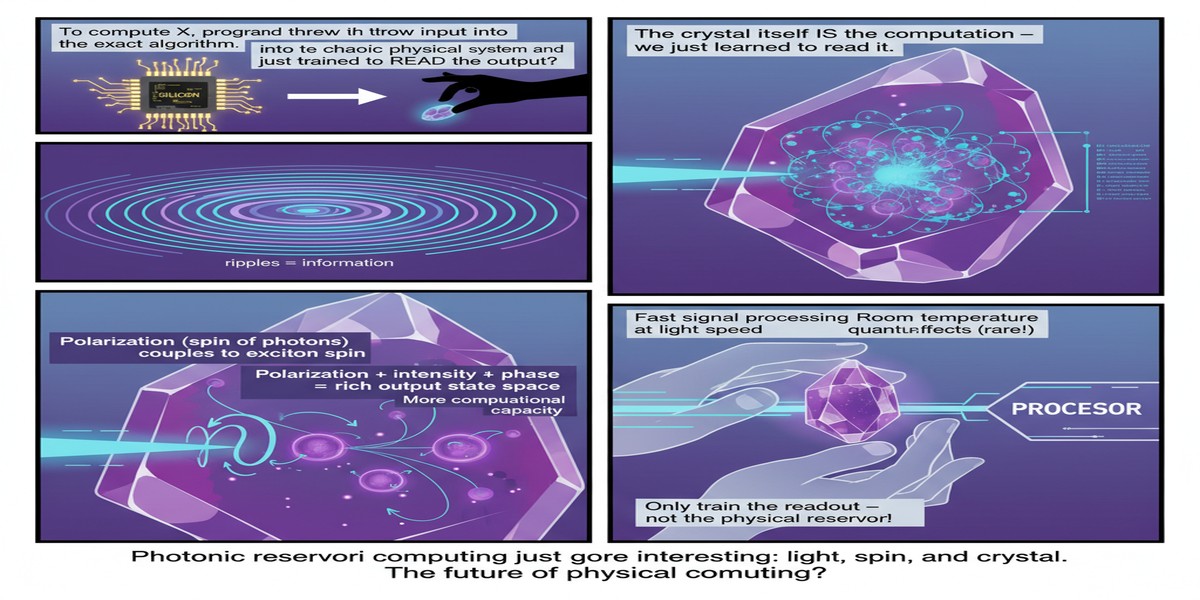
The reason reservoir computing stays niche is substrate. Software reservoirs running on GPUs are not especially efficient. The promise of the approach is that the reservoir can be implemented in physical dynamical systems — optical cavities, spin systems, mechanical resonators — where the physics itself performs the computation at essentially zero marginal energy cost. You feed in light or electrons, the physical system evolves according to its own dynamics, and you read out the result.
"Reservoir Neuromorphic Computing Based on Spin-Orbit Coupling in an Organic Crystal Resonator" by Teng Long et al. (arXiv:2511.23155, November 2025) is one of the more intriguing demonstrations of this idea I have read recently. It uses an organic crystal waveguide resonator in which spin-orbit coupling creates a rich, high-dimensional optical response — and that response serves as the reservoir. The results are quantitatively strong: 10x reduction in network size, 3x speedup for complex symbol classification, and reduced power consumption compared to full neural network approaches.
What Spin-Orbit Coupling Does in This Context
Most people encounter spin-orbit coupling as a quantum mechanics concept in atomic physics — it describes the interaction between an electron's orbital motion and its spin. In photonics, the analogous effect couples the polarization state of light (the photonic analogue of spin) to its spatial mode or momentum. In an organic crystal waveguide resonator, this coupling creates complex, polarization-dependent interference patterns as light propagates through the structure.
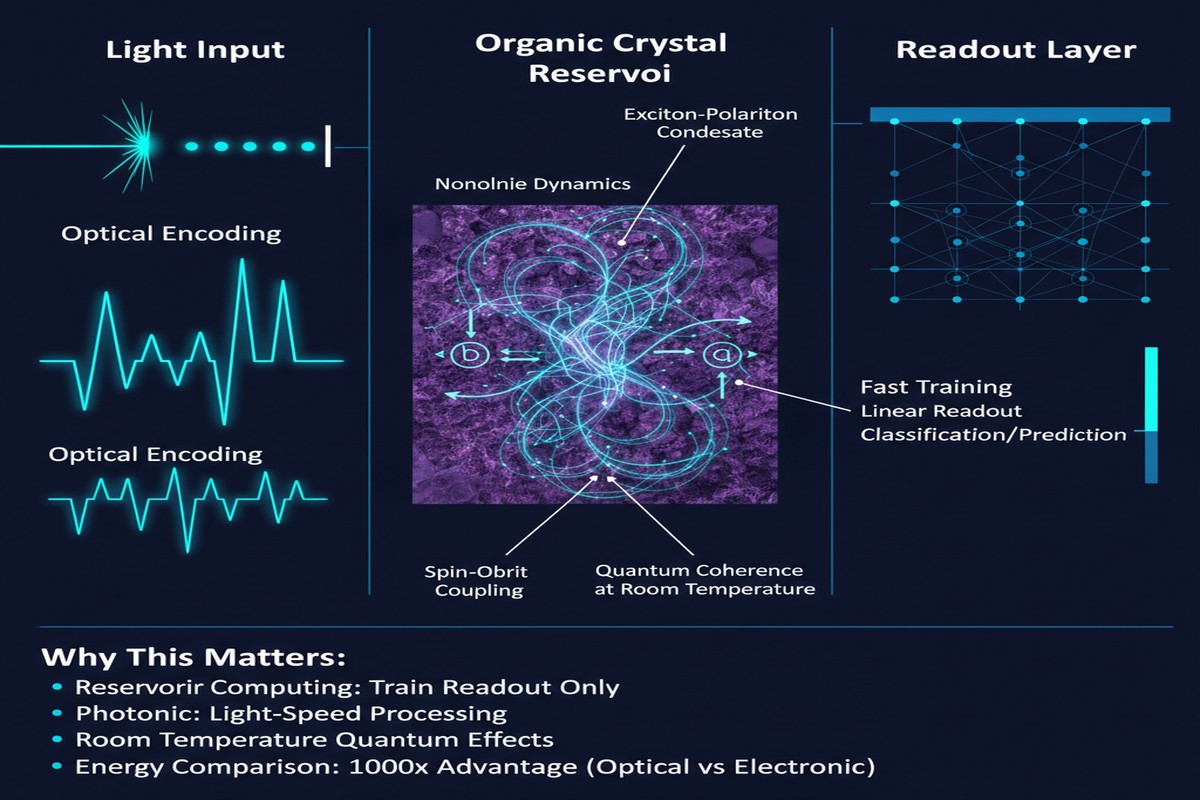
The critical insight of this paper is that this coupling-induced complexity is not noise to be suppressed — it is the computational resource to be exploited. When an input optical signal enters the crystal resonator, the spin-orbit coupling mixes polarization states and spatial modes in a deterministic but highly sensitive way. Different input patterns produce characteristically different output field distributions. The system is, in effect, performing a nonlinear transformation of the input into a high-dimensional optical feature space.
This is precisely what a reservoir is supposed to do. The authors feed sequences of optical symbols into the resonator, measure the output field distributions, and train a linear readout layer to classify the symbols. The reservoir — the crystal resonator — is never trained. Only the readout layer has learnable parameters.
flowchart LR
    subgraph Input["Input Layer"]
        I1[Optical Symbol\nSequence]
        I2[Temporal\nEncoding]
        I1 --> I2
    end

    subgraph Reservoir["Physical Reservoir\nOrganic Crystal Resonator"]
        direction TB
        R1[Waveguide\nEntry]
        R2[Spin-Orbit\nCoupling Zone]
        R3[Polarization\n× Mode Mixing]
        R4[Nonlinear\nInterference]
        R5[High-Dim\nOptical Field Output]
        R1 --> R2 --> R3 --> R4 --> R5
    end

    subgraph Readout["Trained Readout"]
        RO1[Linear Classifier\nTrained Layer Only]
        RO2[Symbol\nClassification]
        RO1 --> RO2
    end

    I2 --> R1
    R5 --> RO1

    subgraph Comparison["vs. Full Neural Net"]
        C1["Network Size: 10x smaller"]
        C2["Speed: 3x faster"]
        C3["Power: Reduced"]
    end

    RO2 -.->|"Achieves"| Comparison

    style R2 fill:#0f3460,color:#fff
    style R3 fill:#16213e,color:#00d4ff
    style Reservoir fill:#1a1a2e,color:#ccc
    style Comparison fill:#0f3460,color:#fff
The Results in Detail
The 10x network size reduction is the most striking result and it needs explanation. The comparison baseline is a conventional recurrent neural network (or equivalent temporal classifier) trained end-to-end to perform the same symbol classification task. Such a network needs a large number of trainable parameters to model the temporal dependencies in the input sequence. The reservoir system replaces most of those parameters with the physical dynamics of the crystal — zero trainable parameters in the reservoir, only a small linear readout at the output. The total learnable parameter count drops by an order of magnitude.
The 3x speedup for complex symbols is a consequence of two factors. First, the reservoir processes the input in a single forward pass through the crystal — there is no iterative optimization or recurrent feedback through a software stack. Second, the linear readout is computationally trivial once trained. The bottleneck is the optical propagation time through the resonator, which is constrained by the speed of light in the medium, not by transistor switching.
The power reduction compared to full neural network approaches is harder to quantify precisely from the paper's results, but the mechanism is clear: replacing multiply-accumulate operations in silicon with passive optical propagation in an organic crystal eliminates the dominant source of energy consumption in conventional digital inference.
The Organic Crystal Angle
Why organic crystal? Most photonic reservoir computing demonstrations use semiconductor waveguides, optical fiber loops, or photonic integrated circuits on silicon. Organic crystalline materials are less common in photonics research because they are harder to fabricate reproducibly and more sensitive to environmental conditions.
But organic crystals have properties that make them interesting for spin-orbit coupling applications. Their excitonic resonances can be engineered by chemistry, their nonlinear optical coefficients are high, and — critically for this application — their spin-orbit coupling strengths can be tuned by modifying the crystal structure. The organic crystal in this paper is chosen specifically because its spin-orbit coupling produces the right kind of mixing: diverse enough to provide rich reservoir dynamics, consistent enough to be reproducible across measurements.
The reproducibility question is the one I would press the authors on. Organic crystals are not silicon. Batch-to-batch variation, sensitivity to humidity and temperature, and long-term stability under optical pumping are all legitimate concerns. The paper demonstrates that the approach works on a specific crystal sample. Whether it scales to manufacturable devices is an engineering problem that the paper does not address.
Why This Matters
The physical reservoir computing paradigm matters because it represents a fundamentally different approach to the energy problem in AI inference. The dominant approach — train a digital neural network, run it on a chip with transistors — hits a wall that is ultimately defined by Landauer's principle and the energy cost of irreversible bit operations. Physical reservoirs, particularly optical ones, can in principle perform computation at energy costs limited only by photon shot noise — orders of magnitude below what silicon CMOS can achieve.
This matters most at two extremes. At the low end, sensor nodes that need to perform temporal pattern recognition — classifying vibrations, sounds, or optical signals — could run reservoir classifiers with microwatt or nanowatt power budgets if the reservoir is implemented in passive photonic hardware. At the high end, data center scale inference has an energy problem that is becoming critical; photonic co-processors could handle specific workloads (temporal sequence classification, anomaly detection, signal processing) at dramatically lower energy cost than GPU clusters.
The organic crystal demonstration is not at either of those production scales. But it demonstrates the principle in a system where the spin-orbit coupling physics provides a richer reservoir than most previous demonstrations. That richness — the 10x parameter reduction — is what makes this worth paying attention to.
My Take
I want to be honest about what this paper is and is not. It is a physics and proof-of-concept paper, not an engineering paper. The authors demonstrate that spin-orbit coupling in an organic crystal resonator can serve as a functional reservoir for optical symbol classification. They do not demonstrate a manufacturable device, they do not address environmental stability, and they do not benchmark against other photonic reservoir implementations in a systematic way.
What they do demonstrate is that the specific physical mechanism — spin-orbit coupling — provides qualitatively better reservoir dynamics than simpler optical systems. The 10x parameter reduction is not an incremental improvement. It suggests that the coupling-induced mixing is genuinely expanding the input into a higher-dimensional space than what you get from a passive optical delay line or a simple multimode fiber.
For me, the most interesting implication is the selectivity argument. Spin-orbit coupling is tunable by material design. If you can engineer the coupling strength and spatial structure by modifying the organic crystal chemistry, you can in principle design reservoirs that are optimally matched to specific task classes. A reservoir tuned for temporal audio patterns would look different from one tuned for optical flow classification. This is a degree of freedom that silicon digital systems do not have — you cannot tune the physics of a CMOS transistor for a specific task.
The path from this demonstration to a deployable product is long. It requires advances in organic photonics fabrication, environmental encapsulation, and readout integration. But the physics demonstrated here is real, the results are quantitatively meaningful, and the approach is sufficiently distinct from conventional neuromorphic hardware that it deserves sustained attention from the field.
Keep an eye on this group. If they can demonstrate the same results on a second independently grown crystal sample, the reproducibility question moves from "concern" to "solved" and the engineering work can begin in earnest.
Paper: "Reservoir Neuromorphic Computing Based on Spin-Orbit Coupling in an Organic Crystal Resonator" — Teng Long et al., arXiv:2511.23155, November 2025.