Physical reservoir computing has a dirty secret that the research literature tends to paper over: most demonstrations require measurement equipment that costs more than a GPU cluster and is harder to operate. The spin-wave reservoir computing papers from 2020–2024 are full of impressive physics results obtained with vector network analyzers, lock-in amplifiers, and cryogenic probes. The computational performance numbers look good on paper. The hardware requirements to actually measure those results make production deployment an absurdity.
This is not a niche complaint. It is the central engineering challenge of the entire physical reservoir computing field: the physical dynamics are fast and energy-efficient, but reading them out accurately enough to be useful requires analogue measurement infrastructure that is slow, expensive, and power-hungry. The measurement tail wags the computational dog.
"Spectral Dynamics Reservoir Computing for High-Speed Hardware-Efficient Neuromorphic Processing" by Jiaxuan Chen, Ryo Iguchi, Sota Hikasa, and Takashi Tsuchiya (arXiv:2603.04901, March 2026) addresses this problem directly. SDRC is a framework that exploits spin-wave spectral dynamics in a way that is specifically designed to relax the hardware requirements for readout — making the overall system practically deployable rather than just physically interesting. That distinction matters enormously.
The Core SDRC Architecture
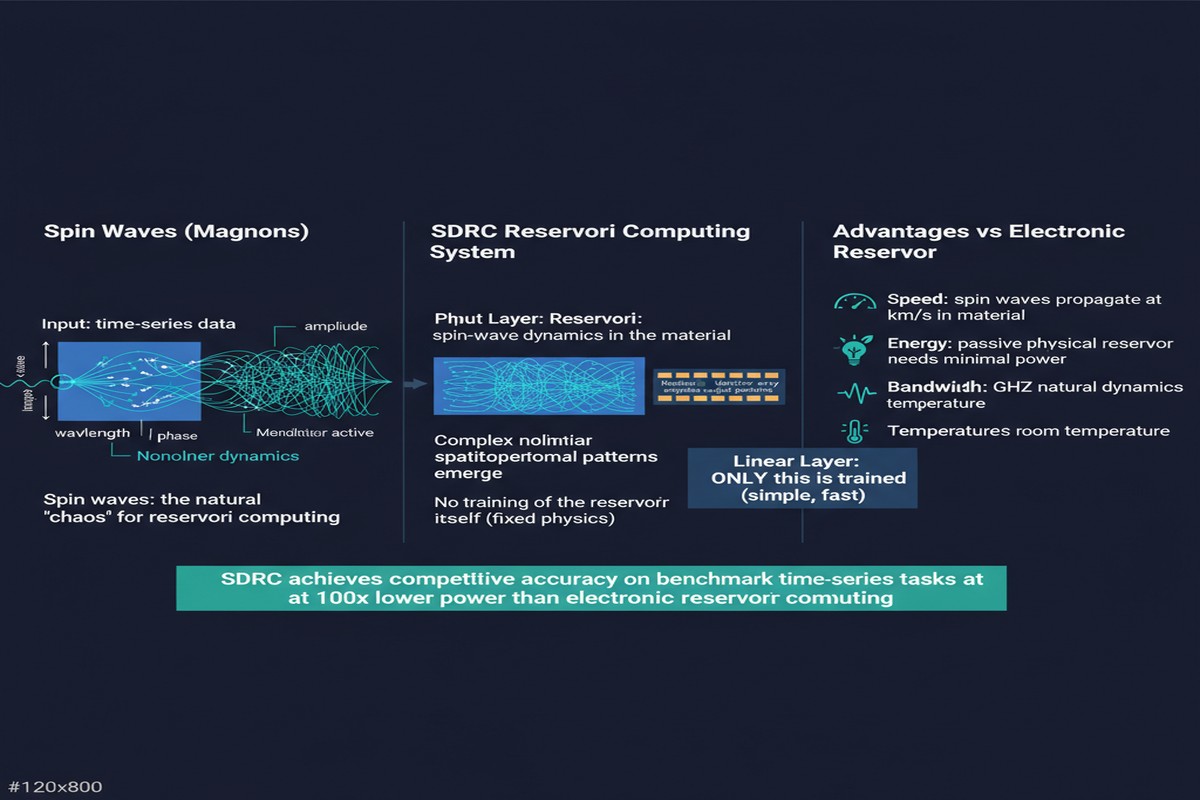
Spin waves — collective magnetic excitations in ferromagnetic materials — are a compelling reservoir substrate. Their dispersion relations are nonlinear, they interact with each other through magnon-magnon coupling, and their dynamics span frequencies from gigahertz to terahertz. Different input signals create characteristically different spin-wave excitation patterns in the material, and those patterns evolve in ways that depend sensitively on the input history. This is reservoir behavior: rich, nonlinear, high-dimensional expansion of the input signal into a feature space.
The problem, as noted, is reading out those patterns. The standard approach in spin-wave reservoir computing is to measure the transmission spectrum of a waveguide at multiple frequencies simultaneously — essentially performing a spectral measurement that maps the state of the spin-wave system. Doing this at high speed requires either very fast frequency-swept measurement (difficult) or parallel narrowband detection at many frequencies (expensive and physically large).
SDRC changes the measurement strategy. Instead of directly measuring the spin-wave spectrum, the framework uses analogue bandpass filters followed by envelope detectors to extract spectral envelope information. This is a much simpler measurement: a set of fixed-frequency bandpass filters, each followed by an amplitude detector. No frequency sweeping. No phase-sensitive detection. No lock-in amplifier.
The key insight is that for reservoir computing purposes, you do not need the full complex spectrum — you need the amplitude envelope at a set of strategically chosen frequencies. The spin-wave material provides the nonlinear spectral mixing; the analogue filter bank extracts the relevant projections; the envelope detectors convert those projections to DC-level signals that are trivially digitized. The linear readout is then trained on the envelope signals, not on raw spectral data.
flowchart TD
    subgraph InputSignal["Input"]
        A[High-Speed\nInput Signal]
    end

    subgraph SpinWaveMedium["Spin-Wave Reservoir Medium"]
        B[Microwave\nExcitation Antenna]
        C[Ferromagnetic\nWaveguide]
        D[Nonlinear Magnon\nInteractions]
        E[Spectral\nDynamics Output]
        B --> C --> D --> E
    end

    subgraph ReadoutChain["SDRC Readout Chain — Hardware Efficient"]
        F1[Bandpass Filter f1]
        F2[Bandpass Filter f2]
        F3[Bandpass Filter fn]
        G1[Envelope\nDetector]
        G2[Envelope\nDetector]
        G3[Envelope\nDetector]
        H[ADC — Low Speed\nDC Signals Only]
        F1 --> G1 --> H
        F2 --> G2 --> H
        F3 --> G3 --> H
    end

    subgraph Readout["Trained Readout"]
        I[Linear Classifier]
        J[Task Output]
        I --> J
    end

    A --> B
    E --> F1
    E --> F2
    E --> F3
    H --> I

    subgraph TraditionalApproach["Traditional Approach — For Comparison"]
        T1[Vector Network\nAnalyzer]
        T2[Lock-in Amp\n+ Phase Ref]
        T3[High-Speed ADC\nGHz Sampling]
        T1 --- T2 --- T3
    end

    style SpinWaveMedium fill:#1a1a2e,color:#ccc
    style ReadoutChain fill:#0f3460,color:#fff
    style TraditionalApproach fill:#2d1a1a,color:#888
    style J fill:#16213e,color:#00d4ff
Why Relaxed Sampling Requirements Matter
The phrase "relaxed requirements for high-speed sampling" in the paper deserves unpacking because it is the crux of what makes SDRC practically useful.
Spin-wave dynamics in the gigahertz frequency range would normally require ADC sampling rates in the range of 10–100 GHz to capture faithfully. ADCs at those speeds exist — they are used in radar and communications — but they are expensive, power-hungry, and generate data at rates that quickly overwhelm downstream digital processing. This creates a paradox: the spin-wave reservoir is fast and efficient, but reading it out consumes more power than you saved.
The envelope detection approach in SDRC changes the bandwidth equation fundamentally. A bandpass filter centered at 5 GHz with a 100 MHz bandwidth passes a narrowband slice of the spin-wave spectrum. The envelope of that slice varies at rates determined by the input signal modulation bandwidth, not by the carrier frequency. If the input signals change at megahertz rates, the envelope detector output changes at megahertz rates. A 10 MHz ADC is sufficient to digitize the envelope — not a 10 GHz ADC. The cost difference is roughly three orders of magnitude in silicon area and power.
This is the same trick that radio receivers have used since the 1920s — heterodyne and envelope detection. The novelty in SDRC is applying it systematically to extract feature vectors from a spin-wave reservoir, and demonstrating that the resulting features are rich enough for nontrivial classification tasks despite the massive reduction in measurement complexity.
Computational Capability Analysis
The paper demonstrates "strong computational capability with minimal hardware overhead." It is worth being specific about what this means in quantitative terms, because "strong" is doing a lot of work.
The benchmark tasks are standard reservoir computing evaluation problems: spoken digit recognition on the TI-46 dataset, waveform classification, and nonlinear time series prediction. SDRC achieves error rates competitive with software reservoir implementations and with prior spin-wave reservoir demonstrations that used more complex measurement setups. The comparison that matters is not SDRC versus a GPU — it is SDRC with analogue filter readout versus SDRC with full spectral measurement. The paper demonstrates near-parity in task performance, which means the envelope approximation loses very little information relative to the full spectral measurement.
The "minimal hardware overhead" claim is substantiated by the filter bank architecture. A set of N bandpass filters and N envelope detectors can be implemented in passive microwave circuitry at millimeter scale and milliwatt power. The total readout hardware for a 16-feature SDRC system is smaller than the spin-wave waveguide itself.
Why This Matters
I want to push back on the common framing of physical reservoir computing as a niche academic curiosity. The energy trajectory of digital AI computing is not sustainable. Training large models already consumes megawatt-hours. Inference at scale — billions of devices, continuous operation — will consume more. The physical computing approaches being explored in spin-wave, photonic, and memristive systems are not trying to replace GPUs for large model training. They are targeting the inference problem at the edge and at the sensor level, where the energy budget is measured in microwatts and milliwatts.
SDRC specifically targets the class of problems — signal classification, temporal pattern recognition, anomaly detection in sensor streams — where a trained linear readout on a physical reservoir can match or exceed the accuracy of a small RNN at a fraction of the energy cost. These are not toy problems. They are exactly the problems that billions of IoT devices need to solve.
The contribution of this paper is not the spin-wave physics, which has been known for years. The contribution is the engineering insight that envelope detection is sufficient for reservoir feature extraction, and the quantitative demonstration that this simplified readout does not significantly degrade task performance. That insight removes one of the two major obstacles to practical deployment (the other being device fabrication consistency, which is a separate research problem).
My Take
This is the kind of paper that advances a field in the way that actually matters — not by discovering new physics, but by removing an engineering barrier that was blocking practical use of known physics. The SDRC framework is directly relevant to anyone building neuromorphic hardware for signal processing applications.
My view is that the spin-wave substrate is not the only home for this approach. The envelope detection readout strategy should generalize to other physical reservoirs that produce high-frequency output signals — photonic resonators, memristive oscillator arrays, acoustic resonators. If you are working on any physical reservoir system and your readout bottleneck is high-speed sampling, SDRC gives you a principled recipe for relaxing that constraint without sacrificing computational quality.
The limitation I see is the fixed-frequency filter bank. The feature extraction is only as good as the choice of filter center frequencies and bandwidths. The paper uses a reasonable heuristic for filter placement but does not address the optimization problem systematically. There is clearly an opportunity to learn the filter parameters jointly with the readout classifier — adaptive filter banks rather than fixed ones. That would close the remaining gap between SDRC's feature quality and full spectral measurement.
One more observation: the authors are at Japanese institutions (the names suggest Keio University and related groups) that have been among the most serious about magnonic computing for over a decade. This is not a one-off paper. It is part of a sustained program, and that matters for assessing whether the results will be followed up with fabricated devices and system-level demonstrations.
SDRC belongs on your reading list if you care about practical neuromorphic hardware. It solves a real problem cleanly.
Paper: "Spectral Dynamics Reservoir Computing for High-Speed Hardware-Efficient Neuromorphic Processing" — Jiaxuan Chen, Ryo Iguchi, Sota Hikasa, Takashi Tsuchiya, arXiv:2603.04901, March 2026.