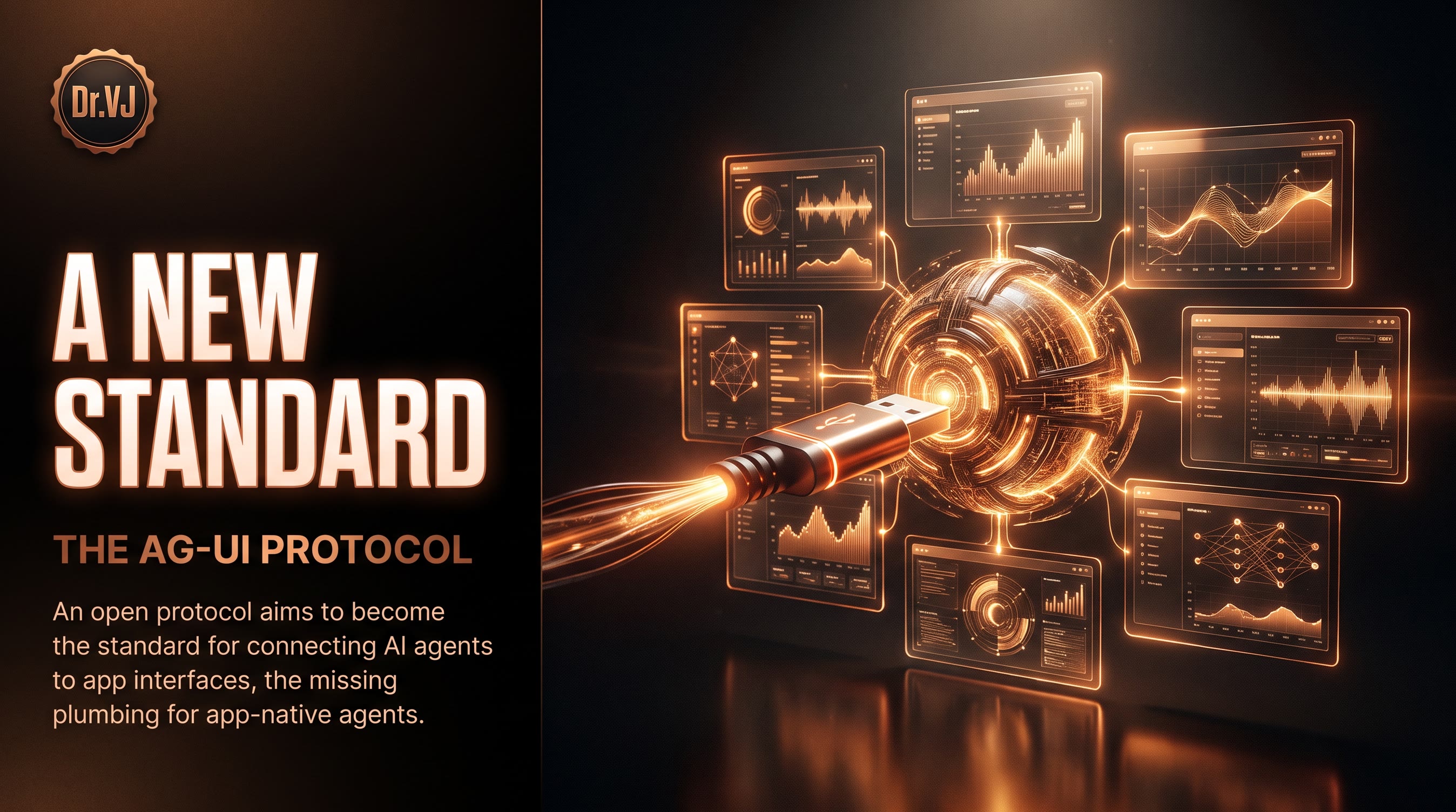
CopilotKit raised $27M this week to build the AG-UI protocol — an open standard for connecting AI agents to user interfaces. The round was led by Glilot Capital, NFX, and SignalFire.
If you're tracking AI agent infrastructure, this is worth understanding: we're in the early stages of a protocol standardization battle that will determine how agents communicate with everything from frontend applications to backend systems to each other. AG-UI is one piece of a larger puzzle.
What AG-UI Actually Is
AG-UI is a protocol — a standardized way for AI agents to connect to and communicate with user interfaces. It provides:
- Streaming chat (real-time agent responses in the UI)
- Front-end tool calls (agents invoking functions in the application)
- State sharing (agent and UI maintaining shared context)
The key differentiator from other approaches: AG-UI focuses on "generative UI" — not just displaying text responses, but allowing agents to produce dynamic, interactive interface elements. Instead of the agent saying "I've updated the order status," it renders the updated order status component directly in the UI.
This is the difference between a chat interface and a genuinely agent-native interface. The agent is an active participant in the UI, not a text generator attached to a form.
The Protocol Landscape
AG-UI doesn't exist in isolation. It's part of a broader protocol ecosystem emerging around AI agents:
Anthropic's MCP (Model Context Protocol): Standardizes how agents connect to external tools and data sources. MCP is about what the agent can access — databases, APIs, file systems. Think of it as the agent's connection to the world.
Google's A2A (Agent-to-Agent): Standardizes how agents communicate with each other. A2A is about inter-agent communication — how one agent delegates to another, shares context, and coordinates.
CopilotKit's AG-UI: Standardizes how agents connect to user interfaces. AG-UI is about the agent's relationship with the human — streaming responses, generating UI components, handling user events.
The three protocols cover different layers of the agent communication stack. They can coexist and complement each other — an agent might use MCP to access tools, A2A to coordinate with other agents, and AG-UI to render results in the application UI.
Why Standardization Matters Now
The AI agent landscape has been chaotic: every framework has its own way of connecting agents to applications. LangChain has its chains, LangGraph has its state machines, custom implementations have their own abstractions.
This was fine when agents were experimental. Now that agents are going into production — embedded in enterprise applications, handling real business workflows — the lack of standardization creates real problems:
Vendor lock-in: Applications built on one framework's agent abstraction are hard to migrate. If you build your agent workflow in LangChain and want to switch to Mastra, you rewrite significant portions.
Integration overhead: Every agent application needs custom glue code to connect the agent to the UI, the tools, and other agents. This glue code is expensive to write and maintain.
Interoperability: You can't easily take an agent built in one framework and connect it to a UI framework that wasn't designed for it.
Protocols solve these problems the same way HTTP standardized web communication: by creating a common language that all participants can use, regardless of their internal implementation.
CopilotKit's Strategy
What makes CopilotKit interesting is their horizontal approach: they support multiple stacks — Google, Amazon, Microsoft, LangChain, Mastra — rather than requiring a specific full-stack platform.
Their quote: "Our strategy is to be the default choice in the ecosystem, and then to monetize the top enterprises." This is the Apache foundation model, not the Salesforce model. Build the standard, capture the ecosystem, monetize the enterprises that need support and self-hosting.
The $27M will likely go toward:
- Growing the open-source community around AG-UI
- Building enterprise tooling for self-hosted deployment
- Expanding protocol coverage (better tool integration, more UI frameworks)
What This Means for AI Builders
If you're building applications with AI agents, the protocol standardization wave has a practical implication: invest in abstraction layers that are protocol-agnostic, not framework-specific.
The specific advice:
- Design your agent application to work with MCP-compatible agents (so you can switch models)
- Design your UI integration to work with AG-UI-compatible agents (so you can switch frameworks)
- Don't hard-code your agent into a specific framework's abstractions
The protocols are still evolving. MCP is the most mature. A2A is newer. AG-UI is the newest. But the direction is clear: the agent infrastructure layer is standardizing, and the window for building on proprietary abstractions is closing.
The companies that adopt protocol-native architectures now will find it easier to adopt new capabilities as the standards evolve. The companies that build on proprietary framework locks will spend significant engineering effort on migration when the standards mature.
Related posts: Advanced Tool Use Patterns for AI Agents — the MCP-compatible tool architecture. Multi-Agent Coordination Protocols — A2A-like patterns for agent communication. Agent Skills Framework — workflow discipline for AI coding agents. AI Agent Infrastructure Readiness — the $1.7T gap between models and production. CopilotKit AG-UI at $27M — app-native AI agents with Fortune 500 customers and protocol stack analysis.