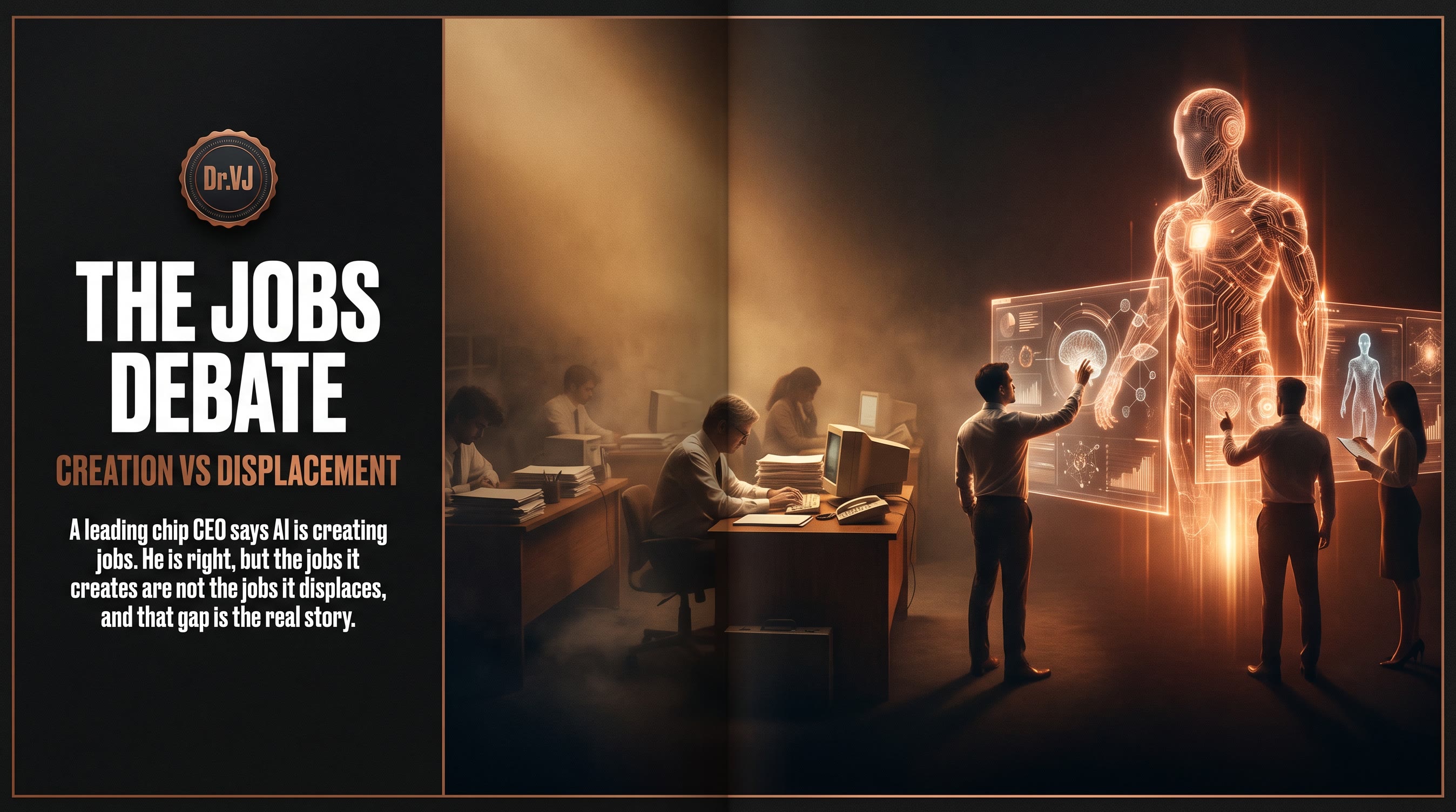
Jensen Huang recently said AI is "creating an enormous number of jobs" — and faced the inevitable pushback from workers worried about displacement. He's not wrong. But the debate as it's currently framed misses something important about what the AI employment transition actually looks like.
The question isn't whether AI creates jobs. It does. The question is whether those jobs appear fast enough, in the right places, and for the right people to make the transition manageable for the workers being displaced.
I've been in the AI industry long enough to see the employment patterns from both sides. Let me try to be honest about what I see.
Where Huang Is Right
The new jobs argument has genuine substance. The AI industry itself employs more people than it did five years ago — not just in AI labs, but in data annotation, model evaluation, AI safety testing, deployment engineering, and the surrounding infrastructure. The services layer that enables AI deployment is a significant employer.
More concretely: for every human replaced by an AI in a call center, there are new jobs in AI training data creation, AI output quality assurance, AI system monitoring, and AI integration with existing business processes. The work of making AI actually useful in enterprises is labor-intensive in ways that weren't obvious five years ago.
The forward-deployed AI engineering role I wrote about last week is a direct example — a job category that didn't exist before AI needed to be deployed at enterprise scale.
Where the "AI Creates Jobs" Argument Falls Short
The fundamental problem with Huang's framing is the "where, when, and for whom" gap.
Geographic mismatch: The jobs AI creates tend to be in tech hubs — San Francisco, Seattle, Austin, New York, London, Singapore. The jobs AI displaces are distributed across the country and the world: call centers in the Midwest, manufacturing in the Southeast, back-office work in every city. The geographic distribution of job creation and job destruction don't match.
Skill mismatch: The jobs AI creates require different skills than the jobs AI displaces. A call center worker who loses their job to an AI agent doesn't immediately become a prompt engineer or an AI evaluator. The retraining pathway exists but it's not automatic, and the transition takes time and resources that displaced workers often don't have.
Timing mismatch: The jobs AI creates appear over years and decades. The jobs AI displaces can disappear over months. A company that decides to replace its customer service team with AI agents can execute that decision in a quarter. The new AI infrastructure companies that will eventually hire those displaced workers take years to grow.
Compensation mismatch: The jobs AI creates — AI engineers, data scientists, ML engineers — have median compensation that is significantly higher than the jobs AI displaces. This means even if the net job count stays positive, the distribution of who benefits from AI employment shifts toward people who were already in the upper tier of the labor market.
What the AI Employment Transition Actually Looks Like
From what I observe in the industry, the AI employment transition is producing a pattern that economists call "skill-biased technological change" — where technology increases demand for high-skill workers and decreases demand for medium and low-skill workers.
But there's a twist: AI is now affecting cognitive tasks that were previously considered "high-skill." Legal document review, financial analysis, medical image interpretation — tasks that required years of education and training — are being partially automated. The skill-bias is moving up the employment ladder.
The workers most affected aren't just the ones doing repetitive manual tasks. They're analysts, assistants, junior professionals, and knowledge workers who were told their education and training made them relatively safe. The "AI will replace the routine work" framing was comforting but incomplete.
The Policy Conversation That's Not Happening
The political conversation about AI and jobs is stuck on two false extremes: "AI will destroy all jobs" and "AI will create more jobs than it displaces." Both are wrong in different ways.
The honest conversation is about transition management. The jobs being created by AI have different locations, skill requirements, compensation levels, and timing than the jobs being displaced. Effective policy would address those specific mismatches:
- Geographic mismatch requires investment in places where AI jobs are being created, not just in the coastal tech hubs
- Skill mismatch requires retraining infrastructure that's faster and more accessible than traditional education
- Timing mismatch requires some form of transition support (income support, benefits continuity) for workers between jobs
- Compensation mismatch raises questions about whether the gains from AI productivity are being distributed broadly enough
Huang is right that AI creates jobs. He's also implicitly right that worrying about a robot apocalypse is premature. But the transition that's actually happening — gradual, uneven, concentrated among specific worker populations — deserves a more serious policy conversation than either side of the current debate is having.
The Industry's Responsibility
The AI companies building these systems have a responsibility that goes beyond the standard "we're creating jobs" talking points. They benefit from the productivity gains AI creates. The workers who enable those gains by providing training data, evaluation feedback, and the human labor that AI augments or replaces — they're not all sharing in the gains proportionally.
The companies with the largest AI footprints have the resources to invest in transition support: retraining programs, geographic investment in places affected by AI displacement, income support during transitions. Some are doing this. The scale is not proportional to the scale of the disruption.
The Bottom Line
Huang's "AI creates jobs" argument is factually correct and strategically self-serving. The AI industry is creating employment, and the net job impact may well be positive over a long enough time horizon.
But the workers currently being displaced by AI — and the policymakers trying to manage the transition — deserve a more honest accounting. The jobs AI creates are not appearing in the same places, for the same people, at the same speed as the jobs AI is destroying.
The transition is real. Managing it is a policy challenge, not a technical one.
Related posts: Forward-Deployed AI Engineering — the new career category AI is creating. Coinbase's AI Restructuring — when a public company explicitly restructures its org chart around AI productivity gains.