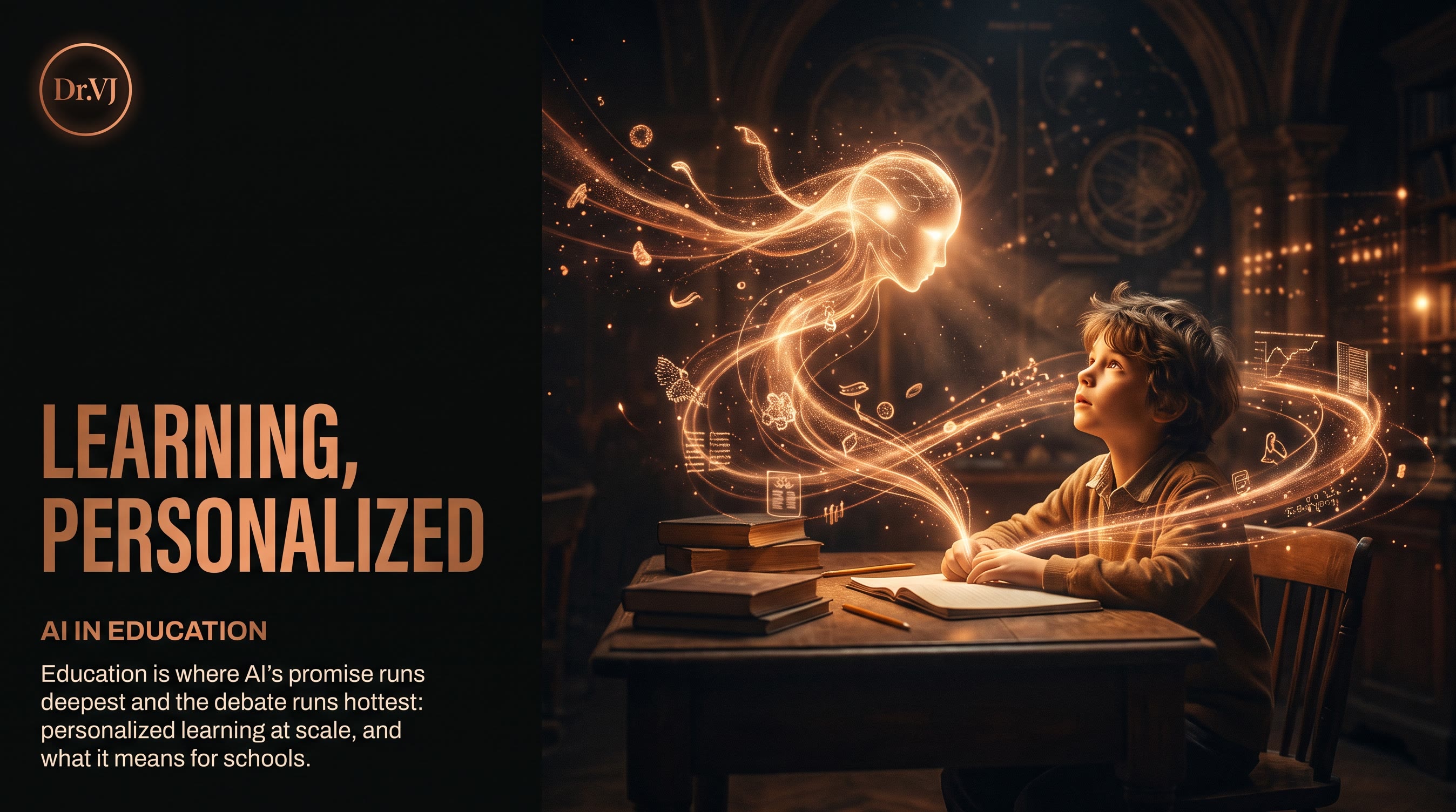
Benjamin Bloom's 1984 research, now called the "2-sigma problem," demonstrated that students who receive one-on-one tutoring outperform classroom-taught students by two standard deviations — a dramatic difference that corresponds to the difference between the 50th and 98th percentile of achievement. The problem is that one-on-one tutoring at scale is economically impossible: there simply aren't enough tutors, and the ones who exist are expensive. For four decades, this finding has been educational technology's north star — the target that justified investment in adaptive learning, intelligent tutoring systems, and personalized instruction research.
The arrival of genuinely capable large language models has changed the equation in ways that make Bloom's vision plausible for the first time. Not because we've solved all the pedagogical problems — we haven't — but because the technology barrier that prevented scalable personalized tutoring has been removed. What remains are the institutional, equity, and pedagogical questions that are genuinely harder than the technical ones.
What AI Tutoring Can Actually Do
The current generation of AI tutors — built on top of frontier models from OpenAI, Anthropic, and others — is meaningfully different from the adaptive learning software of the previous decade. The difference is conversational intelligence: the ability to understand what a student is struggling with not just through their answers to predefined questions, but through the ways they describe their confusion, the questions they ask, and the errors in their reasoning.
Khan Academy's Khanmigo, one of the most visible AI tutoring implementations, demonstrates the paradigm well. Rather than simply presenting content and testing recall, Khanmigo engages students in Socratic dialogue — asking guiding questions rather than providing direct answers, identifying misconceptions from student reasoning, and adapting its explanations to a student's expressed understanding level. The pedagogical approach is deliberate: the goal is to build understanding, not to transfer answers.
The research evidence on AI tutoring outcomes is early but promising. Carnegie Learning's AI-powered math tutoring platform, one of the better-studied implementations, has shown measurable improvements in math achievement in multiple studies. The RAND Corporation's research on adaptive math software has produced mixed but generally positive results. Duolingo's AI features (vocabulary explanation, conversation practice with an AI partner) have contributed to engagement metrics that translate to retention and learning outcomes.
What AI tutors do particularly well: providing immediate, patient, personalized feedback on practice problems; explaining concepts in multiple ways until the student grasps one; allowing students to ask "embarrassing" questions they might not ask in class; and maintaining engagement through conversational naturalness. What they do less well: reliably detecting when a student is fundamentally confused versus superficially confident, accurately assessing deep conceptual understanding versus pattern-matched correct answers, and providing the motivational relationships that human teachers build over time.
The Academic Integrity Crisis
The elephant in the room of AI and education is academic integrity. ChatGPT's public release in late 2022 triggered an immediate and still-ongoing crisis in educational assessment. If a capable language model can write a convincing essay, solve math problems, produce code, and answer examination questions, what does it mean to assess student learning?
The initial institutional response — AI detection tools — has proven inadequate. Turnitin, GPTZero, and similar detection tools have unacceptable false positive and false negative rates. They flag human writing as AI-generated (an accusation that is devastating when wrong) and miss AI-generated content that has been lightly edited. The fundamental technical problem is that good language models produce text that is statistically similar to human text — that's what makes them useful, and it's what makes detection hard.
Some institutions have responded with AI bans, proctored in-person assessments, oral examinations, and assignments specifically designed to require current events knowledge or personal experience that an AI can't fabricate plausibly. These responses have partial merit but are fundamentally rearguard actions — strategies for preserving assessment formats designed before AI, rather than reimagining assessment for the AI age.
The more productive response, which leading educators are pursuing, is to rethink what we're assessing. If an essay assignment is meant to assess whether a student can synthesize information and construct an argument, and AI can do that, then either: (a) we should let students use AI and assess something else (their ability to critically evaluate and improve AI-generated arguments, for instance), or (b) we should redesign the assignment to require something AI can't substitute for (personal reflection, original research, iterative development with documented thinking).
The educators I most respect in this space have moved past "how do we catch cheating?" to "what should students actually be able to do, and how do we develop and assess that with AI as a tool they will use for the rest of their professional lives?" This is the right question, and it requires rethinking curriculum, not just assessment policy.
Equity: AI as Equalizer or Divider?
The equity dimension of AI in education is where my thinking has evolved the most in the past two years. The initial framing — AI tutoring could democratize access to high-quality education — was optimistic in ways that glossed over the mechanisms of inequity.
The optimistic case: students in under-resourced schools with large class sizes and inadequate support can access AI tutors that provide the individualized attention their classrooms can't provide. First-generation college students can access AI writing tutors who help them develop academic writing skills that peers from elite prep schools acquired over years. Students in rural areas can access STEM support that their local schools can't offer. These are real mechanisms.
The pessimistic counter-case: device access and reliable internet connectivity are still unequally distributed. The most sophisticated applications of AI in education — AI as a collaborative partner in creative projects, AI-augmented advanced coursework, AI tools for research — are concentrated in schools that already have technology infrastructure, sophisticated teachers who can integrate AI effectively, and students with the metacognitive skills to use AI as a learning amplifier rather than a shortcut. The "AI divide" may replicate and extend the existing digital divide.
The evidence from early large-scale AI tutoring deployments is mixed on equity impacts. Some implementations have shown more benefit for lower-achieving students (consistent with the intuition that students who are already thriving have less room to improve and more existing support). Others have shown faster adoption among already-advantaged students who have stronger baseline digital literacy and more parental support for navigating new tools.
The policy implication: AI in education requires active design for equity, not passive hope that access alone produces equitable outcomes. This means teacher professional development (so that teachers in under-resourced schools can effectively integrate AI), infrastructure investment (devices and connectivity), and curriculum design that leverages AI's strengths for the students who have historically benefited least from traditional education.
The Teacher Role in an AI-Augmented Classroom
The "AI will replace teachers" narrative deserves direct engagement, because it's both wrong about the technology and wrong about what learning is.
Current AI tutors are effective at certain things: practice and feedback loops, content explanation, answering factual questions. They are not effective at: building the trust relationships that enable vulnerable students to take intellectual risks, inspiring intrinsic motivation through the transmission of a teacher's genuine passion for a subject, developing the classroom community and social learning that peer interaction provides, mentoring students through major life transitions, or handling the full complexity of a student in crisis.
The more accurate framing is that AI is going to change what teachers do — automating the rote, repetitive, low-value parts of the job (grading routine assignments, answering recurring factual questions, differentiating the same core material for different learning levels) and freeing teacher time for the higher-value human interactions: mentoring, discussion facilitation, complex project guidance, and relationship-building.
This is genuinely good news for what the profession of teaching could become, but it requires investment in teacher development and, critically, a willingness by educational institutions to redeploy the time savings toward high-value human instruction rather than just reducing teacher headcount.
Specific Applications Gaining Traction
Beyond AI tutoring, several specific AI applications in education are showing genuine adoption and impact:
AI-assisted curriculum development: Teachers using AI to generate differentiated lesson materials, develop practice problem sets, create rubrics, and draft assessment questions. This is already widespread, primarily happening informally as individual teachers use commercial AI tools.
Automated feedback on writing: AI providing detailed, immediate feedback on student essays — not just grammar correction but structural feedback, argumentation quality, and suggestions for development. Products like Turnitin's AI feedback tools, Grammarly's full-document feedback, and specialized educational writing feedback tools are in use at scale.
Language learning: Duolingo's AI features, SpeakAI, and similar products are demonstrating that conversational AI practice can meaningfully supplement human language instruction, particularly for speaking practice that is difficult to provide at scale in classroom settings.
Special education support: AI tools that adapt content presentation for different learning needs, provide text-to-speech and alternative format outputs, and support students with learning disabilities are showing strong impact. This is an area where the individualization capability of AI is particularly valuable and where equitable access is especially important.
The Long View
Zooming out from the current moment of institutional disruption and policy debate, I believe AI will be understood in retrospect as one of the most significant educational technology shifts in history — comparable to the printing press, the textbook, or the internet, rather than comparable to previous waves of educational technology that produced modest effects.
That belief is grounded in the specificity of what has changed: for the first time, there is a technology that can engage in genuine pedagogical dialogue, adapt to individual understanding levels in real time, and be patient and available without limit. These are not incremental improvements on previous educational technology — they are qualitatively different capabilities.
But technology alone has never determined educational outcomes. The decisions that will determine whether AI education reaches its potential are institutional and human: Will schools receive the investment needed to deploy AI equitably? Will teacher education systems produce teachers who can collaborate with AI effectively? Will assessment systems evolve to reward the thinking skills that matter in an AI-augmented world? Will we thoughtfully preserve the human elements of education that AI cannot provide?
These questions are not technical questions. They're policy questions, funding questions, and values questions. The technology is ready. The real work is the human part — as it usually is.
Explore more from Dr. Jyothi