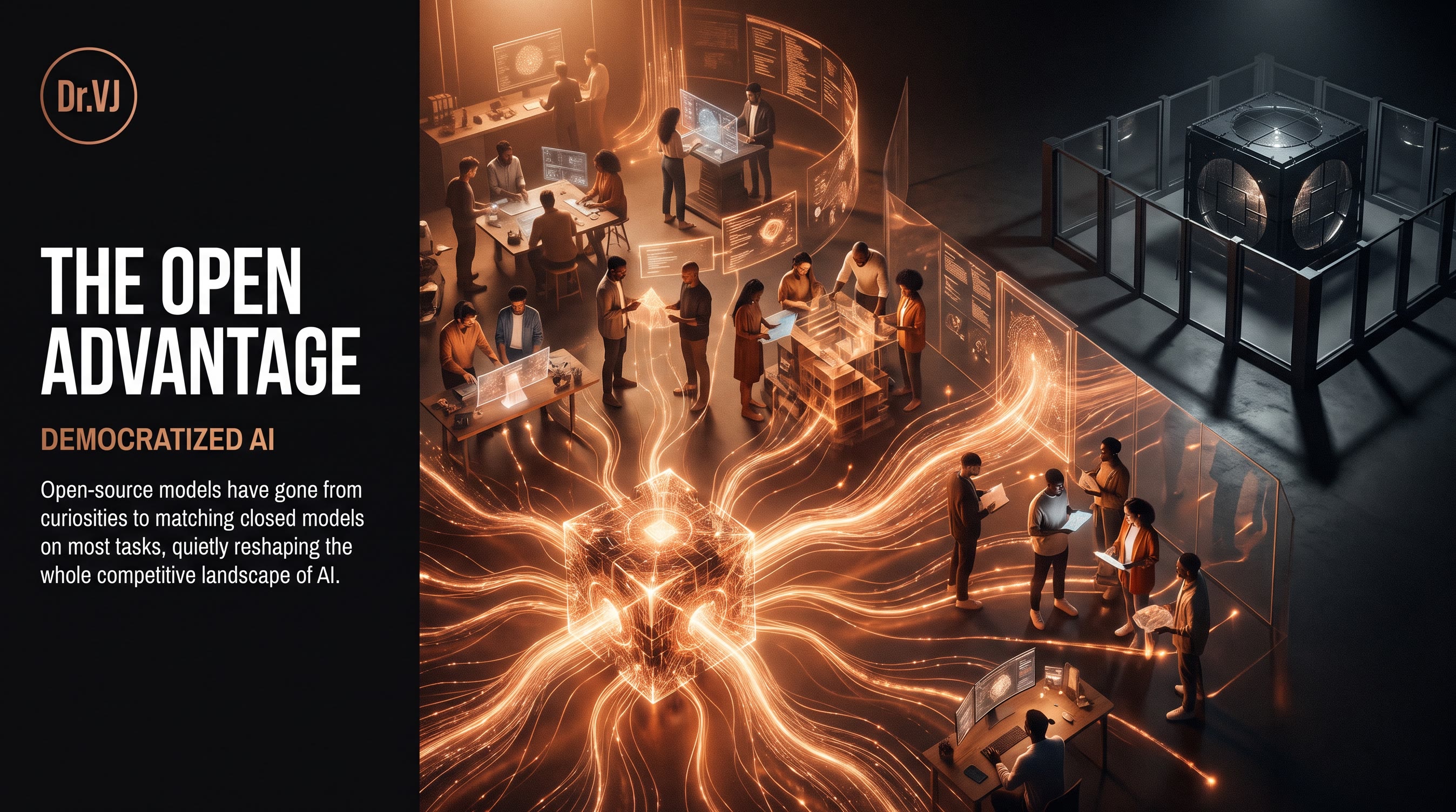
The AI startup landscape of 2025 generated staggering numbers. Venture investment in AI startups exceeded $100 billion globally. Anthropic raised at a $60 billion valuation. xAI raised $6 billion in a single round. Cursor reached unicorn status in under two years. Perplexity grew from curiosity to serious search challenger. The money flowing into AI is historic — but what does it actually mean for the shape of the opportunity, and where is the real building happening?
I want to give you a structural view of the AI startup ecosystem — not a list of impressive funding rounds, but a framework for understanding where defensible value is being created and where it isn't.
The Layered Ecosystem
The AI startup landscape structures itself in distinct layers, each with different economics, barriers, and opportunities.
The foundation model layer is the most capital-intensive and most concentrated. OpenAI, Anthropic, Google DeepMind, Meta AI, and Mistral are the primary players building at the model frontier. The capital requirements for training state-of-the-art models — compute costs, research talent, safety infrastructure — have crossed into territory that excludes all but the best-funded organizations. A frontier training run can cost $50–200 million. This layer is effectively a competition among a small number of very well-resourced entities, not a startup opportunity in the conventional sense.
That said, Mistral's trajectory is instructive. Starting in 2023 with €105 million in seed funding (then among the largest seed rounds in European history), Mistral has competed meaningfully at the foundation model layer by focusing on efficiency and the open-weight ecosystem rather than pure scale. Their success demonstrates that a focused research team with a differentiated technical approach can build a durable position even in a capital-intensive layer — though the window for new entrants is narrowing.
The infrastructure layer is where a wave of specialized AI infrastructure startups has emerged. Vector database companies (Pinecone, Weaviate, Chroma), LLM observability and monitoring platforms (Arize AI, Helicone, LangSmith by LangChain), prompt management tools, fine-tuning infrastructure (Modal, Replicate), and AI-specific cloud computing (CoreWeave, Lambda Labs as Nvidia GPU alternatives) have all found real markets. This layer has genuine technical moats — data network effects, API ecosystem lock-in, performance advantages from purpose-built architecture — and is producing durable businesses.
The infrastructure layer is also where the "shovel sellers" critique has the most validity. Just as selling shovels to gold miners was more consistently profitable than mining itself during the gold rush, building infrastructure used by all AI applications regardless of which applications win has been a good strategy. But this window is closing: the major cloud providers (AWS Bedrock, Azure AI, Google Vertex AI) are commoditizing significant portions of the AI infrastructure stack, and startups that have built in spaces that AWS or Google will eventually absorb need to be thinking carefully about their differentiation strategy.
The model fine-tuning and adaptation layer has been more contested than initially expected. The thesis that every enterprise would need a fine-tuned version of a foundation model drove significant investment in companies building fine-tuning tooling and fine-tuned vertical models (legal AI, medical AI, financial AI). The reality has been more nuanced: instruction tuning and prompting have proven more capable than early estimates suggested, reducing the need for full fine-tuning in many cases, while retrieval-augmented generation (RAG) has emerged as the dominant pattern for domain adaptation.
Companies like Cohere (enterprise-focused foundation models with strong RAG and fine-tuning tooling), AI21 Labs (document intelligence and NLP-specific models), and various vertical-specific model companies have found real markets but more modest scale than the infrastructure layer.
The application layer is where the largest volume of AI startups is operating and where the opportunity is most genuinely accessible. But it's also where the defensibility questions are hardest.
The Application Layer: Where the Gold Rush Is
AI-native application startups are being built across every vertical: legal (Harvey, Clio Duo), healthcare (Abridge, Suki, Corti), sales and marketing (Clay, Jasper, Copy.ai), customer service (Intercom, Sierra), recruiting (Beamery, Findem), financial analysis (Tegus, AlphaSense), and dozens of others. The common pattern: take an AI capability (typically built on top of an API from OpenAI, Anthropic, or another foundation model provider), apply it to a specific professional workflow with domain-specific UX, integrations, and context, and sell to enterprises or professionals in that vertical.
The business models are real. Harvey's legal AI platform is reportedly in use at major law firms. Abridge's clinical documentation AI has deployed at large health systems including UPMC. These are not vaporware — they're products that professionals use and pay for.
But the defensibility question is acute and worth being honest about. When a startup's core capability is "fine-tuned GPT-4o for [industry]," what happens when:
- OpenAI or Anthropic builds the same vertical feature into their platform
- The underlying model capability improves enough that the fine-tuning advantage disappears
- A better-funded competitor enters the vertical with a similar approach
The startups that are most defensible at the application layer share certain characteristics: deep workflow integration (their product is woven into the daily software stack of users, not a standalone tool), proprietary training data (accumulated from user interactions, creating a data moat), and domain-specific data network effects (the product improves as more users generate feedback and corrections). Harvey's competitive position, for example, is strengthened by the legal cases it has processed and the feedback from lawyers that has shaped its outputs — data that a new entrant cannot easily replicate.
The Agent Startup Wave
The emerging category that I find most interesting from a startup opportunity standpoint is the AI agent layer: companies building autonomous AI agents that complete multi-step tasks in specific domains. This includes:
- Coding agents: Cognition Labs (Devin), Poolside AI, and others building more capable autonomous software engineering
- Research agents: Perplexity (evolved from search to research assistant), Elicit, and Consensus for scientific literature
- Business process agents: startups automating specific business workflows end-to-end — accounts payable processing, contract lifecycle management, customer onboarding
- Personal AI assistants: Mem.ai, Notion AI, and the emerging category of always-on AI that maintains context across your entire work life
The agent category is early but moving fast. The technical progress on reasoning, tool use, and multi-step planning has been rapid enough that applications that seemed like science fiction in 2023 are prototype-ready in 2025. The challenge is that agent reliability is still imperfect — an agent that successfully completes a task 85% of the time is frustrating rather than useful for many enterprise workflows, because the 15% failure case requires human intervention that may be more disruptive than doing the task manually.
Venture Capital's AI Allocation Shift
The VC landscape's AI investment has shifted significantly in pattern. In 2023, investment was concentrated in foundation models (Anthropic, OpenAI's Microsoft investment, Inflection AI) and infrastructure. In 2025, application layer companies attracted the largest volume of deals, while later-stage investment in AI infrastructure and a new wave of agent companies dominated by dollar volume.
The valuation environment deserves scrutiny. Several AI startups have raised at revenue multiples that are extraordinary even by SaaS standards — 100x ARR, 200x ARR in some cases. This is sustainable only if two conditions hold: continued rapid revenue growth, and durable moats that prevent commoditization as the underlying model costs continue to decline and capabilities improve.
I expect significant rationalization of the AI application layer in 2026. Some companies that raised at extraordinary valuations in 2024–2025 will struggle to grow into those valuations as competition intensifies and the differentiation from their foundation model providers narrows. This is normal and healthy market dynamics, not a bubble pop — the underlying technology is creating real value, and the winners in each vertical will build durable businesses. But not all current valuations will be vindicated.
Where the Real Opportunities Are
For founders thinking about where to build in 2026, my honest view:
Vertical AI with proprietary data generation remains the most compelling opportunity. Pick a domain with large enough professional workflows, build a product that becomes the system of record (not just a productivity tool), and design the data flywheel deliberately from day one.
AI infrastructure for the governance and compliance layer is underdeveloped relative to need. AI observability, audit trails, bias testing, model documentation, and compliance automation are in demand from enterprises with serious governance requirements and are still largely unsolved at scale.
Agent infrastructure and orchestration — the plumbing that makes AI agents reliable enough for enterprise use — is both technically hard and commercially important. Reliability, error recovery, human-in-the-loop handoffs, and observability for agentic systems are problems where specialized tooling will have real value.
Human-AI collaboration tools that match specific professional contexts — not generic AI assistants but deeply domain-specific tools that understand the vocabulary, workflows, and judgment criteria of specific professions — continue to have strong opportunity, particularly in domains with high professional labor costs and meaningful data moats.
The AI startup ecosystem in 2026 is maturing past the "throw money at anything with 'AI' in the pitch deck" phase. The capital will continue to flow to AI startups, but the bar for defensibility is rising. The founders who will build lasting value are those who understand not just the AI capabilities they're deploying, but the structural forces — incumbency dynamics, data moats, workflow lock-in — that determine whether a business can sustain its position as the technology evolves beneath it.
Explore more from Dr. Jyothi