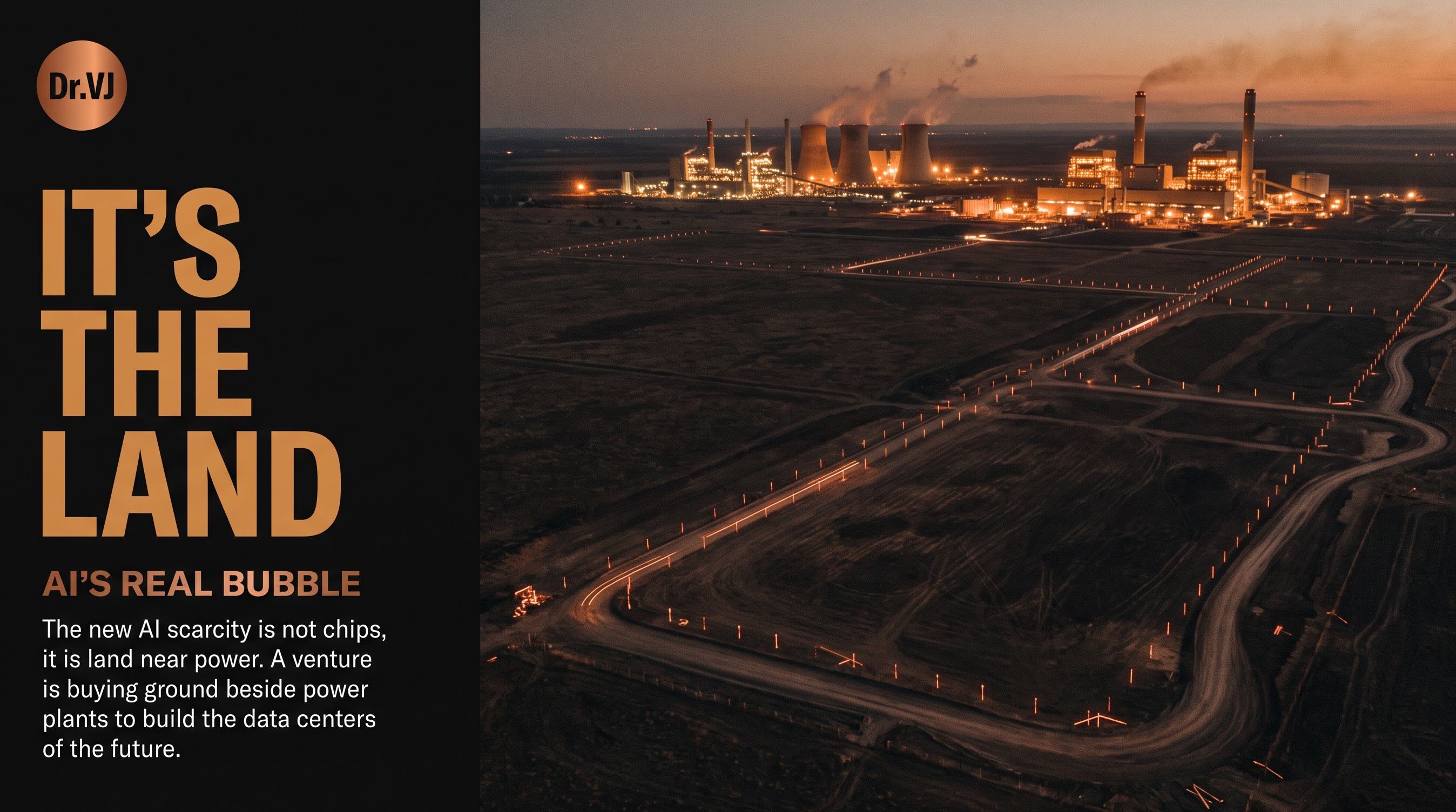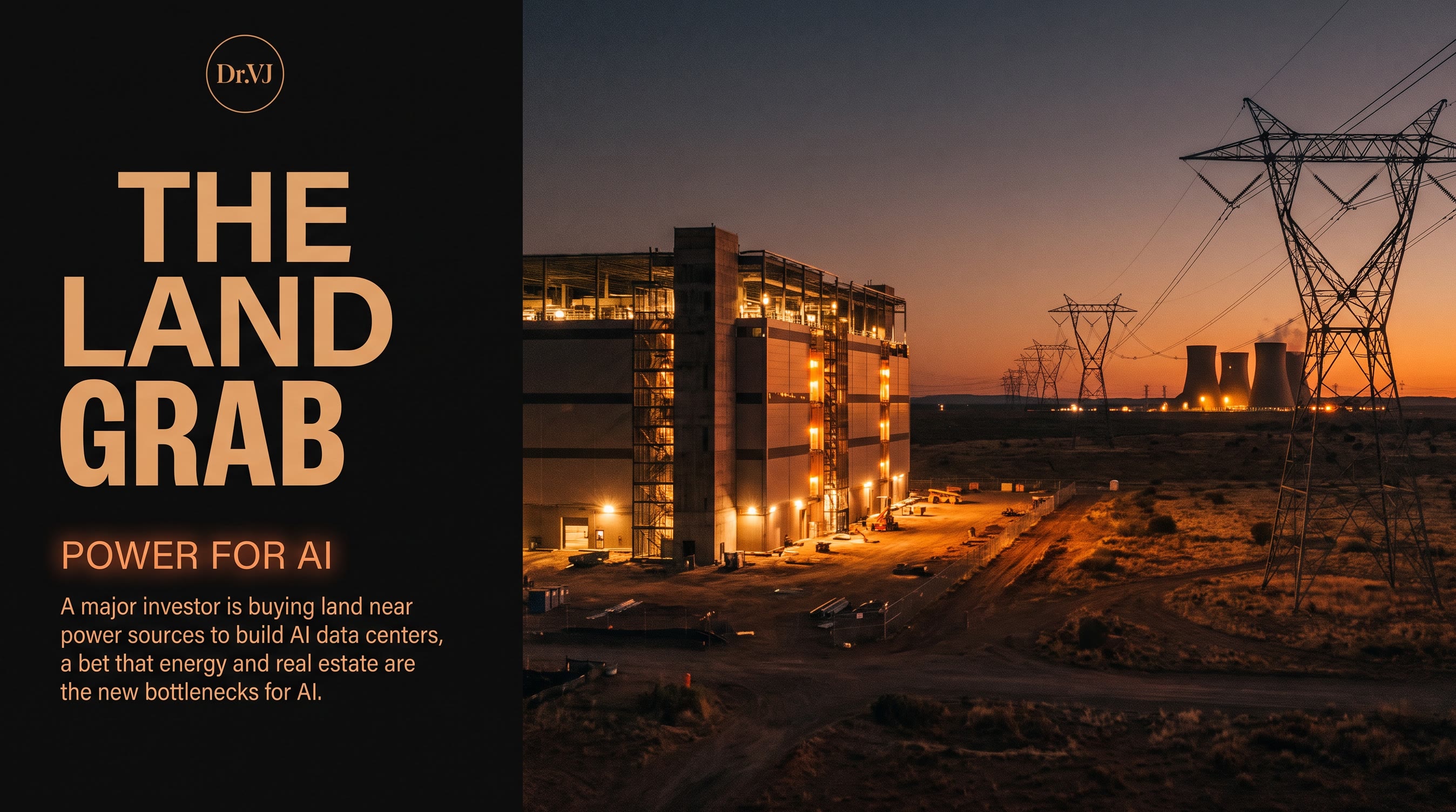
Coatue — one of the biggest names in venture capital and hedge funds — has a new plan for generating returns on AI beyond its sizable stakes in Anthropic, OpenAI, xAI, and data center companies. It's called Next Frontier. And the strategy is surprisingly simple: buy the land.
Not just any land. Land near large power sources. Where electricity is cheap, abundant, and can be delivered to computing infrastructure without years of grid upgrades.
This is the most concrete signal yet that the real bottleneck in AI infrastructure isn't compute or models — it's power.
What Next Frontier Is Actually Doing
Coatue's Next Frontier venture is acquiring land in locations where large-scale power is available. The company then develops these parcels into data centers — the physical facilities that house the GPUs and AI inference infrastructure that AI models run on.
The model is vertical integration at the infrastructure layer: instead of relying on third-party data center providers, Coatue is building owned infrastructure that's co-designed with AI workloads from the ground up.
The centerpiece of the strategy is a joint venture with Fluidstack — a cloud infrastructure startup that has reportedly secured a $50 billion deal to construct data centers for Anthropic. Fluidstack handles the technical infrastructure; Coatue provides the capital and land acquisition capability.
Why Land Near Power Is the Scarce Resource
Over 1,500 new data centers are being built across the United States. Every one of them needs power — significant, reliable, continuous power. And power grid capacity isn't keeping up.
The bottleneck isn't the land itself — there's plenty of land. It's land with proximity to power substations, transmission lines, and power plants that can deliver the megawatts AI infrastructure requires. Building a data center in a location without adequate power means years of wait time for grid upgrades — time that AI companies competing on speed don't have.
This is why data center companies are paying premium prices for land near power sources that already have grid capacity. The real estate isn't valuable for its location in the traditional sense — it's valuable because it's a shortcut to power delivery.
The Anthropic Connection
Coatue already holds significant stakes in Anthropic. Adding the Next Frontier venture — and the Fluidstack JV for Anthropic data centers — is a way to capture value at multiple layers of the Anthropic ecosystem simultaneously.
If Anthropic succeeds as an AI company, it needs more data center capacity. Coatue is positioning to own that capacity directly rather than relying on third-party providers. This is the same logic that drove hyperscalars to build their own data centers rather than renting from others.
The $50 billion Fluidstack deal, if accurate, represents one of the largest AI infrastructure commitments in history. That's the scale of data center investment required to support frontier AI model training and inference at scale.
What This Means for the AI Infrastructure Market
Three implications stand out:
Power is the new location: Traditional data center strategy was about geographic diversification and cost arbitrage. The new strategy is about power proximity. The companies that can secure power capacity fastest will be able to scale AI infrastructure fastest.
Vertical integration at the infrastructure layer: Coatue isn't just investing in AI companies — it's building the physical infrastructure those companies depend on. This is a new form of vertical integration where capital and infrastructure capability are as important as technology.
Land and power as competitive moat: Securing land near power sources creates a durable competitive advantage that can't easily be replicated. Grid upgrades take years. Power procurement agreements are hard to renegotiate. The companies that locked up power capacity early have a structural advantage that compounds.
What This Means for AI Builders
If you're building AI products that depend on infrastructure, the Coatue move is a signal: the physical constraints of AI infrastructure are becoming as important as the computational ones. Power availability will increasingly determine which AI companies can scale.
For infrastructure companies, the message is clear: land near power is worth acquiring aggressively. The bottleneck isn't compute — it's the ability to deliver power to compute.
The $50 billion Anthropic data center commitment tells you the scale of infrastructure investment required for frontier AI. This is infrastructure-scale capital deployment — not startup investment, not venture returns, but institutional-grade infrastructure building.
The AI boom is becoming a real estate and utilities story as much as a technology story.
Related posts: AI Agent Infrastructure Readiness — the $1.7T gap between models and production. Venture Capital's $3.2B AI Bet — a16z and Katie Haun targeting AI infrastructure. TDK Ventures Boring AI — the infrastructure bets that will define the next phase of AI. BMW i Ventures $300M AI Fund — industrial capital betting on agentic and physical AI. Samsung $1T AI Chips — HBM chip shortage and the memory infrastructure bottleneck.