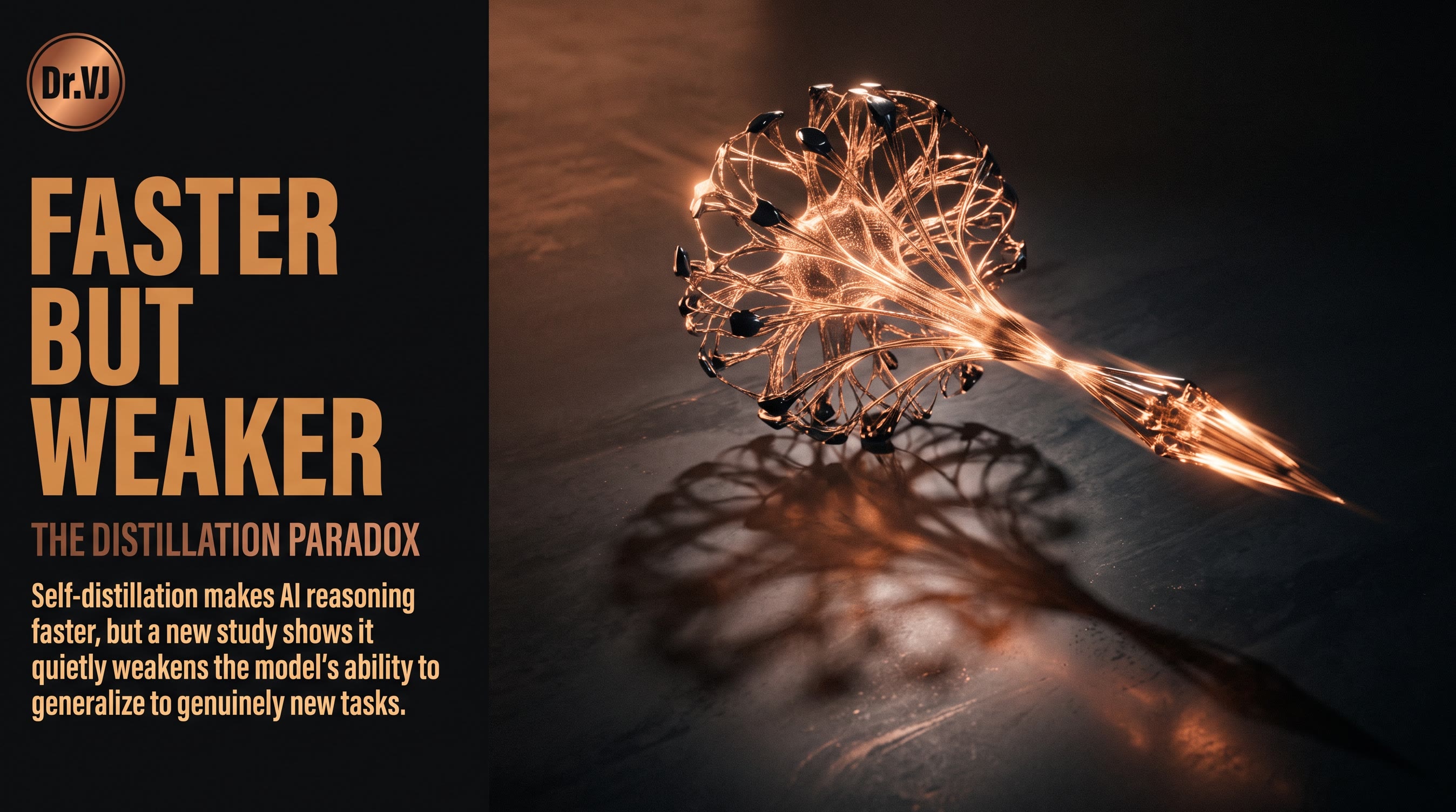
Self-distillation is one of the more practically useful techniques in LLM development: you use a model's own outputs to train a smaller or faster version of itself. The results are impressive — faster inference, reduced model size, maintained performance on targeted tasks. A new study from April 2026 makes the case that there's a hidden cost, and it's worth understanding the trade-off in detail.
What self-distillation does
Standard knowledge distillation: train a small model on the outputs of a larger model. The small model learns to imitate the large model's behavior, with the goal of getting most of the capability at a fraction of the compute cost.
Self-distillation: use a model to generate training data for itself. The model produces responses, filters or enhances them, and trains on the enhanced version. This can improve specific capabilities (reasoning, formatting, style) without external supervision.
The technique is compelling because it doesn't require a larger teacher model — you can improve a model using only its own outputs. This makes it widely applicable and relatively cheap.
The generalization paradox
The April 2026 study (titled "The Paradox of LLM Self-Distillation") documents a consistent finding: models fine-tuned via self-distillation show improved performance on tasks similar to the training distribution, but degraded performance on novel tasks that weren't represented in the training data.
The mechanism is intuitive in retrospect:
Distribution compression — Self-distillation teaches the model to replicate its own outputs. The training distribution becomes a compressed version of the model's current behavior. The model gets better at what it already does, but less exposed to what it doesn't yet do.
Confidence calibration drift — A model's own outputs are, by definition, things the model is confident about. Training on self-generated data reinforces confidence, including overconfidence on incorrect outputs. This narrows the error distribution rather than reducing it.
Novel task exposure — Fine-tuning on self-generated data doesn't introduce new signal about tasks the model handles poorly. A model that's weak on math reasoning won't get better at math by training on its own math outputs — it'll get more confident at the specific types of math it already handles.
Practical implications for builders
If you're using self-distillation or considering it, the paradox has specific implications:
Don't use self-distillation to fix weaknesses — This is the most important implication. If a model struggles with a task, self-distillation will make it more confident at that task's easy cases while leaving the hard cases unaddressed. You need external training data or a stronger teacher model for genuine improvement.
Use it for efficiency gains on known tasks — If a model already handles a task well, self-distillation is an effective way to compress that capability into a smaller/faster model. The generalization loss doesn't matter if you only care about the tasks in the training distribution.
Mix external data aggressively — The most effective fine-tuning strategies use self-distillation for efficiency while mixing in external data to maintain generalization. Pure self-distillation is efficient but fragile.
Monitor for confidence calibration drift — After self-distillation, check whether the model's confidence estimates are calibrated. Self-distilled models tend to be more overconfident, which affects how you should use them in high-stakes applications.
The self-distillation paradox doesn't make the technique useless — it's one of the more efficient approaches to model compression and targeted improvement. But it does mean you should apply it with eyes open: faster reasoning and stronger performance on known tasks, traded against reduced generalization. Know which trade you're making.