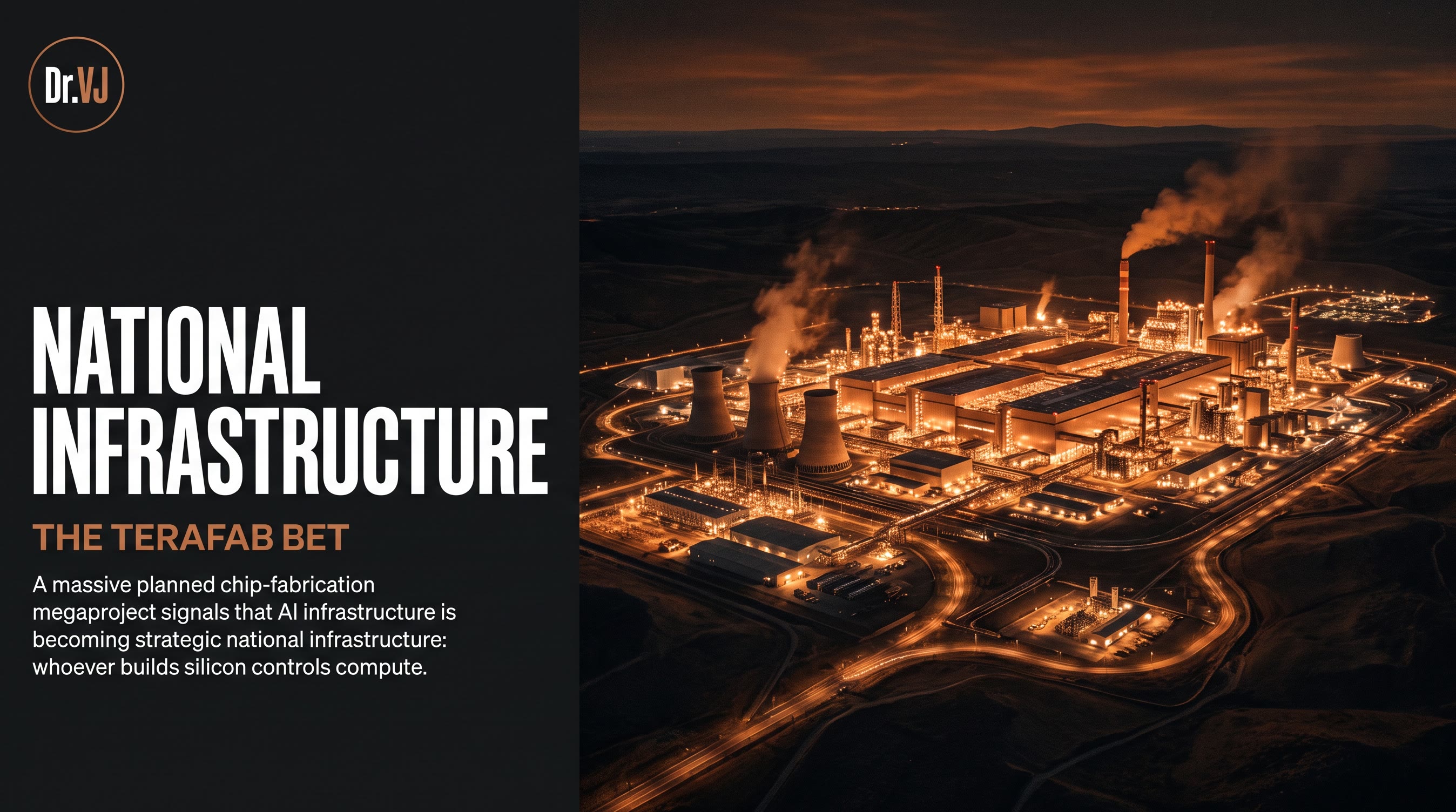
For most of the AI era, the assumption has been that compute access is a market problem — you buy GPU time from cloud providers, and the market allocates compute efficiently. SpaceX's reported $119B chip factory (code-named "Terafab") suggests that assumption is being replaced by something older and more familiar: compute is a national security concern, and strategic infrastructure requires strategic investment.
The scale of the bet
$119B is extraordinary by any measure. For context:
- It's roughly equivalent to the GDP of a mid-sized country
- TSMC's most advanced Arizona fab costs around $40B
- Intel's entire capital expenditure budget is around $25B/year
A $119B single facility investment suggests SpaceX (and by extension, xAI) is planning a scale of vertical integration that goes beyond anything in the current AI industry. This is not a research lab building a model. This is a company building the infrastructure layer that models depend on.
Why this matters beyond the xAI story
The Terafab investment, if real at the reported scale, signals several things about the AI industry's direction:
Compute is becoming a strategic asset — The US government's push to bring semiconductor manufacturing onshore (CHIPS Act, export controls on advanced chips to China) reflects the same underlying logic: compute access is national security. SpaceX building a chip factory is the private sector arriving at the same conclusion.
The TSMC dependency problem — Every AI lab currently depends on TSMC for advanced chip fabrication. This creates geographic concentration risk, geopolitical exposure, and supply chain fragility. A domestic US fab at scale removes that dependency — at enormous capital cost, but with strategic benefits that are worth calculating.
Vertical integration as competitive advantage — Tesla proved the power of vertical integration in EVs. SpaceX proved it in rockets. xAI applying the same logic to AI infrastructure — owning model development, data center operations, and chip fabrication — creates a cost and resilience structure that pure-play AI labs can't match.
The builder implications
For teams building AI systems, the infrastructure layer is becoming more important, not less:
Chip architecture choices matter more — As custom silicon proliferates (TPUs, Trainium, Grok chips, Apple's Neural Engine), the instruction set architecture and tooling ecosystem of your compute target affects every layer of your stack. Choosing the right compute substrate is a more strategic decision than it's been in years.
Infrastructure reliability is a product decision — The teams that treat infrastructure as a solved problem ("just use the cloud") are missing the degree to which infrastructure choices affect latency, cost, and resilience at scale. The Terafab investment signals that the most capable players are investing in infrastructure as a product differentiator.
Multi-cloud isn't paranoia — In a world where compute is strategic infrastructure, single-provider dependency is a risk. Teams building production AI systems should be thinking about compute substrate portability earlier than the industry typically does.
The Terafab story is about more than SpaceX or xAI. It's about the industrialization of AI — the transition from AI as a technology product to AI as critical infrastructure, with the capital commitments and strategic considerations that implies. The teams that understand this shift now are better positioned for the next phase.