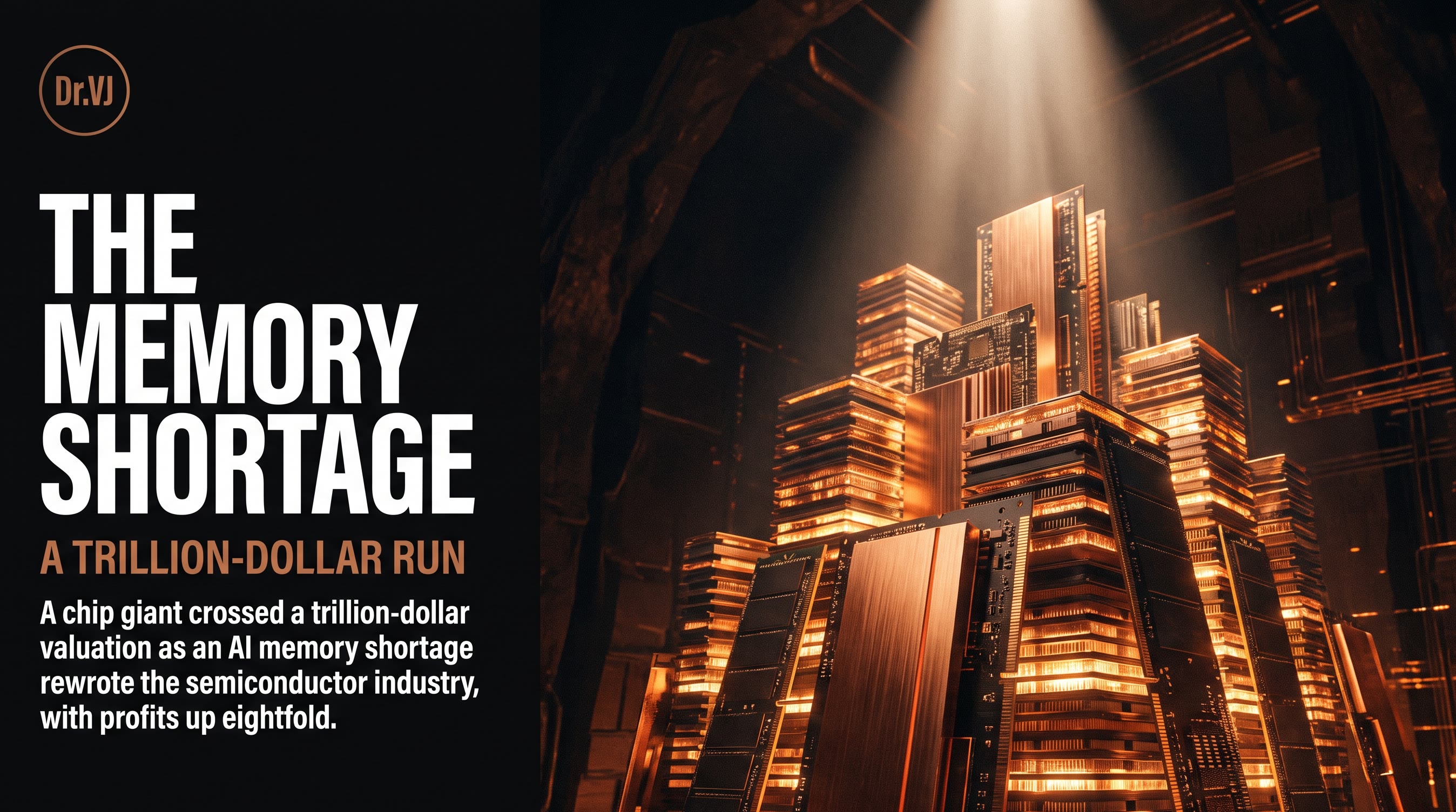
Samsung crossed $1 trillion market capitalization on May 6, 2026 — shares surged more than 10% in a single day. The company joins TSMC as the only Asian companies to ever reach this milestone. The driver: AI infrastructure demand for memory chips has created a shortage that Samsung is uniquely positioned to solve.
This is the clearest signal yet that the AI boom isn't just about models — it's about the physical infrastructure those models run on. And right now, that infrastructure includes a lot of memory chips that Samsung makes.
Why HBM Chips Are the AI Bottleneck
High-bandwidth memory (HBM) chips are specialized memory modules designed for high-speed data transfer — exactly what AI inference and training workloads require. Unlike standard consumer memory, HBM stacks multiple DRAM dies vertically, connecting them through microscopic through-silicon vias (TSVs) to achieve bandwidths that standard DDR memory can't match.
Every AI system needs them. Training large language models, running inference at scale, processing multi-modal data — all of it depends on moving enormous amounts of data between memory and compute at high speed. HBM is the enabler.
The problem: supply hasn't kept up. Samsung, SK Hynix, and Micron are the only three companies capable of producing HBM at scale, and all three are struggling to meet demand from AI data centers.
The 8x Profit Surge and What It Means
Samsung's Q1 2026 profits were eight times higher than the same period last year. The jump isn't from selling more phones or TVs — it's from HBM chips. The company has been shifting capacity from consumer chip businesses to HBM production, accepting lower volumes in consumer markets in exchange for higher margins in AI infrastructure.
The chip shortage is so acute that companies building AI are competing for HBM allocations. This is a supply-constrained market where memory manufacturers have pricing power they haven't had in a decade.
The Apple Foundry Angle
Reports emerged that Apple is exploring partnerships with Samsung and Intel for chip manufacturing on U.S. soil. Currently, Apple relies almost exclusively on TSMC in Taiwan — a concentration risk that's become increasingly visible as geopolitical tensions in the Taiwan Strait persist.
Samsung's foundry division could benefit from Apple's diversification strategy. Samsung manufactures both memory and logic chips, making it a potential one-stop partner for companies looking to reduce Taiwan dependency.
The Worker Strike Signal
Labor unrest at Samsung: workers are threatening an 18-day strike later this month, demanding a larger share of AI-related profits. This is a revealing data point — when AI windfalls start showing up in worker demands, you know the profits are real and visible. The strike threat is an indirect confirmation of how substantial the AI-driven demand surge has been.
What the Memory Shortage Means for the Industry
The shortage is causing a structural shift across the memory industry:
Supply is being pulled from consumer to AI markets: Companies are deliberately reducing consumer chip production to redirect capital and capacity toward HBM. This means higher costs for consumer electronics that use memory — phones, TVs, gaming consoles — as supply tightens.
HBM margins are higher than consumer margins: The shift is economically rational even at lower volumes. AI infrastructure customers will pay premium prices for HBM; consumer markets are more price-sensitive.
The three-player market is consolidated: SK Hynix, Micron, and Samsung control essentially 100% of advanced HBM production. New entrants face years of TSV and stacking technology development. The moat is durable.
What This Means for AI Builders
If you're building AI products, the memory shortage has direct implications:
HBM allocation affects model deployment timelines: GPU availability gets attention, but HBM availability is equally constraining. AI companies that secure memory supply agreements have an advantage over those competing in the spot market.
Memory cost is becoming a larger share of AI infrastructure cost: As models get larger and inference volumes grow, memory costs compound. Architecture decisions that reduce memory requirements — quantization, distillation, attention optimizations — have increasing economic value.
Vertical integration at the memory layer is happening: TSMC is expanding HBM production. Samsung is expanding foundry. The companies that make AI infrastructure are integrating backward into memory and compute. The moat is getting wider for vertically integrated players.
Samsung at $1 trillion is a milestone, but the more important story is what it represents: the physical infrastructure of AI is becoming a bottleneck, and the companies that control that infrastructure are capturing value at a rate that hasn't been seen in semiconductors since the early smartphone era.