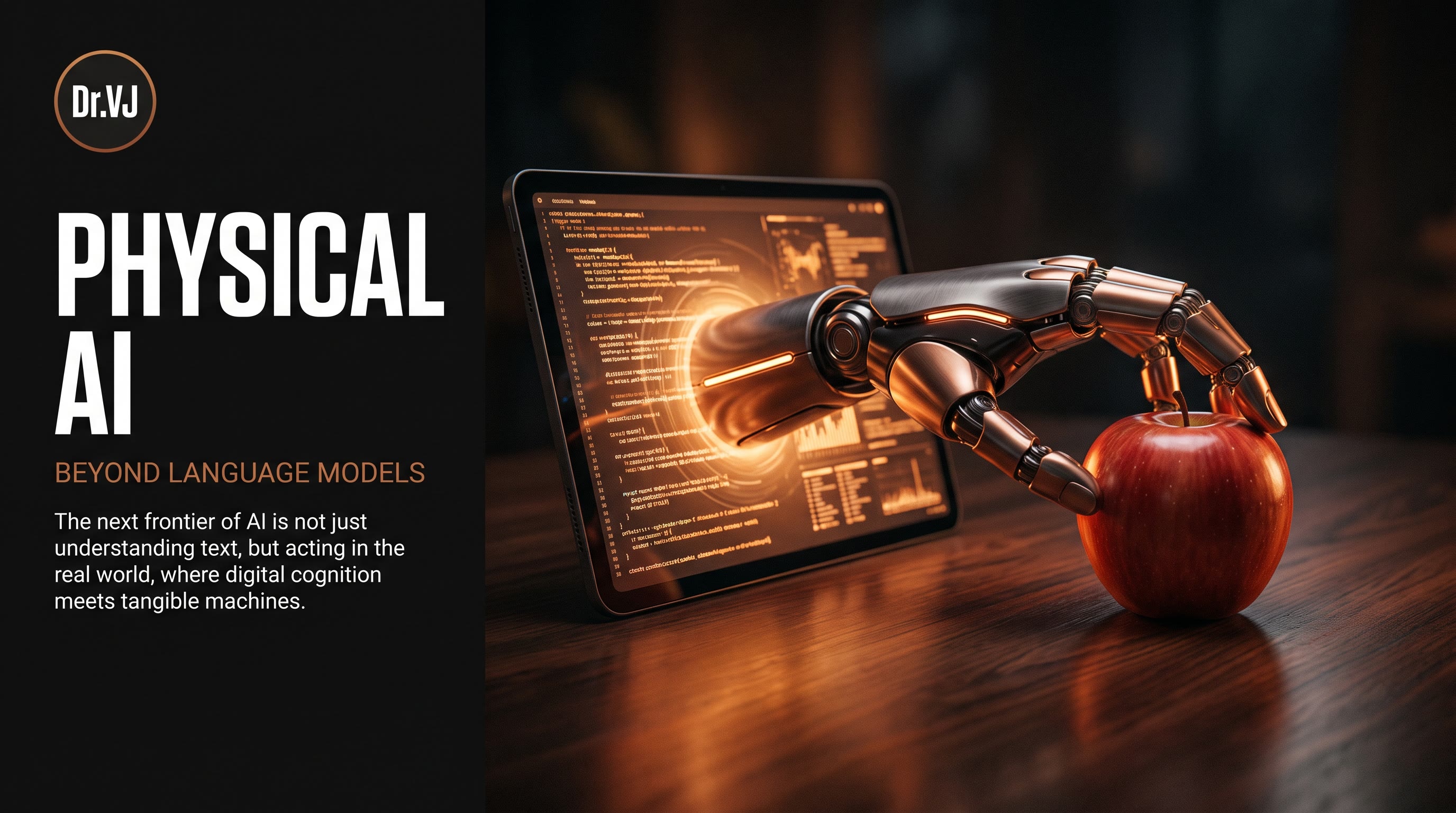
Physical AI — AI systems that perceive, reason about, and act in the physical world — has been surfacing in governance conversations without getting the same product-stage attention that language models received. That gap between governance discussion and product development is a mistake, because Physical AI is where the next major AI value creation will happen.
What Physical AI Actually Means
The term covers a range of systems: robots that navigate physical spaces, AI models that process sensory data from cameras and sensors in real time, autonomous systems that manipulate objects, and simulation environments that train physical world models before deployment.
What distinguishes Physical AI from standard AI is the consequence structure. A language model that makes a mistake produces text — annoying, potentially harmful, but contained. A robot that makes a mistake can cause physical harm. This asymmetry is why governance frameworks for Physical AI are harder to design and why the technical requirements are different from pure language reasoning.
Why It's Harder Than Language Model Development
The data problem alone is enormous. Language models trained on internet text leverage effectively unlimited data at relatively low marginal cost. Physical AI systems need data from real-world sensor streams, robot deployments, and physical interactions — all of which are expensive to collect, limited in diversity, and carry real-world risk during collection.
The evaluation problem is equally hard. You can evaluate a language model by having it reason about text. Evaluating a robot requires defining what "good" physical performance means across the diversity of real-world scenarios it will encounter. Edge cases in physical environments are harder to anticipate and more dangerous when they occur.
The simulation shortcut — training in simulation and deploying to the real world — has been the standard approach, but the sim-to-real gap (the difference between simulated performance and real-world performance) remains a stubborn research problem. Systems that perform well in simulation often fail in ways that are expensive to debug in real deployments.
The Commercial Landscape
Despite the technical difficulty, the commercial interest is real. Manufacturing automation, warehouse logistics, surgery, inspection, and exploration are all domains where AI that can physically interact with the world would create enormous value.
The NVIDIA Jetson ecosystem, Google's physical AI research, and a range of robotics startups are all pointed at this space. The investment thesis is that the combination of better sensors, cheaper compute, improved simulation environments, and better physical world models is closing the practical gap sufficiently that commercial deployments are becoming viable in controlled environments.
The key qualifier: "controlled environments." Physical AI deployment in unstructured environments — the real world as humans experience it — remains hard. The factory floor, the warehouse, the structured logistics environment: these are where Physical AI is landing first, because they're the environments where the edge cases can be managed.
Why It Matters for AI Practitioners
For practitioners watching AI development, Physical AI is where the next set of fundamental unsolved problems lives. The techniques that worked for language — scaling, reinforcement learning from human feedback, chain-of-thought prompting — don't directly transfer to physical world agency.
The research questions are different: how do you do RLHF for a robot? How do you evaluate whether a physical AI system is safe to deploy? How do you handle the distribution shift between simulated training and real-world deployment? How do you reason about the long-tail of physical edge cases?
These are hard problems. They're also the problems that will define the next phase of AI development once the language model space stabilizes around a set of clear winners.
Physical AI is the frontier that isn't getting the attention it deserves — yet.