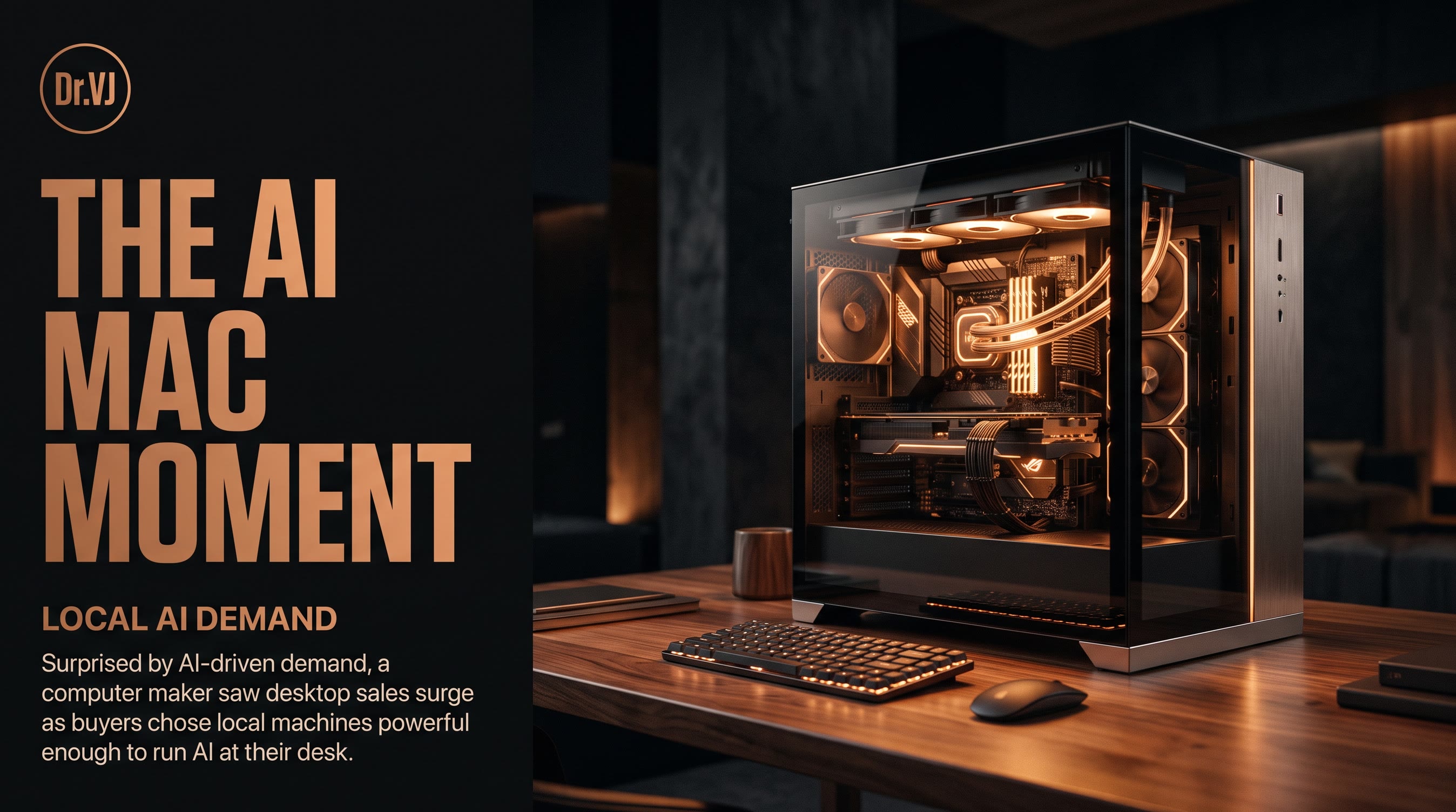
Apple reported $8.4 billion in Mac revenue this quarter — up 6% year-over-year, beating expectations that had predicted flat sales. Tim Cook's explanation was direct: customers recognized Macs as "amazing platforms for AI and agentic tools" faster than Apple anticipated. The company is now facing supply constraints across multiple Mac models, with Cook saying it may take "several months" to balance supply and demand.
This is a meaningful shift. For the past several years, the PC market has been defined by incremental upgrades and commodity competition. Now, AI workloads are creating a new demand axis — and Apple is at the center of it.
What Drove the Surge
Three forces combined to create the unexpected Mac demand spike:
Local AI model running: The primary driver is customers using Macs to run AI models locally — particularly the OpenClaw ecosystem and similar tools. MacBooks and Mac minis with sufficient RAM and Apple Silicon's unified memory architecture make them well-suited for running large language models locally. Unlike cloud-based AI, local running offers privacy, lower per-query cost, and no rate limiting.
Enterprise adoption: Companies like Perplexity chose Mac for building AI assistants. The enterprise market is discovering that Apple hardware, combined with local AI capabilities, offers a different value proposition than traditional cloud-first AI tools — especially for companies with data sensitivity concerns.
AI agentic tool recognition: Both consumers and enterprises are recognizing that Macs are effective platforms for AI agent workflows. The combination of Apple Silicon performance, macOS's Unix foundation, and the ability to run local models creates a capable environment for AI development and deployment.
The Products Driving Demand
The strongest demand came from MacBook Neo, Mac mini, and Mac Studio — Apple Silicon machines with the memory bandwidth and GPU cores necessary for serious AI workloads. Mac mini became China's top-selling desktop during the OpenClaw AI frenzy. Kansas City Public Schools dropped Chromebooks for MacBook Neo, specifically citing AI workload capabilities.
The pattern is consistent: buyers are making purchasing decisions based on AI capability, not just traditional metrics like processor speed or screen size.
Why This Is a Signal, Not a Blip
The traditional PC market has been relatively stable for years — replacement cycles, commodity pricing, incremental improvements. AI-driven demand changes that calculus in two ways:
New evaluation criteria: When AI workloads become a primary use case, the evaluation criteria for hardware change. Unified memory bandwidth matters. Neural Engine performance matters. The ability to run local models efficiently becomes a purchasing factor alongside traditional specs.
Supply chains adjust: When demand shifts to AI-focused purchases, supply chains need to reorient. Apple hasn't been alone in underestimating AI-driven PC demand — the entire industry is recalibrating.
The revenue number ($8.4B) is significant not because of the growth rate, but because it confirms that AI capability is now a primary driver of Mac purchasing decisions in a way it wasn't 12 months ago. Customers are buying Macs specifically to run AI workloads, and they're willing to pay for the hardware to do it.
What This Means for AI Builders
If you're building AI applications and considering hardware strategies, the Apple Silicon Mac surge has practical implications:
Local AI is viable: The infrastructure for running capable AI models locally on Mac hardware is mature enough for real development and production use cases. OpenClaw and similar tools have crossed the threshold from experimental to practical.
Privacy-preserving AI has market: The demand for local AI models reflects a real market need — organizations and individuals who want AI capabilities without cloud data handling. If your use case fits this profile, the infrastructure ecosystem is ready.
Apple Silicon as AI dev platform: For AI development work — prototyping, fine-tuning, evaluation — Apple Silicon Macs offer a capable alternative to cloud compute. The combination of CPU, GPU, and unified memory on a single chip makes them particularly effective for certain AI development tasks.
The AI Mac moment is real. It's driven by a combination of hardware capability, local AI tooling maturity, and buyers increasingly evaluating devices through an AI capability lens. Whether you're buying hardware for AI work or building AI products, the Mac's unexpected resurgence is a data point worth incorporating into your planning.
Related posts: Agentic RAG — extending retrieval to agentic systems. Real-Time Inference for AI Agents — the latency and infrastructure challenges for production AI. Apple iOS 27 AI Models — Apple's shift from proprietary AI to model-agnostic platform.