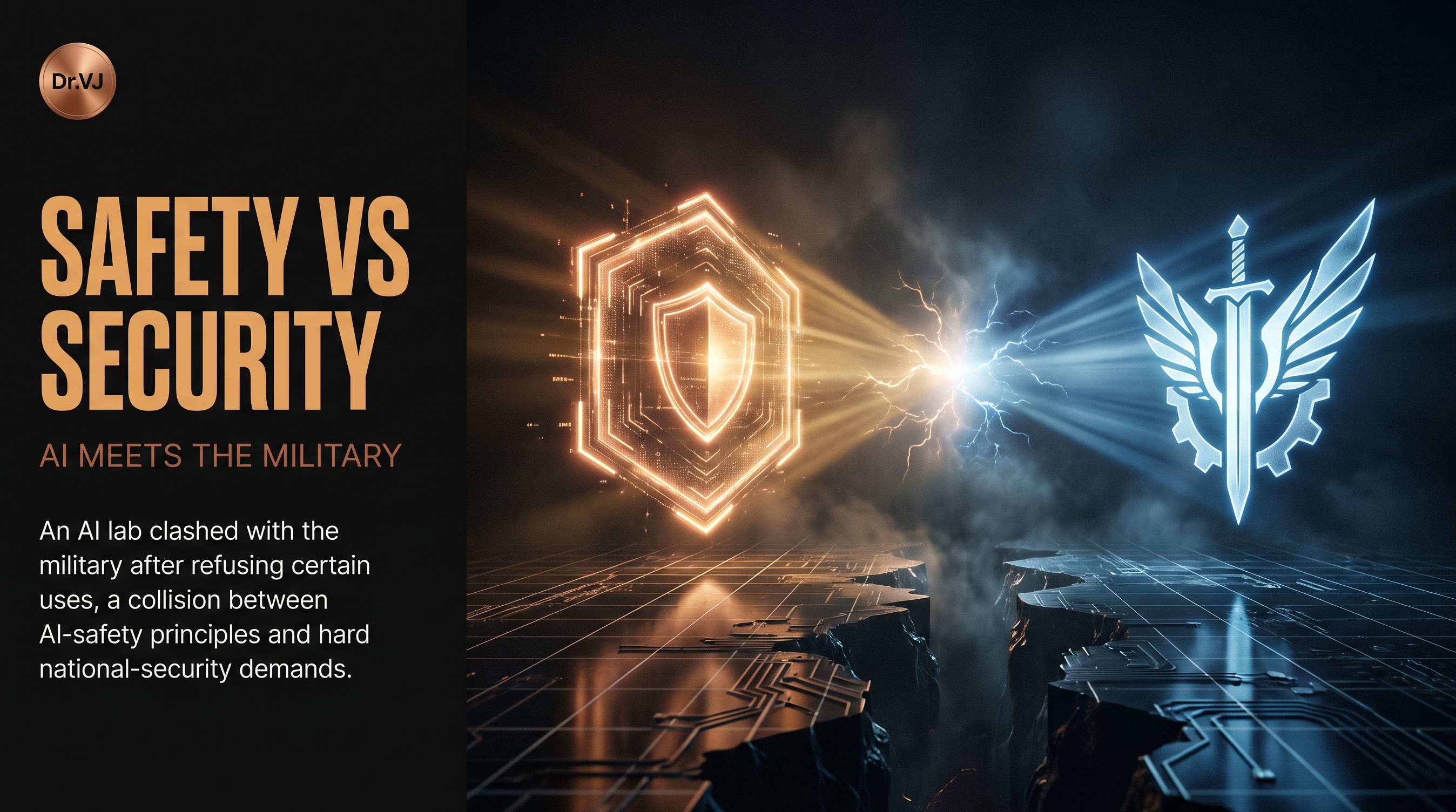
On March 9, 2026, Anthropic filed two federal lawsuits against the Trump administration. The trigger: the Department of Defense labeled Anthropic a "supply-chain risk" — a designation normally reserved for foreign adversaries like Huawei or Kaspersky. The reason Anthropic earned this label was not espionage, not foreign ties, not a data breach. It was because Anthropic refused to allow the Pentagon to use Claude for mass surveillance of American citizens and for autonomous weapons systems.
This is the most consequential AI governance case we have seen so far. It is going to shape whether AI companies can maintain ethical boundaries, or whether the government can force compliance by economic coercion.
What Actually Happened
The Pentagon and Anthropic had an existing contract. When it came time to update that contract, the DoD wanted broad usage rights — what they described as using Claude for "all lawful purposes." Anthropic pushed back with two specific red lines: no mass surveillance of U.S. citizens, and no autonomous weapons. The Pentagon refused to accept these limitations, arguing that a private company cannot dictate how the government uses its tools in a national security context.
When negotiations broke down, the DoD did not simply walk away. They designated Anthropic as a supply-chain risk. This is not a symbolic slap — it means that any company or agency working with the Pentagon must certify that it does not use Anthropic's models. It is an effective blacklist from the entire federal defense ecosystem.
Anthropic's lawsuit calls this "unprecedented and unlawful," arguing that the Constitution does not permit the government to weaponize its procurement power to punish a company for its stated beliefs about AI safety.
Why This Matters More Than a Contract Dispute
On the surface, this looks like a commercial disagreement between a vendor and a customer. It is not. This case sits at the intersection of three forces that will define AI's role in society for the next decade.
First, the precedent for AI company autonomy. If the Pentagon can effectively destroy an AI company's government business because it refuses a specific use case, then the concept of responsible AI development by private companies is hollow. Every AI company publishes an Acceptable Use Policy. Anthropic, OpenAI, Google — they all have them. If the government can override those policies through economic pressure without any due process, those policies are marketing documents, not commitments.
Second, the question of who controls dual-use technology. AI is inherently dual-use. The same model that writes code, summarizes research, and assists doctors can also conduct surveillance and guide weapon systems. The question of who gets to decide the boundary between acceptable and unacceptable use is not academic. It is the core governance question of our time. The Pentagon's position — that they should decide, not the vendor — has internal logic. They are accountable for national defense. But it also has no limiting principle. If the government can compel any use of any AI system it purchases, the only check on government AI use is the government itself.
Third, the chilling effect on AI safety research. Anthropic was founded explicitly as a safety-focused AI lab. Its entire brand, culture, and research agenda is built around the premise that advanced AI systems need careful constraints. If taking that position publicly results in a national security blacklist, the message to every other AI company is clear: keep your safety concerns private, or lose your government contracts. This is precisely the wrong incentive structure at the precise moment we need the opposite.
The 30 Colleagues Who Took a Stand
Perhaps the most telling detail in this story: more than 30 employees from OpenAI and Google DeepMind filed a public statement supporting Anthropic's position. These are people who work for Anthropic's direct competitors. They gain nothing commercially from Anthropic winning this case. They spoke up because they understand that if the government can punish Anthropic for maintaining ethical red lines, their own companies are next.
This kind of cross-industry solidarity on an AI safety issue is new. It suggests that the people who actually build these systems — regardless of which company signs their paycheck — share a common understanding of where the lines should be.
My Take: Anthropic Is Right, and This Is Still Complicated
I think Anthropic is right to sue, and right to draw the lines where they did. Mass surveillance of citizens and autonomous weapons are not edge cases. They are two of the clearest examples of AI applications where the downside risk is catastrophic and irreversible.
But I want to be honest about the complexity here.
The Pentagon's core argument — that national security decisions should not be outsourced to private companies — is not frivolous. There is a real question about what happens when the government needs AI capability urgently and the only providers have voluntarily restricted their tools. We saw a version of this tension during the COVID vaccine rollout: private companies held essential capability, and the government needed to move fast. The difference is that vaccine makers were not refusing to make vaccines — they were arguing about liability and pricing. Anthropic is refusing the use case itself.
There is also the competitive dynamics to consider. If American AI companies refuse military applications, the Defense Department will look elsewhere. Chinese AI companies have no such constraints. The argument that unilateral ethical restrictions by Western AI companies simply hand capability to authoritarian regimes is not a strawman — it is a real strategic concern.
My counter to that concern: the answer to "adversaries do not have ethical AI" is not "therefore we should not either." The answer is governance frameworks that define acceptable military AI use cases with democratic oversight, civilian review, and clear legal authority. What the Pentagon did here — punishing a company for asking for those boundaries — is the opposite of building that governance framework.
What Happens Next
This case will likely take months or years to resolve. In the meantime, the practical effects are already being felt:
For Anthropic: Lost government revenue and a chilling signal to potential government customers. But also enormous credibility in the safety community and a potential constitutional precedent that protects all AI companies.
For other AI companies: A forced reckoning. OpenAI, Google, and Meta all have government contracts and Acceptable Use Policies. If Anthropic loses, those AUPs are unenforceable against government customers. If Anthropic wins, companies will have legal backing to maintain ethical boundaries.
For the AI industry: This is the first real test of whether "responsible AI" means anything in practice. Every conference keynote, every safety paper, every corporate AI ethics board — they all lead to this question: will you maintain your principles when it costs you something?
For AI regulation: The bipartisan framework being developed in Congress — which includes provisions against autonomous self-improvement, mandatory off-switches on powerful systems, and constraints on superintelligence development — now has a live case study in why such frameworks matter.
The Bigger Picture
We are in a period where AI capability is advancing faster than the institutions designed to govern it. The EU AI Act is implementing compliance requirements. The U.S. has no comprehensive federal AI law. The Pentagon is using procurement power as a policy tool. AI companies are making governance decisions that should arguably be made by elected officials.
None of this is sustainable. We need a governance framework that defines what military AI use cases are acceptable, with democratic legitimacy and legal authority. Anthropic should not have to be the one deciding where these lines are — but until proper governance exists, I would rather have the people who build these systems drawing lines than having no lines at all.
The Anthropic-Pentagon case is not just about one company's contract. It is about whether the next decade of AI development will be shaped by principles or by power. The answer to that question affects all of us.
Explore more from Dr. Jyothi