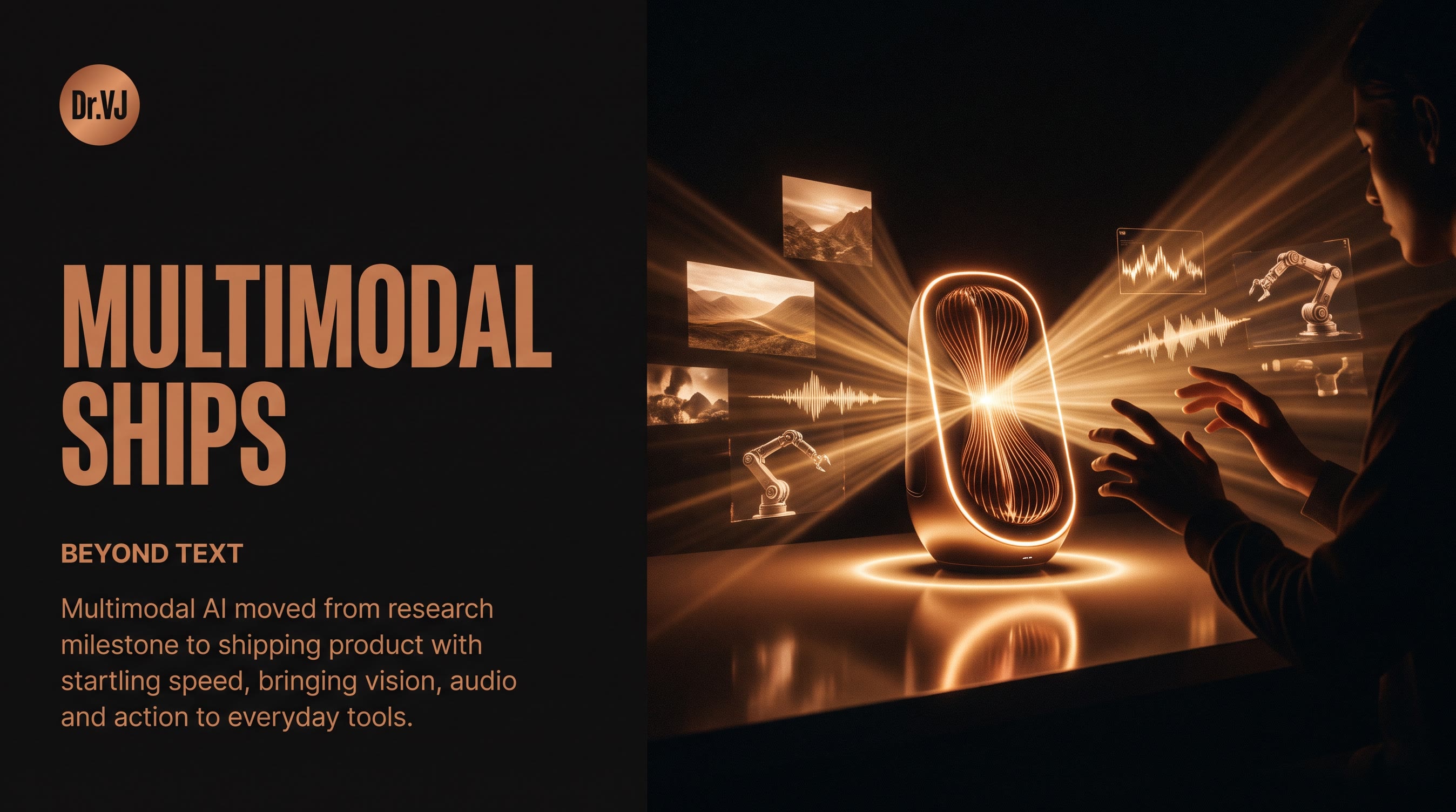
The word "multimodal" has appeared in AI research papers for decades — the idea that AI systems should process multiple types of input (text, images, audio, video) is not new. What is new is the quality, the integration, and the commercial availability of systems that do this well enough to build real products on. The release of GPT-4V (GPT-4 with Vision) in late 2023, followed by GPT-4o's native multimodality in 2024, Google's Gemini series with genuine long-context video understanding, and Anthropic's Claude Vision capabilities have crossed a threshold that matters practically, not just technically.
The threshold is roughly this: multimodal AI is now good enough that product designers should consider what a product looks like with multimodal input as the default, not as a special case.
What Multimodal AI Actually Does
Let me be concrete about capabilities before discussing applications, because vague claims about "understanding" images or audio are common and often misleading.
Image understanding at the current frontier includes: detailed description of image content, answering specific questions about image contents, extracting text from images (OCR quality has improved substantially), analyzing charts and graphs to extract data and draw conclusions, comparing multiple images, identifying objects and their spatial relationships, and — importantly — understanding images in context with text queries. The limitation is that current vision models struggle with precise spatial reasoning (exactly how many pixels from the left edge?), fine-grained detail in complex images, and counting accurately in dense scenes.
Document understanding — processing images of documents, PDFs, forms, tables, and technical diagrams — has seen particular commercial traction. Models that can ingest an invoice image and extract structured data, process a hand-written form, or interpret a technical schematic are enabling automation of document-heavy workflows that previously required either expensive custom OCR pipelines or human review.
Audio capabilities have developed along two tracks. Speech-to-text has been excellent for several years (Whisper from OpenAI, Google's speech APIs, and similar models), but the new frontier is end-to-end audio understanding where the model processes audio directly without a speech-to-text intermediary. GPT-4o's native audio mode, where the model generates audio responses without converting to text internally, enables more natural conversational AI with better prosody, emotional tone, and real-time interaction. The emotional and paralinguistic information in speech (tone, hesitation, emphasis) is preserved rather than discarded in transcription.
Video understanding is the frontier that has advanced most dramatically and where the commercial implications are perhaps the most significant. Gemini 1.5 Pro's ability to process hour-long videos in context — not as a collection of extracted frames, but with temporal understanding of what's happening across time — is a genuinely new capability. The ability to ask "what happened in the meeting recording between the 23-minute and 35-minute mark?" and get a coherent answer is new. So is the ability to analyze surveillance footage, sports footage, or manufacturing quality control video with natural language queries.
Real Applications That Are Shipping
Visual inspection and quality control in manufacturing. Computer vision for quality control is not new, but the flexibility of current multimodal models is. Traditional computer vision QC systems require extensive training on domain-specific defect images and careful feature engineering — they're brittle to new defect types or changed production conditions. Modern foundation vision models can be prompted with natural language descriptions of what to look for ("flag any soldering joint that appears incomplete or shows bridging") and adapt to new inspection criteria without retraining. Companies like Landing AI, Instrumental, and Sight Machine have built inspection platforms on this foundation.
Medical imaging assistance. As described in my healthcare post, AI-assisted radiology and pathology are mature. Multimodality is extending this: the ability to present a chest X-ray along with the patient's clinical history and ask "given this history, what findings in this image are most relevant to monitor?" is a more natural interface than separate image analysis and separate text summarization. Microsoft's partnership with Nuance and Radiology Partners is moving toward this integrated multimodal clinical interface.
Document intelligence. The market for intelligent document processing has exploded. Tax returns, insurance claims, legal contracts, financial statements, architectural drawings — every industry has high-value documents that have historically required significant human labor to process. Multimodal models that can read these documents, understand their structure, extract key information, flag anomalies, and produce structured outputs are driving significant automation. Hyperscience, Instabase, and dozens of vertical-specific players are building here.
Retail and e-commerce. Visual search — finding products similar to something in a photograph — has been a computer vision use case for years, but the quality has improved dramatically. Google Lens is the most used visual search product at scale. For e-commerce, multimodal AI enables: generating product descriptions from product photographs, processing product returns by analyzing images of returned items, virtual try-on through person + clothing image composition, and customer support that can process images of product issues ("here's a photo of my damaged item").
Real estate. Property photos, floor plans, and listing descriptions are natural multimodal inputs for real estate applications. Models that can analyze property photos for condition, compare floor plans to stated square footage, or generate compelling listing descriptions from a property photo set are delivering real efficiency gains for agents and platforms.
Accessibility. Perhaps the most clearly beneficial multimodal application is AI-powered accessibility tooling. Real-time scene description for people with visual impairments (Microsoft's Seeing AI, Be My Eyes's AI features powered by GPT-4V), real-time captioning and sign language recognition, and document accessibility conversion are all making real difference for real people.
The Video Opportunity
Video understanding deserves special attention because it represents the largest frontier with the most commercial upside still largely unaccessed.
The volume of video content that enterprises generate and never fully use is staggering: hours of customer calls, sales meetings, training sessions, product demos, security footage, manufacturing recordings. The ability to make this content searchable, summarizable, and analyzable with natural language queries is genuinely valuable and still early in deployment.
Specific applications that are shipping or close to it: call center recording analysis (identifying compliance issues, coaching opportunities, common customer problems — this is mature), earnings call and analyst day video processing, training video library search and summarization, product demo analysis for sales coaching, and security footage triage.
The technical challenges that remain in video: temporal consistency (keeping track of who is who as people move, appear, and disappear), understanding cause-and-effect relationships across long time spans, and real-time processing (most current video understanding is post-hoc rather than live stream). These are active research areas with rapid progress.
The Real-Time Voice Interface Shift
Separately from video, the real-time audio/voice capability deserves its own discussion because it is changing the interaction model for AI assistants in ways that matter for product design.
The conventional voice assistant model — speech is transcribed, fed to a text model, response generated, converted to speech via TTS — introduces latency, loses prosodic information, and produces stilted responses that don't adapt their cadence and tone to the conversation. GPT-4o's real-time voice mode, Anthropic's work on audio, and competitive products are moving toward native voice-to-voice models that process and generate audio directly.
The user experience difference is significant: faster responses, more natural conversational turn-taking, ability to interrupt and be understood, and responses that naturally vary their tone. For applications in customer service, sales, healthcare communication, and personal AI assistance, this is a significant quality improvement.
The privacy and trust considerations are also significant: always-on voice AI requires careful consent design, data handling practices, and clear user mental models about what is and isn't being recorded and processed. Products that get this right will have a significant trust advantage.
The Missing Pieces
Unified multimodal generation — creating images, audio, and video from text, or editing them — has also advanced rapidly. DALL-E 3, Midjourney v6, Stable Diffusion 3, and specialized models for audio generation (Suno AI, Udio for music; ElevenLabs for voice cloning) and video generation (Sora, Runway Gen-3, Pika) represent a parallel track of multimodal progress. I've deliberately focused this post on understanding rather than generation, but the generation side is equally consequential for creative industries, marketing, and synthetic media concerns.
Grounding and accuracy remain challenges for vision. Models confidently describe things that aren't there (hallucination in the visual domain is a real problem), miss important details, and struggle with precise spatial and numerical reasoning in images. For high-stakes applications, this requires human verification — which is fine for augmentation but limits full automation.
Cross-modal reasoning — drawing genuinely integrated conclusions from text, image, and audio jointly — is still imperfect. Models that process multiple modalities sometimes reason about each separately and concatenate conclusions, rather than deeply integrating information across modalities.
The Practical Upshot for Product Builders
If you're designing AI-powered products in 2026, multimodality should be in your product architecture from the start, not added as an afterthought. The interaction patterns that multimodal inputs enable — show me this thing, explain what's wrong with this image, turn this recording into a summary — are more natural for many real-world workflows than purely text-based interfaces.
The applications with the clearest near-term payoff are those where multimodal input reduces the burden on users to describe things in text: document processing, visual quality control, meeting and call analysis, and customer support where photos of issues can replace lengthy descriptions. Start there, measure the value, and then expand the multimodal scope as capabilities and user comfort grow.
The multimodal era of AI is not approaching — it's here. The question is whether your product design reflects that reality.
Explore more from Dr. Jyothi