Marc Lore just described what the AI-powered restaurant of the future looks like:
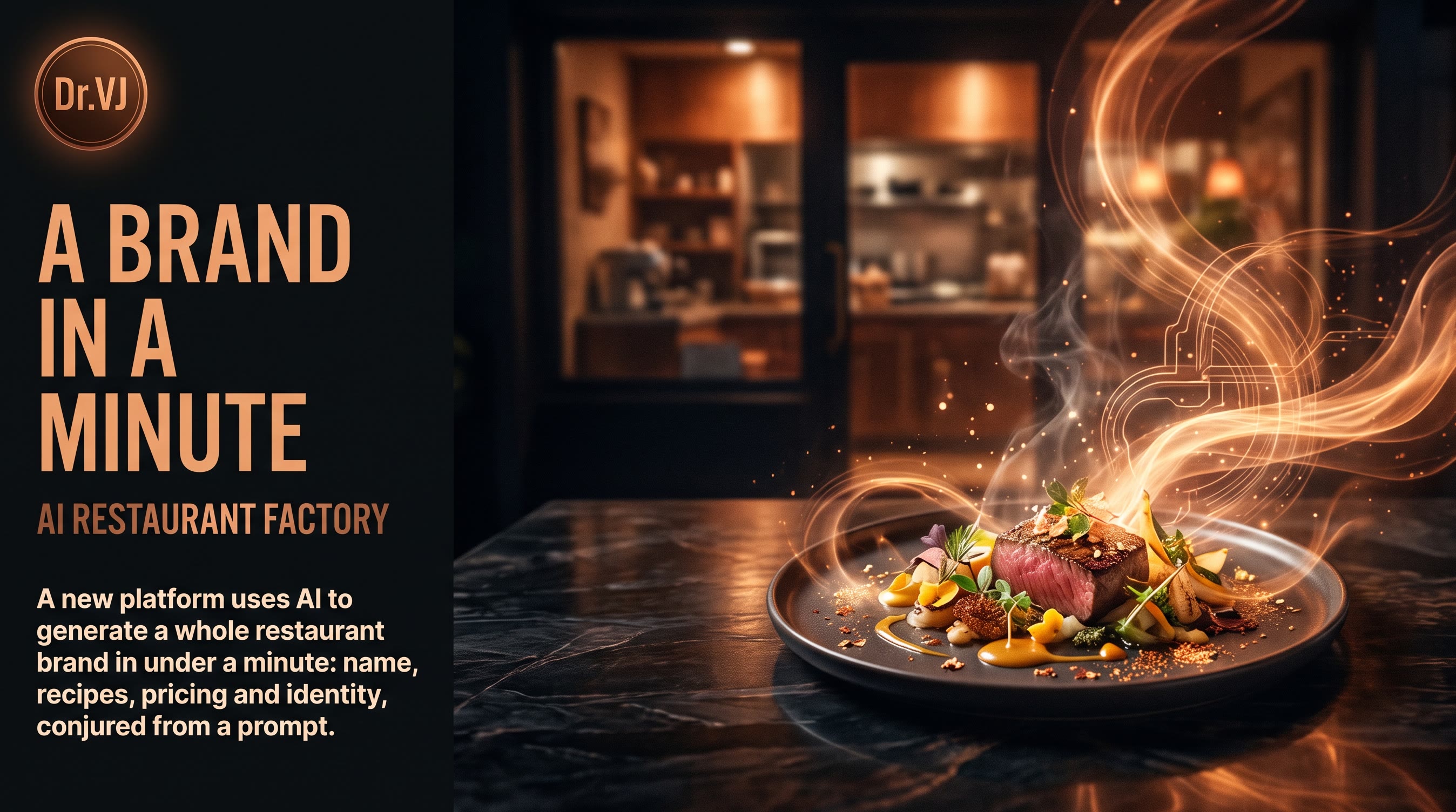
"You type in what kind of restaurant you want to build. It builds the restaurant — AI does — in under a minute."
The restaurant brand, the name, the recipes, the pricing, the health information — all generated by AI from a text prompt. Then robotic kitchens execute the cooking. One kitchen, multiple brands, zero wait staff.
This isn't a vision. Wonder has already served 7 million meals with 12 staff.
What Wonder's AI Actually Does
Wonder Create is an AI platform that generates complete restaurant concepts from text prompts. The AI handles:
- Naming and branding: Generate a restaurant identity that fits a specific cuisine, price point, or concept
- Recipe development: Create complete menus with recipes optimized for the platform's cooking capabilities
- Pricing and health information: Generate nutrition data and pricing that aligns with the brand positioning
- Operational setup: The AI configures the robotic kitchen to execute the specific menu
The kitchen infrastructure is what makes this scalable: Wonder's "programmable cooking platforms" use robotic arms, conveyors, and automated systems (including Spice Robotics' automated bowl-making systems) to execute multiple restaurant concepts from the same physical kitchen. A 700-ingredient library supports diverse menus, with plans for an "infinite sauce machine" covering 80% of online recipes.
The Economics of AI Restaurant Creation
The traditional restaurant model requires significant capital and expertise to launch: hiring chefs, developing recipes, building a brand, training staff. Wonder's model eliminates most of that overhead.
The AI doesn't replace the chef's craft — it commoditizes the mechanics of restaurant creation. Developing a recipe is no longer a creative act requiring culinary expertise; it's a generation task that AI can do in seconds. The differentiation shifts from "can you create recipes" to "can you create recipes that taste good and execute reliably on robotic hardware."
This is the same pattern we see in AI-generated code, design, and content: the barrier to entry collapses, and the competition shifts to the layers above the AI generation — the hardware that executes, the brand that attracts customers, the distribution that delivers.
Why This Matters for AI Builders
Wonder Create illustrates a broader pattern that's relevant beyond restaurants:
AI-generated complete products: Wonder doesn't just generate a recipe — it generates an entire restaurant concept. The AI is moving from generating individual artifacts (a recipe, a logo, a tagline) to generating complete products (a brand, a menu, an operational setup). This is the direction AI generation is heading: not just assist with creation, but generate the complete output.
Hardware + AI integration: The robotic kitchen is essential to Wonder's model. Without the programmable cooking platform, the AI-generated recipes have nowhere to execute. The AI and the hardware are deeply integrated — you can't separate them. For AI builders, this is a lesson: AI products that require hardware co-design have higher barriers but also stronger defensibility.
Platform economics: Wonder's model leverages existing infrastructure — the Grubhub delivery network, Blue Apron meal kit operations, acquired brands like Blue Ribbon Fried Chicken. The AI generation layer sits on top of this distribution and operations infrastructure. Platform economics amplify the AI advantage.
The 2035 Vision
Lore's 2035 vision is specific: "1,000 unique restaurants operating out of 2,500 square feet." That's not a restaurant chain — it's a restaurant platform. One physical location hosting 1,000 distinct AI-generated restaurant brands, each with its own identity, menu, and customer base.
The competitive implication is significant: traditional restaurant chains compete on brand, recipes, and locations. Wonder competes on AI generation speed and hardware efficiency. If Wonder can generate and operate new restaurant concepts faster than competitors can develop recipes, the competitive moat shifts from culinary expertise to AI infrastructure.
The restaurant industry — worth hundreds of billions globally — is being reconfigured around AI generation capabilities. Wonder Create is an early example of what that looks like in practice.
Related posts: AI Agent Infrastructure Readiness — the $1.7T gap between models and production. PayPal's $1.5B AI Transformation — enterprise AI adoption hitting concrete cost-savings targets. Jensen Huang AI Jobs — AI creating jobs vs. displacing them in the new economy.