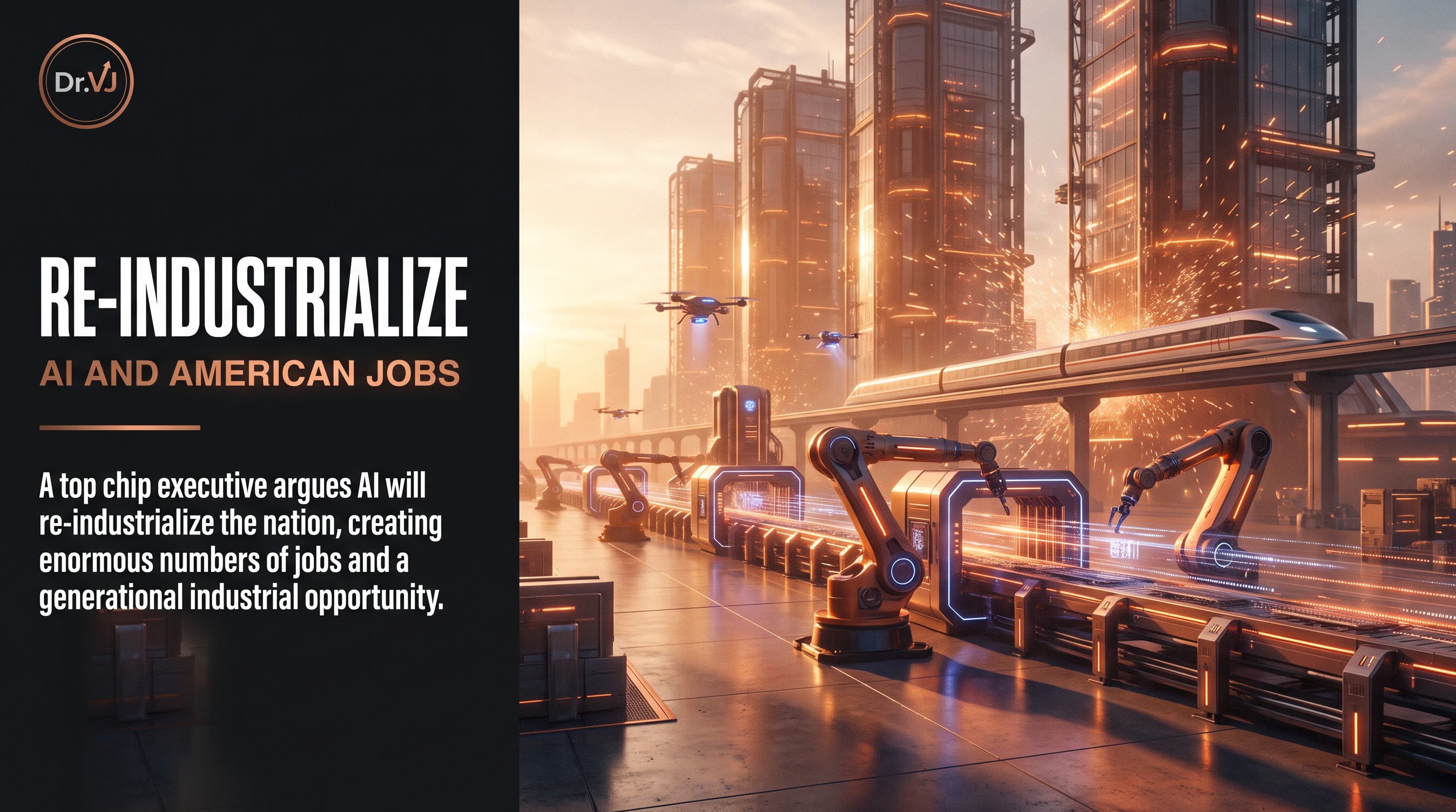
Nvidia CEO Jensen Huang has a counter-intuitive argument in the AI employment debate: AI isn't taking jobs — it's creating them. And more than that, it's America's best chance to rebuild its industrial base.
Speaking at the Milken Institute, Huang made the case that AI is "creating an enormous number of jobs" and called it "the United States' best opportunity to re-industrialize." Coming from the CEO of the company whose chips power virtually every AI system in development, this is a perspective worth taking seriously — and interrogating carefully.
What Huang Is Actually Arguing
The argument has several layers:
New industrial infrastructure: AI hardware manufacturing — the factories that produce GPUs, the data centers that house them, the infrastructure that powers AI inference at scale — is creating a new category of industrial employment. These aren't software jobs; they're manufacturing, construction, electrical engineering, and facilities management jobs that don't require AI expertise but are enabled by it.
Task vs. job distinction: Huang's key insight is that people "misunderstand that the purpose of a job and the task of a job are related." Automating a specific task within a job doesn't eliminate the job — it changes which tasks humans focus on. A radiologist who previously spent 40% of their time on image acquisition and 60% on interpretation might, with AI handling interpretation, spend more time on patient care and complex cases. The job's purpose — helping patients — remains. The tasks change.
Re-industrialization: This is the boldest claim. Huang argues that AI-enabled automation makes it economically viable to manufacture more goods domestically again. If AI reduces labor costs and increases productivity in manufacturing, the economic logic that sent manufacturing overseas weakens. America could rebuild its industrial base with fewer workers but more productive ones.
The Counterpoint: What the Data Says
Huang's optimism runs against some uncomfortable data:
Organizations tracking AI's economic impact estimate that as much as 15% of US jobs could be eliminated over the next several years due to AI. That's not task-level automation — that's role-level displacement.
The counterpoint isn't just about the number of jobs, though. It's about the distribution:
- Jobs displaced by AI tend to be middle-skill, routine cognitive work — legal document review, basic coding, data analysis, customer service
- Jobs created by AI tend to be either high-skill (AI engineers, prompt engineers, AI ethicists) or low-skill (AI training data labeling, AI content moderation)
- The middle disappears
This is the "hollowing out" problem that economists have documented in previous automation waves. The new jobs and the destroyed jobs don't land on the same workers.
What Huang Gets Right
Huang is right that AI creates real economic value that translates to real jobs — just not the ones that are being displaced. The data center construction boom alone represents billions in investment and thousands of jobs that didn't exist five years ago. Nvidia's own workforce has grown significantly.
He's also right that the task-vs.-job distinction is important. Most jobs contain tasks that are automatable alongside tasks that require human judgment, creativity, or empathy. AI that's embedded in workflows doesn't replace jobs — it changes what people spend their time on.
The re-industrialization argument is more speculative but not implausible. If AI-driven productivity gains make domestic manufacturing cost-competitive with overseas labor, the economic calculus that outsourced production changes. Whether this happens at scale is an open empirical question.
What Huang Gets Wrong or Understates
Huang's argument treats the transition as net-positive because total jobs created equals or exceeds total jobs destroyed. But the workers affected aren't the same people.
A radiologist who's retrained as an AI systems manager is, in aggregate, better off. But that individual spent years developing radiology expertise that's suddenly less valuable. The transition has real costs — retraining time, income loss during transition, geographic constraints, age-related retraining barriers — that don't show up in aggregate employment statistics.
The "15% of jobs eliminated" estimate is also the middle scenario. In a faster AI capability progression, that number could be higher.
What This Means for AI Builders
If you're building AI products, Huang's framing has practical implications:
AI as productivity multiplier, not replacement: Products that help workers do more — not products that eliminate workers — are more defensible and more likely to achieve adoption. The "AI creates jobs" narrative is politically and socially sustainable; the "AI replaces jobs" narrative generates regulatory friction.
The transition infrastructure opportunity: Retraining, career transition services, and AI literacy education are genuine market opportunities. As AI displaces certain roles, the infrastructure to help workers transition becomes valuable.
Enterprise adoption acceleration: When CEOs cite Jensen Huang's argument for why AI adoption is positive rather than negative, it accelerates enterprise investment. The narrative shapes the regulatory environment, which shapes how fast you can deploy.
Huang's argument isn't a prediction — it's a choice. America can build AI infrastructure that creates new industrial jobs, or it can cede that infrastructure to other countries. The technology isn't neutral; the deployment decisions are.
Related posts: PayPal's $1.5B AI Transformation — enterprise AI adoption hitting concrete cost-savings targets. Harvard AI ER Diagnosis — AI diagnostic accuracy and the human-AI collaboration model. GPT-5.5 Instant — OpenAI's new default model with reduced hallucination in high-stakes domains.