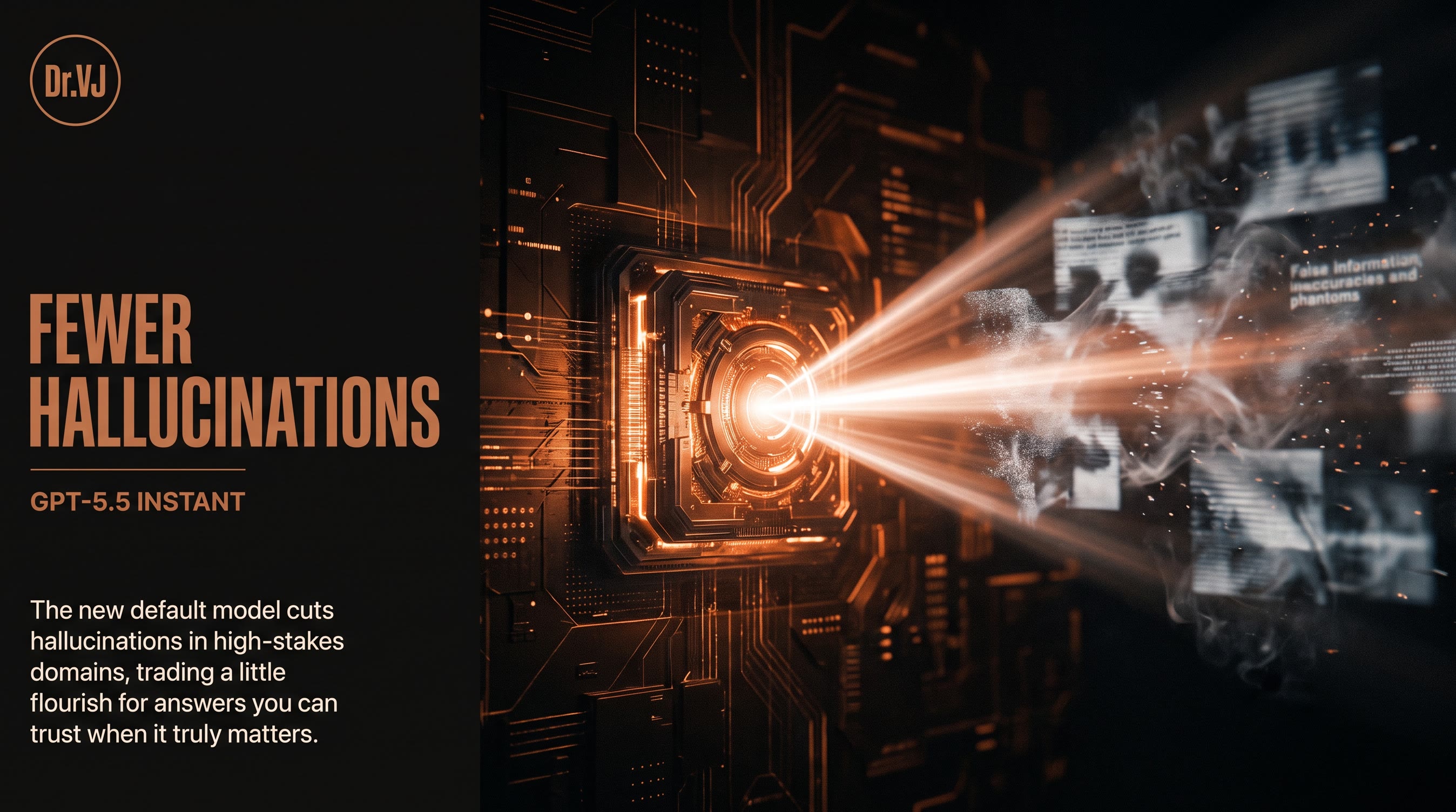
OpenAI just pushed a new default ChatGPT model to production. GPT-5.5 Instant replaces GPT-5.3 Instant as the model that hundreds of millions of users interact with by default. The headline improvement: reduced hallucinations in high-stakes domains.
But the real story is more interesting than the press release makes it sound.
What GPT-5.5 Instant Actually Improves
The benchmark numbers OpenAI is sharing tell a specific story:
AIME 2025 math test: 81.2 vs 65.4 (previous generation). AIME is a competition math test, so this is about reasoning under pressure. A 24% jump in a single generation is meaningful — but competition math is a narrow domain.
MMMU-Pro multimodal reasoning: 76 vs 69.2 (previous generation). This tests reasoning across text, images, and potentially other modalities. Again, significant improvement, but still within the benchmark-optimization framework that AI labs use.
What OpenAI is highlighting that matters more: reduced hallucination in law, medicine, and finance. These are the domains where AI errors have the highest consequences. A hallucinated legal citation can mislead a lawyer. A hallucinated medical fact can harm a patient. A hallucinated financial figure can cause a bad investment decision.
Getting hallucination rates down in these domains requires different training approaches — more retrieval-augmented generation, better grounding in authoritative sources, and explicit training on uncertainty calibration. This isn't just a model upgrade; it's a different optimization target.
The Memory and Context Management Improvements
GPT-5.5 Instant also introduces memory sources displayed across all models, with users able to edit or delete what the model remembers. This is a significant UX improvement: users can see why the model knows something about them and control it.
The context management features — access to past conversations, files, and Gmail for personalized answers — suggest OpenAI is building toward a more agent-like default experience. The model isn't just answering questions; it's maintaining state across sessions and pulling in external data sources.
This is the direction AI models are heading: not just reactive question-answering, but proactive context-building with access to user data. GPT-5.5 Instant is a step toward that world as the default, not an advanced feature.
What "Instant" Means in the Naming
The "Instant" suffix has become OpenAI's label for fast, lower-latency models optimized for interactive use. The counterpoint would be "Deep" or "Slow" models for more deliberative reasoning tasks. This naming scheme suggests OpenAI is building toward a portfolio approach: different model tiers for different use cases, with the default being the fast one.
For developers using the API, GPT-5.5 Instant is available as "chat-latest" — a signal that OpenAI is moving away from versioned API calls toward rolling defaults. This reduces the complexity of model selection but increases the importance of evaluation: if the default changes, your application's behavior changes.
Why This Matters for AI Builders
Three practical implications:
Evaluate on your actual use case, not just benchmarks: The AIME and MMMU-Pro numbers are impressive, but they measure specific reasoning tasks. If your application is about document analysis, customer support, or code generation, the hallucination reduction in law/medicine/finance is more relevant than math benchmark scores.
The default model is now better for high-stakes applications: If you were previously running separate evaluation to determine whether AI outputs were reliable enough for legal, medical, or financial use cases, GPT-5.5 Instant's improved hallucination rates may shift that calculation. Lower hallucination means lower review burden.
Memory and context management are now table stakes: Users expect AI systems to remember context across sessions. GPT-5.5 Instant normalizing this means users will increasingly expect it from every AI product. If your application doesn't have this capability, it will feel primitive.
The race to build the best default model continues. OpenAI just raised the bar — not with a benchmark fireworks display, but with the more valuable improvement: fewer hallucinations in the domains where it matters most.
Related posts: AI Agent Infrastructure Readiness — the $1.7T gap between models and production. Sierra's $950M Raise — enterprise AI agent company capturing value at the application layer. Apple iOS 27 AI Model Choice — Apple's shift from proprietary AI to model-agnostic platform strategy.