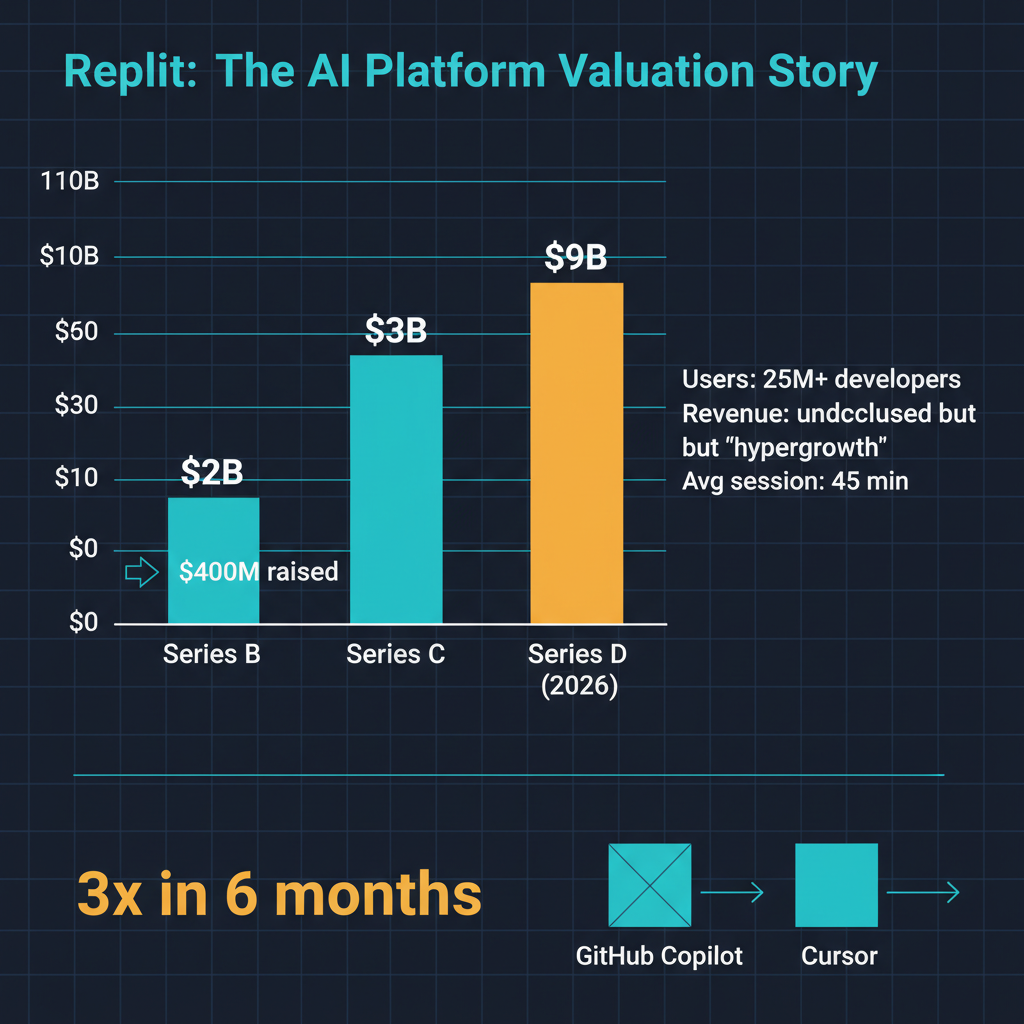
Replit has raised $400 million in a Series D round at a $9 billion valuation. Six months ago, the company was valued at $3 billion. That is a 3x increase in half a year, a trajectory that even by AI startup standards is exceptional. The investment is not just a bet on Replit as a company. It is a bet on a specific vision of the future: that the act of creating software is about to change fundamentally, and that the traditional integrated development environment is an artifact of an era that is ending.
I want to examine what Replit is actually building, why investors are willing to pay $9 billion for it, and what this means for the broader landscape of software development.
What Replit Has Become
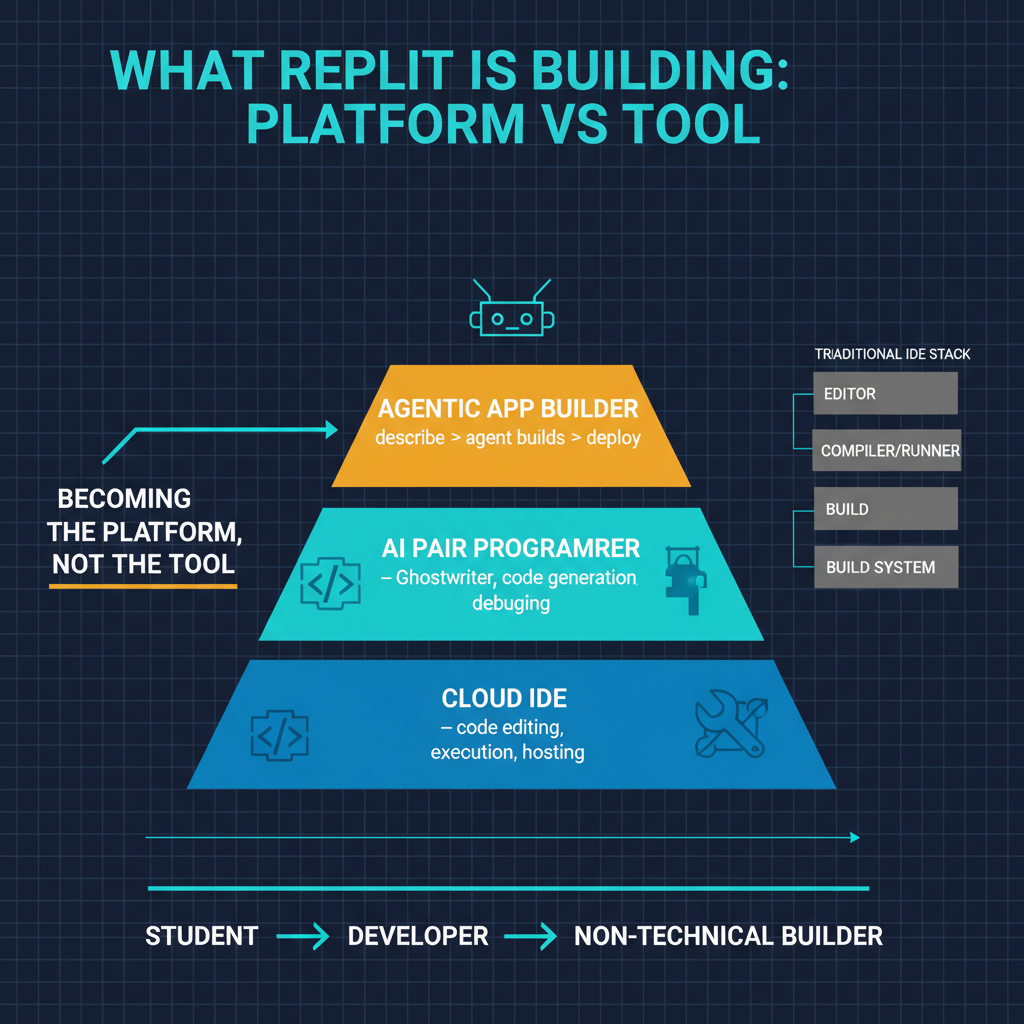
Replit started as a browser-based IDE, a convenient way to write and run code without setting up a local development environment. It was popular with students and hobbyists but was not a serious tool for professional software development. That Replit no longer exists.
The current Replit is an agentic AI software creation platform. You describe what you want to build in natural language, and Replit's AI agent creates the application, including frontend, backend, database schema, API integrations, authentication, and deployment. You interact with the agent through conversation, refining the application through iterative dialogue rather than by writing code directly.
This is not code completion. GitHub Copilot, Cursor, and similar tools augment a developer who is writing code. Replit's agent model is different in kind: it aims to make the user a product manager who specifies requirements and provides feedback, while the AI handles the implementation. The human provides the "what" and the "why." The AI handles the "how."
The distinction matters because it dramatically expands the potential user base. Traditional coding tools serve professional developers, a global population of roughly 30 million. A platform where you describe what you want and an AI builds it could potentially serve anyone who has an idea for a software application, a population that is orders of magnitude larger.
The Wave of AI Coding Tools
Replit exists within a broader wave of AI coding tools that are reshaping software development at every level.
Code completion tools like GitHub Copilot and Amazon CodeWhisperer operate at the most granular level, suggesting the next line or block of code as a developer types. These tools are the most mature and most widely adopted, with Copilot reportedly being used by millions of developers. They accelerate existing developers but do not fundamentally change who can develop software.
AI-enhanced IDEs like Cursor and Windsurf operate at a higher level of abstraction. They can understand entire codebases, implement features from natural language descriptions, and refactor code across multiple files. These tools significantly increase developer productivity, with users reporting 2-5x speed improvements on many tasks. But they still assume a user who understands software architecture, can evaluate code quality, and can debug when things go wrong.
Agentic development platforms like Replit represent the highest level of abstraction. They aim to handle the entire software development lifecycle, from specification to deployment, with the human primarily serving as a reviewer and decision-maker rather than an implementer. Bolt, Lovable, and several other startups occupy similar positions in this space.
The $9 billion valuation for Replit reflects investor conviction that the agentic layer will capture the most value, because it expands the market beyond professional developers to a much larger population of potential software creators.
The Valuation Question
Is $9 billion justified? The honest answer is that it depends on which future you believe in.
If you believe that agentic AI development platforms will become the primary way most software is created within five to ten years, then $9 billion is cheap. The global software development market, including all the custom enterprise applications, internal tools, websites, mobile apps, and automations that organizations build, is worth hundreds of billions of dollars annually. A platform that captures even a modest share of that market by making software creation accessible to non-developers would be extraordinarily valuable.
If you believe that AI coding tools will primarily augment professional developers rather than replace them, then the valuation is aggressive. In this scenario, Replit is competing with established IDEs, cloud development environments, and code completion tools in a market where the user base is limited to existing developers who could use any number of alternatives.
My own view is somewhere in between, but leaning toward the expansive case with significant caveats. I think AI will genuinely expand who can create software. I have seen non-technical people use tools like Replit to build functional applications that would have required a development team two years ago. The capability is real, not theoretical.
But I also think the ceiling on what agentic AI can build without human developer involvement is lower than the most optimistic projections suggest. Simple applications with well-understood patterns, things like CRUD apps, landing pages, internal dashboards, and basic automations, are well within the capability of current agentic tools. Complex applications with novel architectures, nuanced performance requirements, security considerations, and integration with legacy systems still require experienced developers.
The market for simple applications is large. But the market for complex applications is where most of the value in software is concentrated. Replit's ability to move up the complexity ladder will determine whether its valuation is justified.
Implications for Professional Developers
The rise of agentic AI development platforms does not mean professional developers are obsolete. If anything, it changes what professional developers do rather than eliminating the need for them.
In a world where AI can generate functional code for standard patterns, the value of a human developer shifts from implementation to architecture, judgment, and quality. Deciding how a system should be structured, evaluating whether generated code is secure and maintainable, handling the edge cases and integration challenges that AI agents struggle with, and making the design decisions that determine whether a system scales -- these are the skills that become more valuable, not less.
The analogy I find most useful is the impact of spreadsheets on accountants. When electronic spreadsheets replaced manual calculation, they did not eliminate accounting as a profession. They eliminated the most tedious parts of the work, raised the productivity of every accountant, and shifted the profession toward analysis, strategy, and judgment. The accountants who thrived were those who leveraged spreadsheets to do higher-value work. The accountants who only did manual calculations were displaced.
Professional developers who embrace AI tools and focus on the higher-order aspects of software development will be more productive and more valuable than ever. Developers who primarily write boilerplate code for standard patterns are the ones whose roles will be most affected.
The Quality and Maintenance Challenge
The enthusiasm around AI-generated software often overlooks two critical challenges: quality and maintenance.
Code generated by AI agents tends to work in the sense that it produces the desired output for the common case. But it often lacks the robustness, error handling, security hardening, and performance optimization that production software requires. When a non-technical user builds an application with Replit and deploys it, who ensures that it handles edge cases gracefully, that it does not have SQL injection vulnerabilities, that it scales under load, and that it is maintained as dependencies are updated and requirements change?
Maintenance is the larger concern. Most software cost is not in initial development but in ongoing maintenance: bug fixes, feature additions, security patches, dependency updates, performance tuning. If an AI agent built the application, can a different AI agent session maintain it effectively? Can a human developer who did not write the code understand and modify it? These questions are unresolved, and the answers will significantly affect the long-term viability of AI-generated software.
What This Means for the Industry
Replit's $9 billion valuation is both a company-specific story and an industry-level signal. The signal is that investors believe AI will fundamentally change not just how software is written but who writes it. The democratization of software creation, long promised by no-code and low-code platforms that never fully delivered, may finally be arriving through AI.
If this thesis plays out, the implications extend far beyond the developer tools market. Every industry that currently depends on scarce developer talent to build and maintain software would be affected. The backlog of internal tools that enterprises never build because they lack development capacity could be addressed. Small businesses that cannot afford custom software could access it. Individuals with ideas could prototype and validate them without learning to code.
The $9 billion question is whether Replit is the platform that captures this opportunity, or whether it is an early mover that defines the category but eventually loses to a larger competitor with deeper resources and broader distribution. The history of technology suggests that category creators are not always category winners. But Replit's growth trajectory, its head start in agentic AI development, and its rapidly expanding user base give it a credible claim to be building the platform where the next generation of software is created.