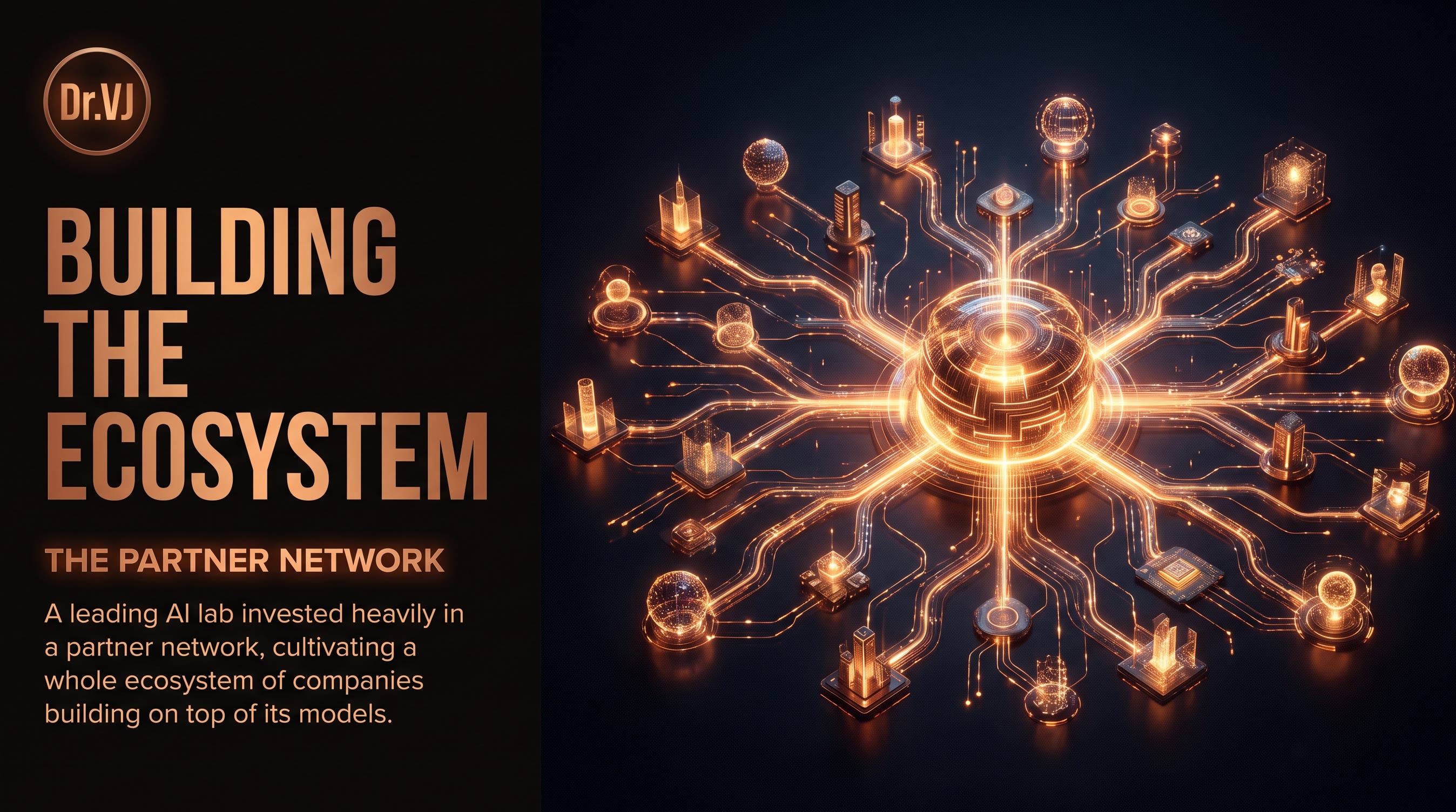
On March 12, 2026, Anthropic announced a $100 million investment in the Claude Partner Network, a program designed to cultivate a developer and enterprise ecosystem around its Claude models. The timing is deliberate. Anthropic's revenue is approaching $19 billion on an annualized basis. Claude's memory features recently rolled out to all users. The company is transitioning from a research lab that sells API access into a platform company that wants developers, enterprises, and integrators to build their businesses on top of Claude.
This is a strategic move that deserves more analysis than the headline number suggests. The $100 million is significant, but the real story is what it reveals about how Anthropic intends to compete in a market where OpenAI has a massive head start in ecosystem building.
What the Claude Partner Network Actually Is
The Claude Partner Network provides funding, technical resources, and go-to-market support to companies that build products and services on top of Claude. This includes systems integrators who deploy Claude in enterprise environments, independent software vendors who embed Claude into their applications, and consulting firms that help organizations adopt AI workflows.
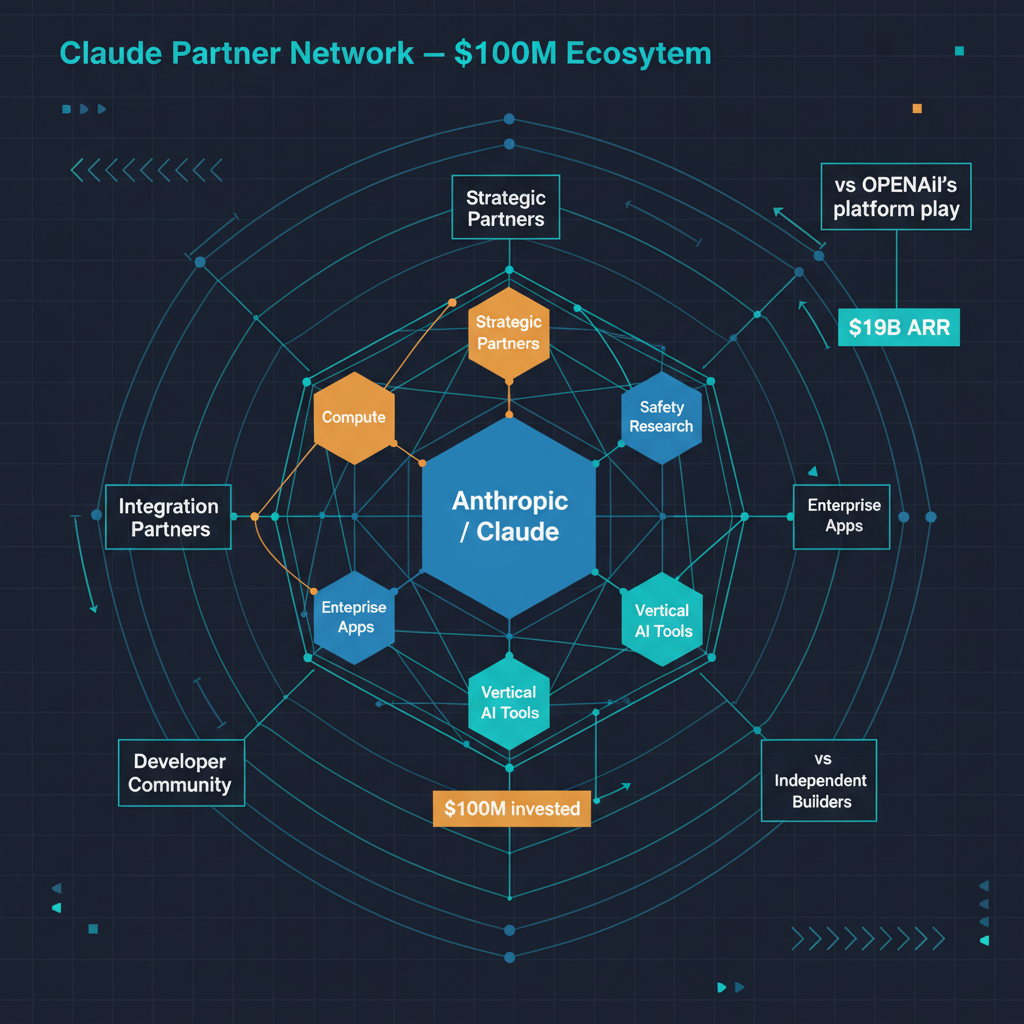
The $100 million is distributed as a combination of API credits, direct investment in select partners, co-marketing funding, and technical integration support. Partners get dedicated engineering resources from Anthropic, early access to new model capabilities, and preferential pricing on API usage.
This is structurally similar to programs that every major platform company has run: Microsoft's partner ecosystem, Salesforce's AppExchange, AWS's partner network. The playbook is well understood. What makes Anthropic's version interesting is the context in which it is being deployed and the specific competitive dynamics it is designed to address.
The Ecosystem Gap Anthropic Needs to Close
OpenAI has a substantial lead in developer ecosystem. The GPT Store, the Assistants API, the plugin architecture, the ChatGPT brand recognition, and the sheer volume of tutorials, libraries, and community resources built around OpenAI's APIs create a gravitational pull that is difficult to overcome through model quality alone.
I have seen this pattern before in technology markets. The better product does not always win. The product with the better ecosystem usually does. VHS over Betamax. Windows over OS/2. Android over Windows Phone. In each case, the platform that attracted more developers and partners built a self-reinforcing cycle: more developers meant more applications, more applications meant more users, more users meant more developers.
Anthropic understands this. Their models are widely regarded as competitive with or superior to OpenAI's in many tasks, particularly in reasoning, instruction following, and safety. But competitive model quality is necessary and not sufficient. If every AI application, every enterprise deployment, and every developer tutorial defaults to OpenAI because the ecosystem support is better, Anthropic loses regardless of model quality.
The $100 million partner investment is an explicit acknowledgment that Anthropic needs to build ecosystem momentum quickly, and that organic ecosystem growth will not be fast enough.
The Revenue Context: $19 Billion Annualized
Anthropic's revenue trajectory provides important context for this investment. Approaching $19 billion in annualized revenue represents extraordinary growth for a company that was generating around $900 million in annualized revenue roughly eighteen months ago. This growth has been driven by a combination of enterprise API consumption, the Claude consumer product, and the Amazon Bedrock partnership.
The $100 million partner investment represents roughly 0.5 percent of annual revenue. This is a modest percentage, but the absolute number is large enough to be meaningful to the partners who receive it. More importantly, it signals to the market that Anthropic is investing in ecosystem building, which influences partner decisions even beyond the direct recipients of funding.
The revenue also changes Anthropic's strategic options. At $19 billion in annualized revenue, Anthropic can fund ecosystem investments from operating cash flow rather than diluting equity. This is a luxury that most AI startups do not have, and it allows Anthropic to be patient and deliberate in how it builds its partner network.
Memory Features and the Platform Thesis
The rollout of memory features to all Claude users is connected to the partner network strategy in ways that are not immediately obvious. Memory allows Claude to retain context about individual users across conversations, building persistent understanding of their preferences, projects, and working patterns. For consumer users, this makes Claude more useful over time. For enterprise deployments, it means Claude can accumulate organizational knowledge.
For the partner ecosystem, memory is a platform feature that enables new categories of applications. A consulting firm can build a Claude-powered advisory service that remembers client history. A software vendor can create a customer support system that maintains context across months of interactions. An educational platform can build a tutoring system that adapts to each student's learning trajectory.
These applications require a foundation model with persistent memory, and they create switching costs that benefit both the partner and Anthropic. Once an enterprise has accumulated months of contextual memory in a Claude-powered system, migrating to a competitor means losing that accumulated context. This is the kind of deep integration that transforms a model provider from a commodity API into a platform that partners build their businesses on.
How This Compares to OpenAI's Ecosystem Strategy
OpenAI's ecosystem approach has been broader but shallower. The GPT Store allows anyone to create custom GPTs, resulting in a large volume of applications with variable quality and limited commercial success for most creators. OpenAI's enterprise partnerships tend to be direct relationships rather than channeled through a partner network.
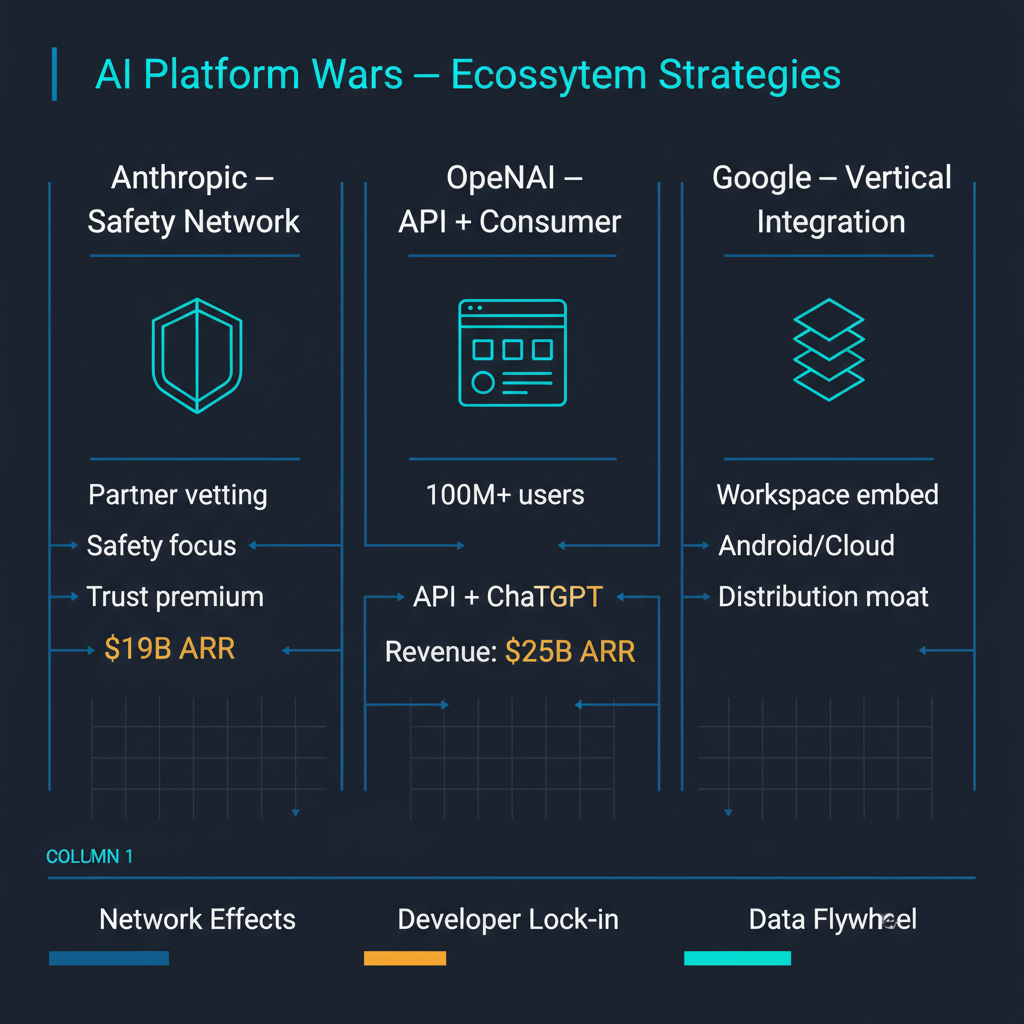
Anthropic's approach is more curated and commercially focused. Rather than creating an open marketplace, they are investing in a smaller number of high-quality partners who have existing customer relationships and domain expertise. This mirrors the difference between Apple's curated App Store and the more open Android marketplace in the early smartphone era.
The curated approach has advantages and disadvantages. The advantage is quality control and deeper relationships. When Anthropic invests in a systems integrator, that integrator becomes a force multiplier for enterprise adoption because they bring existing client relationships and implementation expertise. The disadvantage is slower ecosystem growth and the risk of missing emergent use cases that a more open approach would surface.
Google's approach with Gemini represents a third model: leveraging existing massive distribution channels. Gemini is embedded in Search, Workspace, Android, and Cloud Platform, reaching users through products they already use rather than building a new developer ecosystem from scratch. This distribution advantage is formidable, and both OpenAI and Anthropic must contend with it.
What This Means for Enterprises Evaluating AI Platforms
For enterprise technology leaders evaluating AI platforms, the Claude Partner Network signals that Anthropic is committed to the enterprise market for the long term and is building the support infrastructure that enterprise deployments require. Enterprise AI adoption does not happen through API documentation alone. It requires implementation partners, industry-specific solutions, and ongoing support that a model provider cannot deliver at scale by itself.
The practical implication is that enterprises evaluating Claude should look at the partner ecosystem as part of their decision. Which systems integrators have Claude expertise? Which ISVs have built mature applications on Claude? Which consulting firms can help with AI strategy and implementation? The partner network is designed to ensure that the answer to each of these questions includes credible options.
My Assessment
I think the $100 million Claude Partner Network is a smart and necessary move. Anthropic's models are excellent. Their safety research is industry-leading. Their consumer product has improved dramatically. But platform markets are won by ecosystems, not by products, and Anthropic has been behind on ecosystem building.
The risk is that $100 million is not enough. OpenAI has years of ecosystem head start. Google has distribution advantages that money cannot buy. Microsoft has the enterprise relationship infrastructure through Azure, Office 365, and decades of partner ecosystem management. Anthropic is competing against companies that have deep experience in platform ecosystem building, and money alone does not close that gap.
What Anthropic does have is a model that developers genuinely prefer for many use cases, a safety reputation that matters to enterprises with regulatory exposure, and a focus on quality over volume in its partner relationships. If the Claude Partner Network can translate these advantages into a self-sustaining ecosystem, the $100 million investment will look modest in retrospect.
The AI platform wars are not going to be won on benchmarks. They are going to be won on ecosystems. Anthropic's $100 million bet shows they understand this. The question is whether they have moved fast enough.