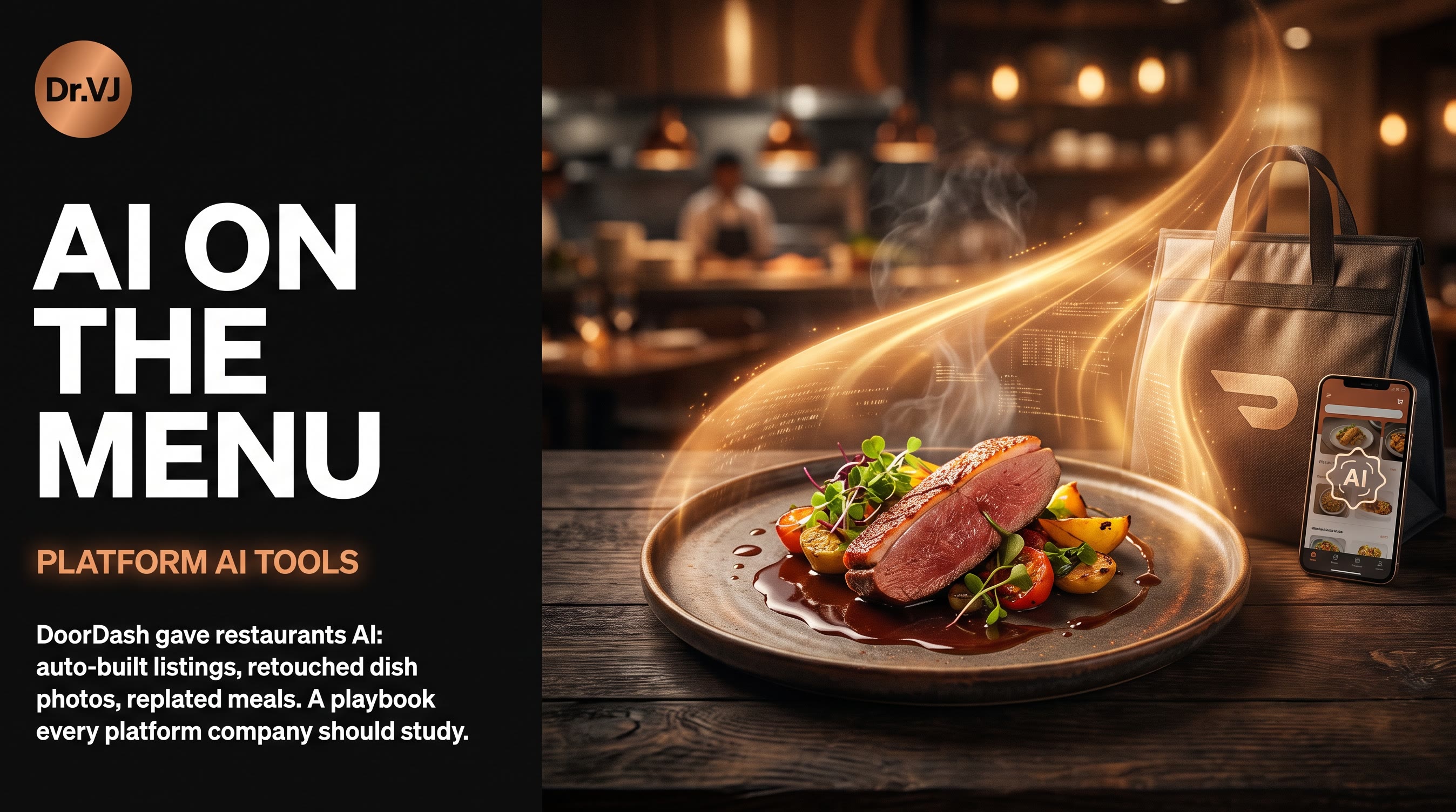
DoorDash added a suite of AI-powered tools for restaurant merchants in May 2026. The headline features: auto-populate listings from existing websites, AI photo retouching, professional plating simulation, and a website builder from existing content. During testing, merchants saw order conversion rates of nearly 10%.
The conversion rate is the number that matters. AI tools that directly move conversion metrics aren't experiments — they're product features.
The Four New Tools
Merchant Onboarding (AI Fetch): DoorDash's AI scrapes a merchant's existing website — photos, store hours, menu items — and auto-creates the listing. The merchant reviews and edits before publishing. This is the same approach Amazon launched for sellers in 2024. The pattern is clear: AI that eliminates manual data entry wins merchant adoption faster than AI that requires more work.
AI Retouch: Replaces backgrounds, sharpens images, optimizes lighting — all without changing the dish. The output is a professional food photo from a amateur snapshot. This is a direct response to a known marketplace problem: bad food photos kill conversion. Most restaurants don't have professional photography for every menu item. AI fills the gap.
AI Replate: Manipulates existing dish photos to look professionally plated. Adjusts lighting and color to simulate what a restaurant-quality presentation would look like. This is more aggressive than Retouch — it changes the visual reality of the photo. The ethical line here is worth watching.
Website Builder: Creates restaurant websites from existing DoorDash content — menu items, photos. Testing showed nearly 10% order conversion. A website that auto-populates from the DoorDash listing, drives direct orders, and requires zero additional effort from the merchant. This creates a direct ordering channel that competes with the DoorDash app itself.
The Conversion Rate as Strategy Signal
Nearly 10% order conversion from AI-generated websites. This number changes the calculus for DoorDash's seller tool investment.
A 10% conversion rate on website visitors means DoorDash can now offer merchants a self-serve path to a functional e-commerce presence — not just a listing within the DoorDash app. This expands the value DoorDash provides to merchants beyond delivery logistics, into the broader restaurant web presence.
The website builder also creates data advantages for DoorDash: understanding what restaurant websites look like, what conversion paths work, what menu presentations drive orders. This data feeds back into the core marketplace.
The AI Photo Editing Ethics Question
AI Replate is the interesting edge case. It takes an amateur photo and makes it look professionally plated. The result doesn't match the physical dish the customer receives.
This is a trust question. If the AI-plated photo looks significantly better than what arrives, disappointed customers become negative reviews. If it looks moderately better, it sets accurate expectations with better visual presentation. The threshold for acceptable "enhancement" matters.
DoorDash is drawing a line somewhere — the AI adjusts lighting and color, not the dish itself. But the space between "accurate enhancement" and "deceptive enhancement" is narrow, and regulatory scrutiny of AI-generated product photos is increasing.
Platform AI vs. Point Solution AI
The DoorDash AI tools are platform features, not standalone products. They're embedded in the merchant workflow — onboarding, photography, website management — and drive conversion metrics that DoorDash tracks.
This is different from point solution AI: tools that require merchants to adopt a new workflow, sign a new contract, or integrate a new system. Platform AI spreads through existing behavior change: the merchant is already on DoorDash, the AI is already there.
The lesson: for platform companies, AI features that spread through existing workflows are more valuable than AI features that require new workflows. The distribution is already built in. The question is which manual steps in the existing workflow can be replaced.
What This Means for AI Builders
If you're building AI tools for platforms or marketplaces:
Conversion metrics validate AI features faster than usage metrics: DoorDash didn't report how many merchants used the photo tools. They reported the conversion rate from the website builder. When AI features drive the metric the business cares about, they're validated. When they drive engagement metrics, they're still experiments.
Platform AI eliminates friction, not effort: The onboarding AI fetches from existing websites. The website builder uses existing content. The photo tools improve existing photos. Every tool builds on existing data rather than requiring new data entry. This is the leverage point: wherever merchants are already doing work, the platform can do it for them.
Self-serve AI tools create data flywheels: Every merchant that uses DoorDash's AI website builder generates data about what website features drive conversion. That data improves the tool, which drives more adoption, which generates more data. The AI tool becomes more defensible with scale.
AI photo enhancement is a trust boundary: AI Replate walks up to the line of deceptive product representation. The companies that define and enforce quality standards for AI-enhanced product photos will build trust faster than those that maximize visual appeal at the expense of accuracy.
DoorDash's AI merchant tools are the template for how platforms add AI value: embed in existing workflows, measure conversion not usage, and let the data flywheel compound.