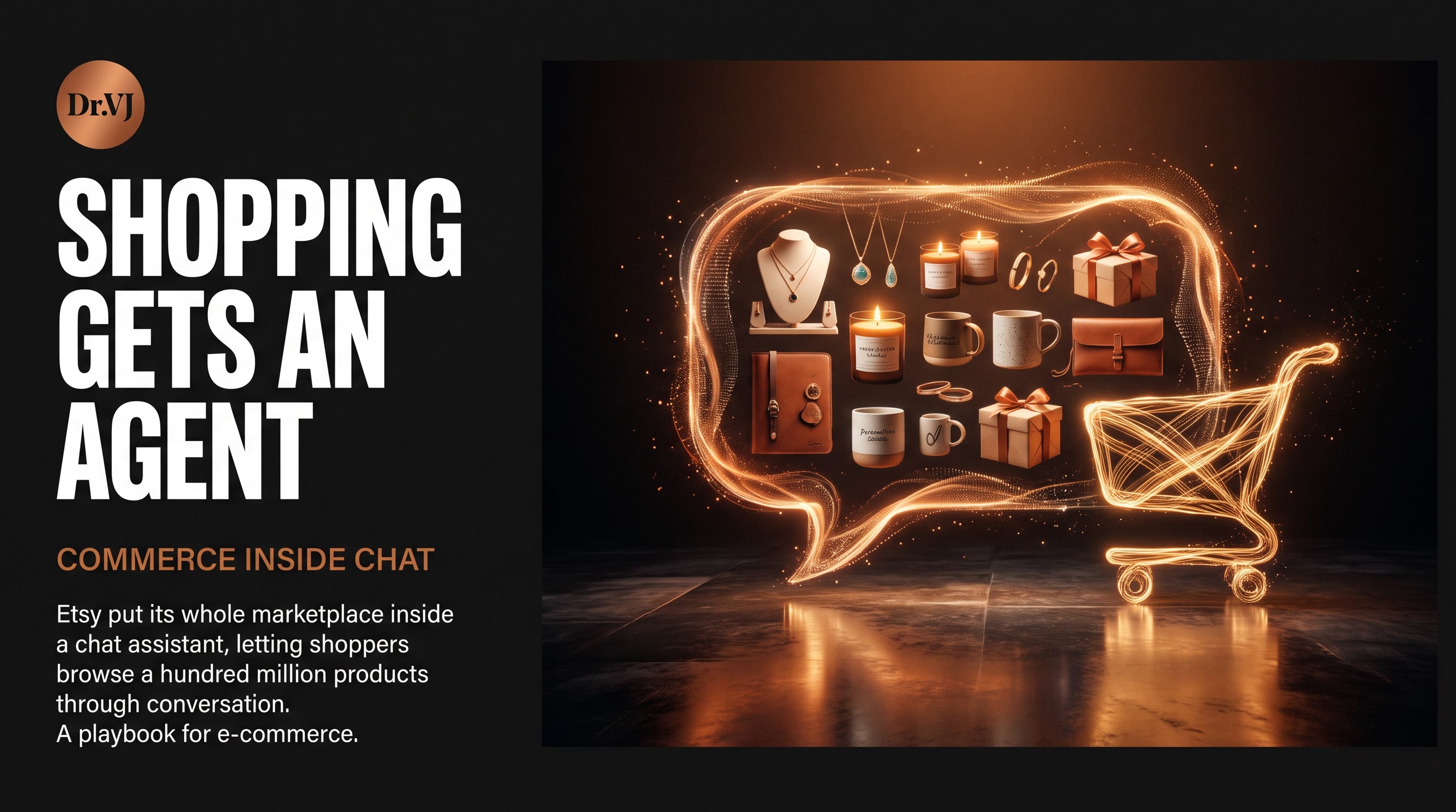
Etsy launched its app inside ChatGPT in May 2026. Users tag @Etsy in a ChatGPT prompt, and the platform surfaces relevant listings from Etsy's 100+ million items. Shoppers browse, compare, and click through to complete purchases — all within ChatGPT.
The feature replaces Etsy's earlier Instant Checkout integration that ended in March 2026. But this isn't just a migration to a new distribution channel. It's a fundamentally different model for AI-powered commerce.
This is what AI-native e-commerce looks like, and every marketplace company needs to understand what Etsy's move signals.
From Search to Conversation
Traditional e-commerce discovery is search-based. You type keywords, get a list, refine, compare, decide. The model is database retrieval: match your query to product attributes.
Etsy's ChatGPT integration is conversational. You describe what you need — "a birthday gift for my sister who likes pottery and lives in Portland" — and the AI surfaces relevant products. The model is AI reasoning: understand the intent, map it to the catalog, present curated options.
The difference matters because the information density of conversational queries is higher than search queries. "Birthday gift for sister who likes pottery" is more informative than "handmade pottery mug." The conversational interface extracts intent that search never captures.
The Gift Assistant as Personal Shopper
Etsy's AI includes a gift assistant that acts as a personal shopper. This is the killer use case for conversational commerce: situations where the buyer has a vague need and wants recommendations, not a specific product.
Gift shopping is notoriously difficult on search engines. You don't know what you want. You need someone to understand the recipient, generate options, explain why each option fits. That's a conversation, not a search.
The gift assistant turns Etsy's catalog into a consulting service. The AI doesn't just retrieve products — it reasons about which products fit the specific context.
AI-Generated Content Labeling
Etsy's "Designed" label identifies AI-generated content for transparency. This is a governance move — Etsy is signaling that it tracks which product content is AI-generated and discloses it to buyers.
The implication: AI-generated product content is now mainstream enough that marketplaces need policies for it. The days when AI-generated titles and descriptions were a competitive advantage are over. Now they're an expected feature that requires disclosure.
The companies that get ahead of AI content governance — clear policies, transparent labeling, quality standards — will build trust faster than those that treat AI content as an undisclosed feature.
What Etsy Is Really Doing
The ChatGPT integration is one front in a multi-front AI strategy:
- Native ChatGPT app: Replaces Instant Checkout as the AI discovery layer
- Conversational search on-platform: Testing natural language gift discovery within Etsy itself
- Seller empowerment tools: AI writing and generation for product listings and buyer messages
- Content transparency: "Designed" labels for AI-generated artwork
Etsy isn't just distributing through ChatGPT. It's building an AI-native commerce capability that works across surfaces — ChatGPT, its own platform, and future AI agents.
The ChatGPT integration is the demonstration. The underlying capability is the AI commerce engine.
The Marketplace AI Opportunity
Etsy's move reveals a broader pattern: marketplaces that build AI discovery capabilities will be able to distribute through every AI surface, not just their own platform.
If ChatGPT, Claude, Gemini, and future AI assistants become shopping destinations, the products that win will be the ones with AI-friendly catalog data — structured attributes, natural language descriptions, intent mapping. The products that lose will be the ones that rely on keyword search optimization.
This is the next wave of e-commerce SEO: AI SEO. Optimizing your product catalog for AI agents rather than search engines. Making your catalog legible to AI reasoning rather than keyword matching.
What This Means for AI Builders
If you're building AI products for commerce or marketplaces, Etsy's approach has concrete lessons:
Conversational discovery is the future: Search-based product retrieval is giving way to conversation-based recommendation. Build for natural language intent, not keyword matching.
AI surfaces are distribution channels: ChatGPT, Claude, and future AI agents are becoming shopping destinations. Distribution strategy needs to include AI agent optimization, not just app store and search engine placement.
Seller tools are a retention mechanism: AI writing tools for product listings keep sellers on-platform and improve catalog quality simultaneously. The seller tooling investment has a dual return: seller retention and buyer experience.
AI content governance is table stakes: Labeling AI-generated content, tracking quality, maintaining disclosure standards — these aren't optional anymore. They're the cost of operating in a marketplace where AI content is standard.
Etsy inside ChatGPT is the beginning of AI-powered commerce at scale. The companies that build AI-native catalog capabilities now will be able to distribute through every AI surface as they emerge. The ones that don't will be invisible to AI agents.