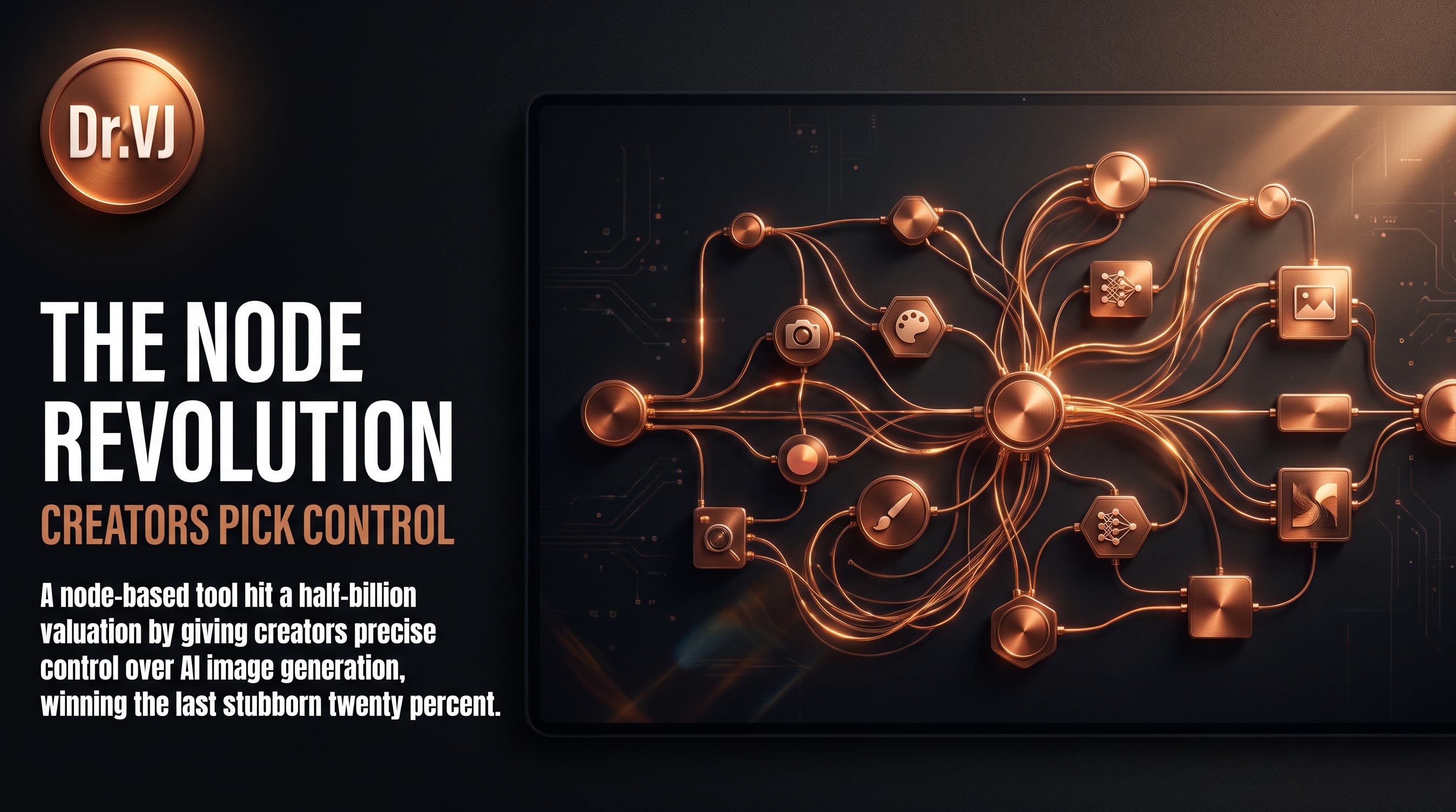
ComfyUI just raised $30 million at a $500 million valuation. The product is a node-based workflow tool for AI image, video, and audio generation. The user count: 4 million. The job title emerging on studio postings: "ComfyUI artist or engineer."
This is significant. ComfyUI is one of the first open-source AI creative tools to reach half-a-billion-dollar valuation — and it's doing it by solving a problem that mainstream AI image generators haven't solved.
The 20% Problem
CEO Yoland Yan described the core issue with prompt-based tools like Midjourney or DALL-E:
"If you think about your typical prompt-based solution, like Midjourney or ChatGPT, you ask for something, it gets only 60%–80% there. But to change that remaining 20%, you have to try this slot machine."
The slot machine problem: you refine your prompt, generate an image that's almost right, then tweak the prompt to fix one element — and the change cascades, undoing three other elements you had right. Each adjustment is a new roll of the dice.
This is fine for exploring ideas. It's unworkable for production creative work where consistency matters.
Why Node-Based Control Solves the Production Problem
ComfyUI's node-based interface breaks the generation process into discrete components: the model, the sampler, the conditioning, the latent vectors, the upscalers. Each node is configurable independently. Changing one element doesn't cascade into others.
The result is precise, repeatable control over generation. Want to change the lighting without affecting the subject's pose? Adjust the lighting node. Need to swap the background while keeping the character exact? Isolate the background pipeline.
This is how professional creative work actually happens — iterative refinement of specific elements, not regenerating everything from scratch.
Yan put it this way: "You cannot easily convey that message in the prompt box of a foundational model."
Open-Source Origins to $500M Valuation
ComfyUI started as an open-source project in 2023, shortly after diffusion models emerged. The founders were addressing a specific problem: early AI image generators added extra fingers, distorted faces, and produced inconsistent results. ComfyUI gave creators the tools to control the generation process at a granular level.
The funding history:
- Late 2024: $19M Series A from Chemistry Ventures, Cursor Capital, and Guillermo Rauch (Vercel founder)
- 2026: $30M led by Craft Ventures, with Pace Capital, Chemistry, and TruArrow, at $500M valuation
The path from open-source project to recognized job title to $500M valuation is a template for how AI tooling captures value in the creator economy.
"ComfyUI Engineer" as a Job Title
Over 4 million users. Usage across visual effects, animation, advertising, and industrial design. "ComfyUI artist or engineer" appearing on studio job boards.
This is the indicator that matters most. When a tool becomes specialized enough that companies hire people by name for proficiency with that tool, the tool has become infrastructure. ComfyUI has crossed that threshold.
The implication: AI creative work is professionalizing. The workflow tools are becoming as important as the underlying models.
What This Means for AI Builders
ComfyUI's success reveals several patterns relevant to AI tooling:
The 60-80% problem is real: Foundation models are good at generating. They're bad at precise control. Any tool that solves the "last 20%" problem for professional use cases has durable value.
Open-source to enterprise is a viable path: Build open-source to get adoption, community, and product iteration. Raise venture capital to scale the business layer. ComfyUI's path is replicable for other AI tooling categories.
Workflow tools become infrastructure: When "proficiency in X tool" becomes a job requirement, the tool has durable demand that doesn't depend on any single model's performance.
The creator economy AI tooling space is maturing. ComfyUI at $500M is proof that the market for professional AI workflow tools is real — and large enough to support venture-scale businesses.
Related posts: Visual AI Monetization Gap — visual AI generates 6.5x more downloads but 387x less revenue than chatbot AI. Etsy AI Commerce — AI-native e-commerce and the shift from search to conversation.