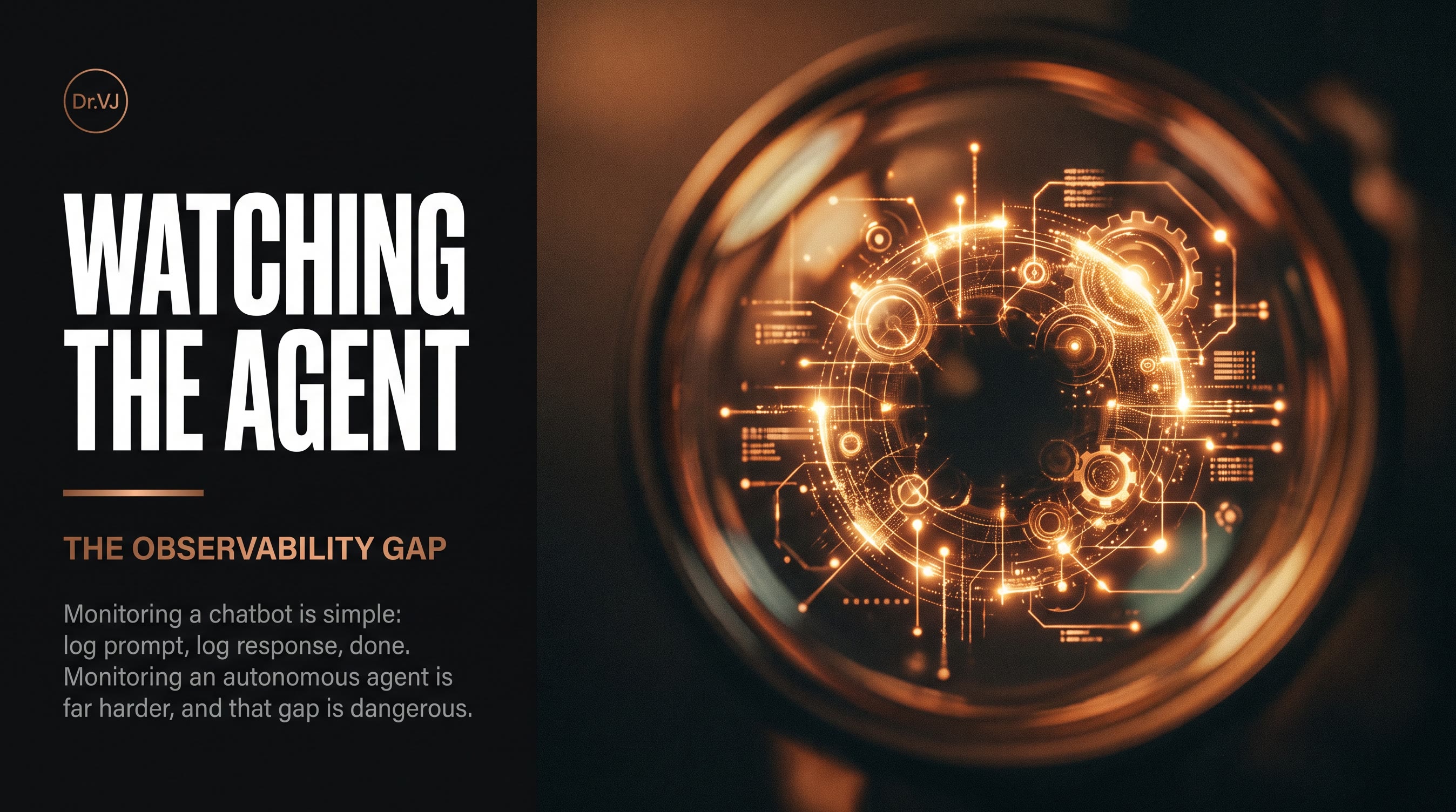
There's a category of debugging problems that only emerge at scale — when an AI system stops being a tool you use on demand and becomes a system that acts autonomously on your behalf. The teams that built the first wave of AI agents are now discovering this in production, and the lessons are instructive.
What observability looks like for traditional AI
For a standard AI API call, observability is straightforward:
- Input prompt logged
- Output response logged
- Latency measured
- Token usage tracked
If something goes wrong, you replay the prompt and examine the output. The system state is contained in a single round-trip.
This model works. It's limited in what it can tell you about model behavior, but it gives you enough to debug simple failures and track usage patterns.
Why agentic systems break this model
An agentic AI system introduces several dimensions that don't exist in single-turn inference:
The action chain — An agent takes multiple steps in sequence. Each step may involve:
- Calling an external API and acting on the result
- Reading from a database
- Modifying state
- Making decisions based on accumulated context
When something goes wrong, you can't just replay the final prompt. You need to reconstruct the entire action chain — what the agent decided at each step, what it observed, what it concluded.
Latent failures — An agent can take an action that seems reasonable in isolation but compounds into a failure over several steps. The intermediate state may look fine. The final outcome may be wrong. The debug surface spans multiple turns, not one.
Non-deterministic state — External systems change between runs. The same agent prompt can produce different outcomes depending on what's in the database, what the API returns, what other agents are doing. Reproducing bugs requires understanding the full system state, not just the agent's reasoning.
The reasoning gap — Traditional AI debugging: "why did the model say that?" Agent debugging: "why did the agent take this sequence of actions?" The reasoning chain — what the model considered, what it weighed, what it dismissed — is part of the failure surface.
What's emerging as the observability standard
The teams running agentic systems in production have converged on several patterns:
Action-level logging — Every agent action logged with its input, output, duration, and decision context. Not just what the agent did, but what it knew when it decided to do it.
Trace reconstruction — Tools that can replay an agent's full execution trace: all tool calls, all decisions, all intermediate states. This is harder than it sounds because traces can be long and involve non-deterministic components.
Behavioral invariants — Properties that should hold true throughout execution (e.g., "this agent should never delete more than 10 records in a single batch"). Checking these at runtime, not post-hoc, because the cost of a violation compounds over the action chain.
Context freshness monitoring — Tracking whether the agent's context window is stale, whether its retrieved information is current, whether its memory reflects the actual system state.
The tooling gap
The observability standard is clear. The tooling to implement it at scale is not.
Most AI observability platforms were built for inference APIs — they handle the logging, latency tracking, and basic quality monitoring of single-turn calls well. They don't yet have first-class support for agent traces: multi-step action chains, tool call logs, reasoning state snapshots.
Teams are building internal solutions: custom trace collectors, database-backed execution logs, bespoke dashboards. This works but is expensive to maintain and doesn't benefit from shared tooling improvements.
The gap is closing — and the teams that build mature observability into their agentic systems now will have a significant operational advantage as these systems become more complex and more consequential.
The agentic AI observability problem is real, and it's not a solved problem. But the patterns for solving it are clear: action-level logging, trace reconstruction, behavioral invariants, and context monitoring. The teams that implement these now are building the debugging infrastructure that the rest of the industry will converge on over the next 12 months.