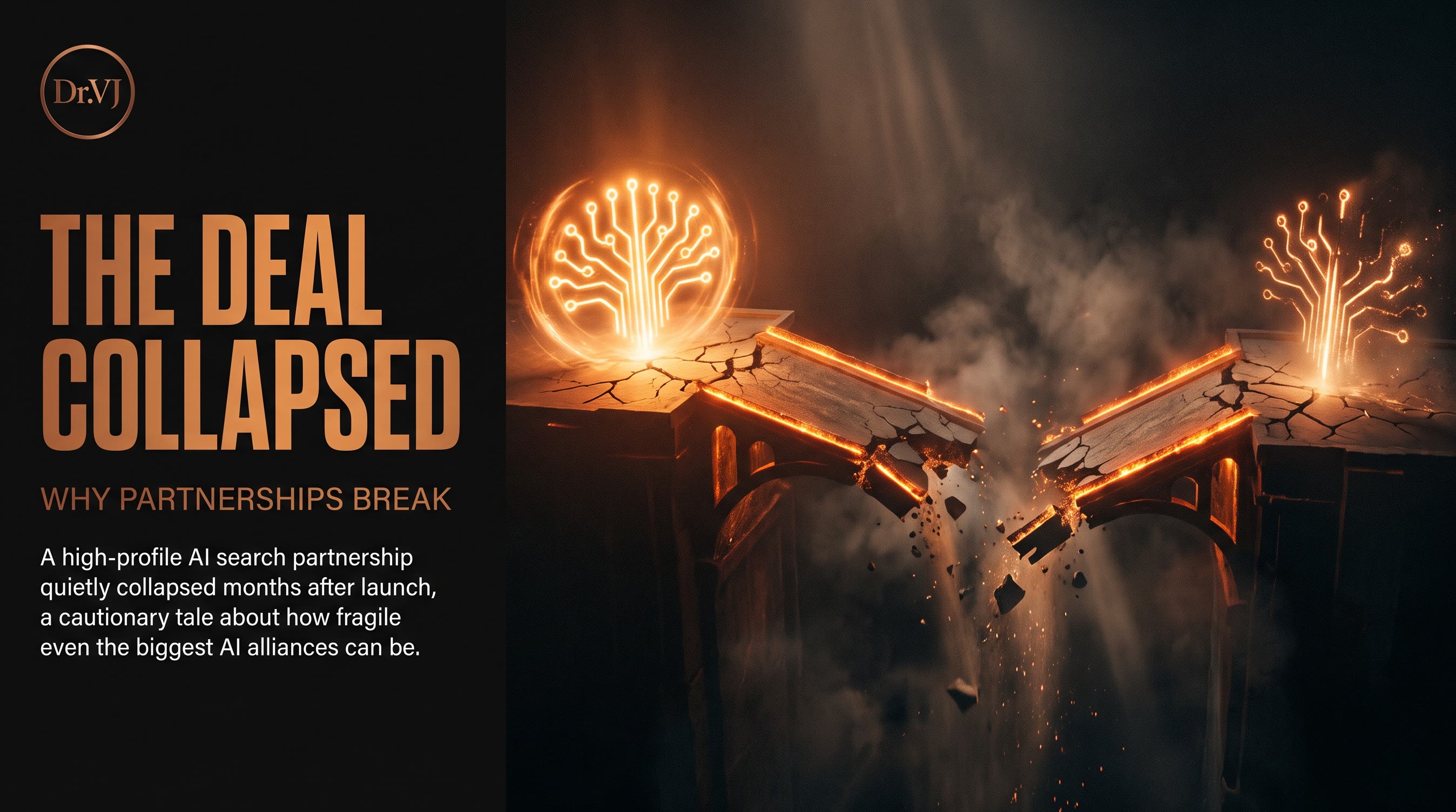
Snap and Perplexity ended their $400 million deal. The announcement came during Snap's Q1 2026 earnings report — a quiet burial of what was supposed to be one of the larger AI search partnerships of 2025.
The deal was announced in November 2025. By February 2026, the companies had "yet to mutually agree on a path to a broader roll out." Testing with select users happened. Broader rollout never came. The companies called it amicable.
What the Deal Was
Snap was going to integrate Perplexity's AI search engine directly into Snapchat. Perplexity was going to pay Snap $400 million in cash and equity over one year. The pitch was straightforward: AI search inside a social platform with 400 million+ users.
For Snap, it was a potential answer to the question every social platform has been asking: what does AI do for our product? For Perplexity, it was a massive distribution deal — hundreds of millions of potential users through a single partnership.
Why It Fell Apart
The details from the earnings report are sparse, but the pattern is recognizable. Large AI partnerships involve questions of control, integration depth, user experience ownership, and product strategy that are hard to resolve between a social platform and an AI search startup.
Some likely friction points:
Product ownership: Who controls how the AI search interface looks and behaves inside Snapchat? Snap has brand requirements. Perplexity has its own product identity. The negotiation over every interaction detail probably consumed more time than either side expected.
Integration complexity: AI search isn't a widget you drop into an app. It involves model serving, latency requirements, conversation context management, and result formatting. Connecting that to Snapchat's infrastructure across two companies was likely technically harder than estimated.
Revenue sharing complexity: $400M in cash and equity over one year sounds simple. The actual mechanics of how that splits across product milestones, user engagement thresholds, and equity vesting are probably where deals like this quietly die.
Strategic misalignment over time: In November 2025, both companies saw the partnership as strategically important. By Q1 2026, one or both had moved on — either because their own AI strategy evolved or because the integration work revealed that the fit wasn't as strong as originally assumed.
What This Signals for AI Partnerships
The AI partnership boom of 2025-2026 is producing a lot of announcements. Some will succeed. Some will quietly end. The Snap-Perplexity case is a useful data point for what goes wrong:
Distribution deals are fragile: The promise of "X million users" is seductive, but converting that into actual product integration is hard. The unit economics have to work for both sides, and the product fit has to survive real engineering constraints.
AI search is sticky: Perplexity's value is partly in its brand and product experience. Shipping that inside another company's app means diluting your own product identity. That's a trade-off every AI search company has to make when considering distribution partnerships.
The earnings report burial is common: When partnerships fail, they usually get mentioned in passing during earnings calls — buried in the Q&A or tucked into a slide deck. This one ended "amicably," which is PR language for "neither side wants to talk about what went wrong."
The Deeper Pattern
The deal was a bet on AI search as a platform feature — the idea that every app needs conversational AI search integrated into it. That thesis might still be right. But the execution revealed that bundling AI search into someone else's product is harder than building it yourself.
For AI companies considering distribution partnerships: the deal size matters less than the product integration path. If you can't agree on "how" before signing "how much," the money won't fix it.
For platforms considering AI partnerships: the $400M price tag doesn't guarantee results. The product experience has to work first. Snap's earnings call buried this quietly. The lesson is loud anyway.
Sources: TechCrunch