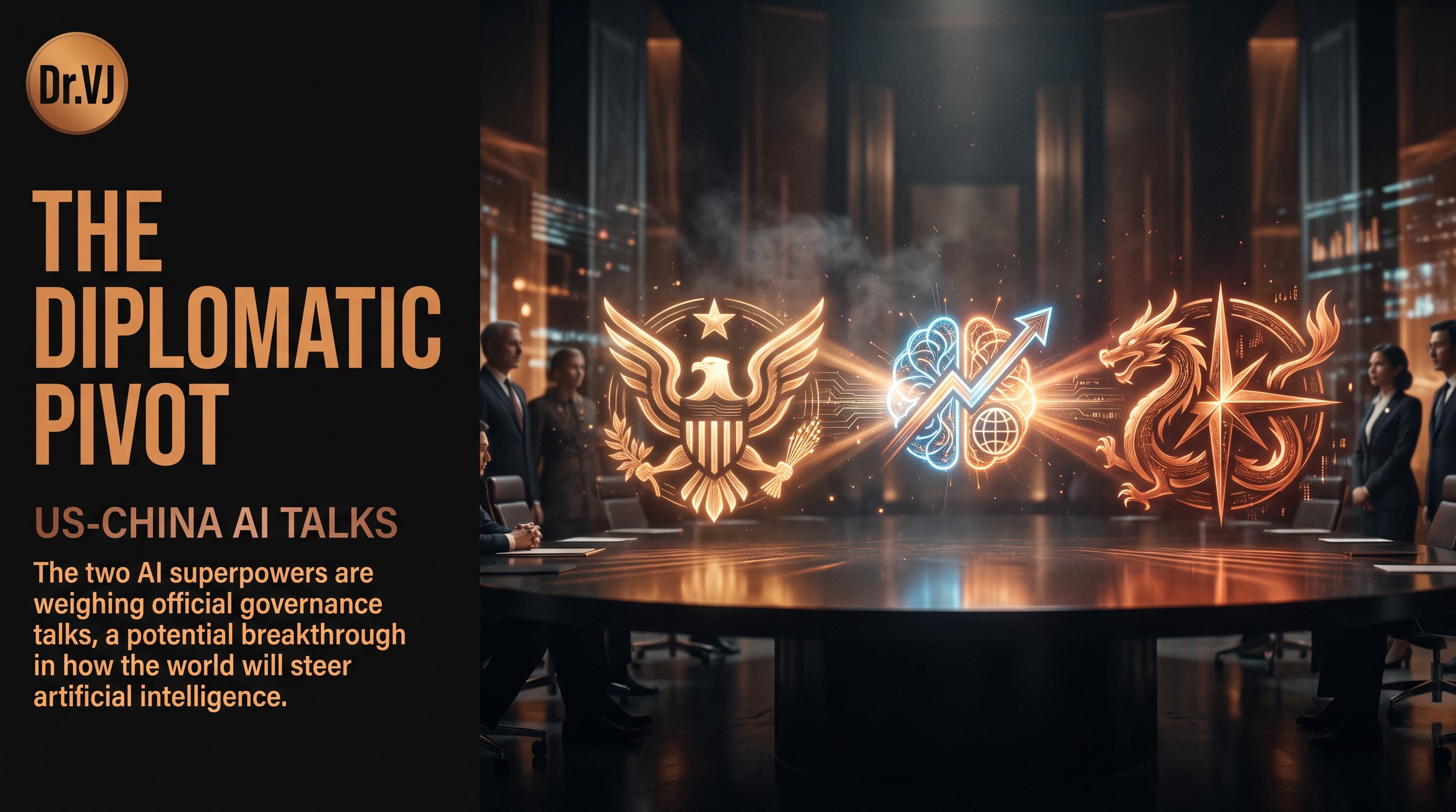
The Wall Street Journal and Reuters are reporting that the US and China are weighing the launch of official bilateral discussions on AI governance — a move that would mark the first structured diplomatic channel between the world's two leading AI powers to address AI-specific governance questions. This isn't just diplomatic theater; it's a significant signal about how the AI competition is shifting from purely technological to regulatory.
Why this is happening now
Several converging pressures are pushing both sides toward dialogue:
Safety incidents are creating diplomatic urgency. The widespread deployment of AI systems has generated a string of high-profile failures — AI-driven misinformation, autonomous decision-making that caused real-world harm, and cross-border AI incidents that implicated both countries' systems. Both governments have an interest in establishing guardrails that prevent incidents from destabilizing bilateral relations.
The competitive landscape is stabilizing. The initial AI arms race phase — characterized by rapid capability building and minimal coordination — is giving way to a more structured competition where both sides have a clearer picture of the other's capabilities and constraints. This creates the stability needed for productive dialogue.
Third-party pressure is mounting. Other nations are building their own AI governance frameworks, and the absence of US-China coordination risks creating a fragmented global regulatory landscape that could disadvantage both countries' AI industries. The EU's AI Act and other national frameworks are creating pressure for the two largest AI powers to align or risk regulatory Balkanization.
What's likely on the table
Based on precedent from other technology governance dialogues (semiconductors, telecommunications, cyber), the discussions would likely address several core issues:
AI safety standards and testing protocols. Agreeing on minimum safety evaluation standards for frontier AI models — similar to how nuclear powers agreed on testing protocols for nuclear weapons. This doesn't mean both sides will share their most advanced systems, but it means establishing shared expectations about what safety testing looks like before deployment.
Red lines on autonomous weapons. The use of AI in military applications is the most sensitive topic. Both sides have interests in avoiding an uncontrolled AI arms race in autonomous weapons, even if they disagree on almost everything else. Informal conversations have already happened; formal discussions would build on those.
Data and compute governance. Cross-border restrictions on AI training data and compute resources are becoming a vector for technological decoupling. Establishing governance frameworks for these resources could reduce friction without resolving the underlying competition.
Transparency and incident reporting. Mechanisms for reporting AI-related incidents that affect the other country's interests — similar to nuclear incident notification protocols. This is the most tractable area for near-term agreement.
What's not on the table
This is not a partnership. The US and China remain competitors in AI, and the discussions are about managing competition, not resolving it. Neither side is likely to agree to:
- Sharing frontier model weights or architectures
- Joint AI safety evaluations that could reveal proprietary capabilities
- Constraints on AI development that don't apply equally to the other side
The discussions are about creating rules of the road for a competitive relationship, not about turning the competition into collaboration.
What this means for builders
Three practical implications:
Regulatory fragmentation may decrease. A US-China AI governance framework would likely establish baseline standards that other countries would incorporate into their own regulations. For builders, this means less regulatory patchwork across major markets.
Diplomatic stability enables long-term investment. Uncertainty about US-China relations has been a factor in AI investment decisions — both countries' companies have been cautious about deep integration. Progress on AI governance could reduce this uncertainty and enable more ambitious cross-border AI partnerships.
Safety and testing standards will become industry requirements. If the US and China agree on minimum safety evaluation standards, those standards will likely become de facto requirements for deploying AI systems in regulated markets globally. Building to higher safety standards isn't just good practice — it will become a competitive necessity.
The AI governance dialogue between the US and China is the most significant diplomatic development in AI since the frontier model era began. Watch this space.