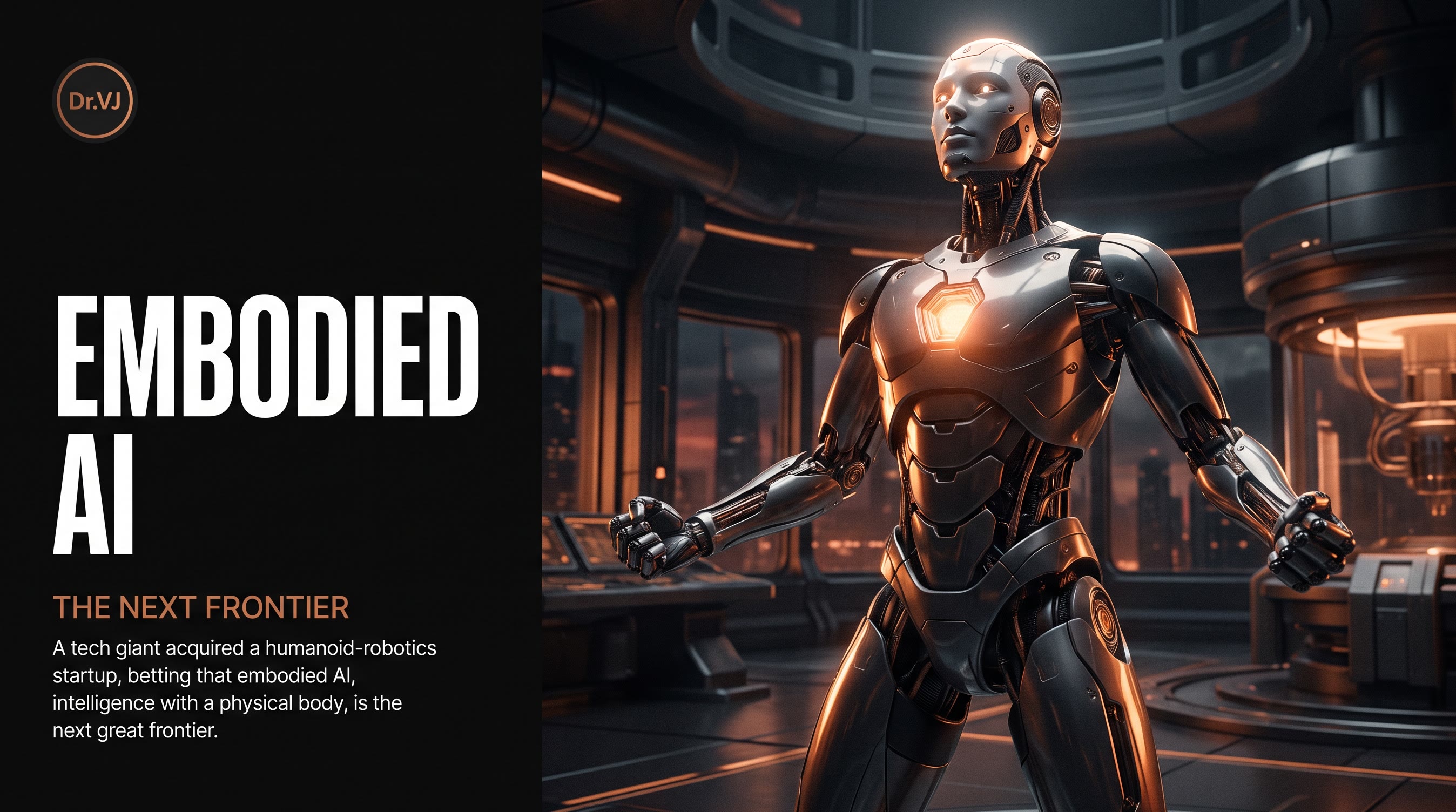
Meta acquired Assured Robot Intelligence (ARI), a humanoid robotics startup, this week. The ARI team — including co-founders Xiaolong Wang (former Nvidia researcher) and Lerrel Pinto (ex-NYU, co-founded Fauna Robotics) — will join Meta's Superintelligence Labs. The deal reflects a broader industry realization: the path to more capable AI may run through physical embodiment.
What Meta Bought
ARI was a humanoid robotics startup working on AI systems for robots — the kind of work that combines computer vision, motor control, and real-world reasoning. The founders brought research credentials from two of the most respected AI and robotics groups in the world: Nvidia's robotics research division and NYU's robot learning lab.
The acquisition isn't about Meta building consumer robots immediately — it's about Meta acquiring talent and research capability in embodied AI. The Superintelligence Labs team, led by Yann LeCun and others, is explicitly focused on AGI-level research. Adding robotics researchers signals that the lab sees physical world interaction as a necessary component of that research.
Why Embodied AI Is Getting Serious Attention
The AI industry has been dominated by language models — systems that process text, images, and audio. These are impressive but operate in a fundamentally limited environment: digital information. Embodied AI operates in the physical world, which introduces constraints that purely digital systems don't face:
Causality and physics: A robot must reason about physical causality — what happens when things interact, how forces propagate, what the consequences of actions are in a 3D physical space. This requires a different kind of reasoning than text prediction.
Temporal grounding: Actions in the physical world have durational consequences that can't be skipped. A robot can't simulate "taking 6 months to cross a room" by reasoning about the endpoint — it has to navigate the intermediate states. This creates fundamentally different learning dynamics.
Sensory-motor coordination: The connection between perception and action in a physical system is intimate and bidirectional. Current LLMs process perception (images, text) as passive input. Embodied AI requires active coordination between sensing and acting.
The bet from Meta and others is that these constraints aren't just complications — they're essential for building more capable AI systems. The argument: intelligence that only operates in digital space is fundamentally incomplete, and achieving AGI may require physical world engagement.
The Market Context
Humanoid robotics has moved from science fiction to serious investment thesis:
- Market forecasts range from $38B to $5T by 2035-2050, depending on the scope and timeline
- Every major tech company has some robotics initiative: Tesla (Optimus), Boston Dynamics, Figure, 1X, Agibot
- The intersection of LLMs and robot control systems has created a new research area (often called "physical AI" or "world models")
The timing makes sense: LLMs have dramatically improved the perception and reasoning capabilities available to robots. A robot that could only react to narrow visual inputs can now understand natural language instructions, reason about complex tasks, and adapt to novel situations. The capability ceiling for robotics has risen significantly.
What This Means for the AI Race
Meta's ARI acquisition is one data point in a broader pattern: frontier AI labs are looking beyond pure LLM scaling for the next breakthrough. The hypothesis that embodied intelligence — AI systems that interact with and reason about the physical world — may be necessary for AGI is gaining traction.
For AI builders, this has a practical implication: the skills and research emerging from embodied AI are increasingly relevant. Computer vision, reinforcement learning from physical interactions, world modeling — these are no longer purely academic. They're becoming components of the mainstream AI research agenda.
Whether or not embodied AI is truly necessary for AGI, the research is productive regardless. Robots that can reliably navigate and manipulate the physical world have immediate commercial value. The commercial and scientific incentives are aligned, which means embodied AI investment will continue regardless of the AGI debate.
Related posts: AI Agent Infrastructure Readiness — the infrastructure layer for agentic systems. CopilotKit's AG-UI Protocol — the emerging protocol standards for connecting agents to UIs. Sierra's $950M Raise — enterprise AI infrastructure category formation.