Barry Diller has known Sam Altman for years. He calls him "a decent person with good values." Then he turned around and argued that it doesn't matter.
Speaking at a Wall Street Journal conference in early May 2026, Diller made a case that cuts against much of the current AI governance debate: the assumption that who leads AI companies, and whether we trust them, is the relevant variable. Diller's argument was different — and more unsettling. He says the problem isn't the people. It's that nobody, including the people building it, knows what's actually being built.
"They don't know"
Diller's core point was simple: "They don't know." By "they," he meant the people at the frontier of AI development. Not because they're hiding something, but because the nature of the technology means that the outcomes of advanced AI systems are genuinely uncertain, even to their creators.
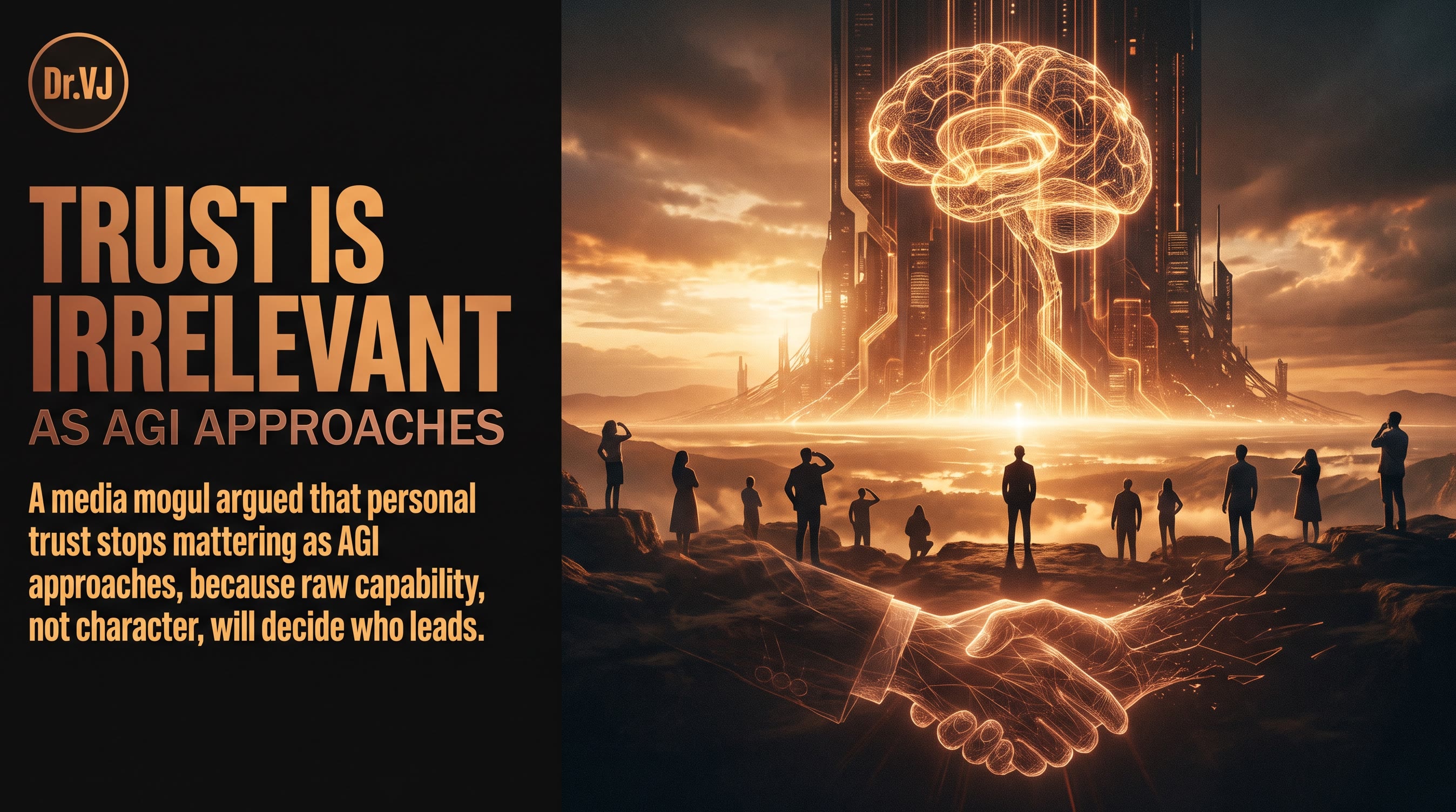
This isn't a comfortable position for an industry that has spent years trying to convince regulators, investors, and the public that it has AI under control. But Diller was explicit: "Trust is irrelevant" because the question isn't whether you trust Sam Altman. The question is whether anyone — including Sam Altman — can predict what AGI means and when it arrives.
Trust is the wrong framework
The governance debate around AI often implicitly assumes that if we can trust the right people to make the right decisions, the technology will be safe. Diller's argument suggests this is backwards: the risk isn't that bad actors will misuse AI. The risk is that the technology is developing faster than anyone's ability to understand its implications.
If that's true, the relevant governance question isn't "who should we trust?" It's "what governance structures are robust even when the people in charge don't fully understand what they're managing?" That's a fundamentally different — and harder — policy challenge.
AGI's consequences are "unknowable"
Diller was unusually direct about the stakes. He described AGI's consequences as "unknowable" and warned that "there's no going back" once certain thresholds are crossed. His framing was almost theological: "an AGI force will do it themselves," he said — meaning that at a certain capability level, the technology becomes an independent actor in history rather than a tool under human control.
Whether you find this framing compelling or hyperbolic, it reflects a genuine shift in how sophisticated observers are talking about AI. The discourse has moved from "can we make AI safe?" to "are we already past the point where that question makes sense?"
What Diller got right — and wrong
Diller is right that individual trust in AI leaders is insufficient as a governance framework. No one person, however well-intentioned, can guarantee outcomes in a system this complex and rapidly evolving.
But he's wrong to suggest that trust is entirely irrelevant. The people building AI systems make thousands of decisions — about architecture, training data, deployment strategy, and safety measures — that collectively determine how the technology develops. Those decisions reflect values. Values reflect trust relationships, both within organizations and between companies and the public.
The more precise claim is that trust alone isn't sufficient — you also need accountability structures that don't depend on trusting any individual. That's a harder thing to build, but it's the thing that actually matters.
The uncomfortable conclusion
Diller's framing is most useful as a diagnostic: the governance frameworks being discussed in most policy circles are calibrated for a world where AI is a tool that humans control. They're not well-calibrated for a world where AI is developing in ways that even its creators don't fully understand.
Whether we call it AGI or something else, the era of AI as a fully-understood, fully-controllable technology may already be ending. Diller's argument is an invitation to stop pretending otherwise.
Sources: TechCrunch